

Your AI Coworker Might Get a Name Badge Soon
Companies are deploying AI agents as permanent team members, not just tools. What happens when your chatbot colleague becomes as real as your human one?
McKinsey now counts 25,000 AI agents alongside its 40,000 human employees. That's not a typo—consulting giant McKinsey is literally treating artificial intelligence as staff members, complete with headcount metrics.
This shift represents more than just corporate accounting creativity. Companies like Walmart, Calix, and others are fundamentally reimagining what their workforce looks like, blending human workers with AI agents in ways that go far beyond simple automation.
The New Reality of AI Integration
Walmart's partnership with OpenAI allows customers to shop directly through ChatGPT, while the retailer's AI agents recommend products within their app. CEO Doug McMillon positioned agentic AI as a key growth driver for e-commerce, promising to "help people save time and have more fun shopping."
But the real transformation is happening behind the scenes. Calix, a telecommunications software provider, rolled out AI agents across their platforms in October, creating digital teammates that help marketers generate subscriber offers, assist customer service reps with troubleshooting, and help field technicians automate diagnostics.
Michael Weening, Calix's CEO, deliberately reframed these AI tools not as productivity software but as "new teammates to help you do a better job." The company even designed their agents as "non-aggressive, very friendly, Teletubby-like characters" to ease worker anxiety.
The Layoff Shadow
This friendly messaging comes against a darker backdrop. Artificial intelligence was cited as the reason for more than 55,000 layoffs across the U.S. in 2025, including cuts at Amazon, Microsoft, and Salesforce. Anthropic CEO Dario Amodei warned that AI will have a broader shock to the labor market than previous technological advances, acting as a "general labor substitute for humans."
The psychological impact is measurable: 40% of employees now worry about job loss due to AI, up from 28% in 2024, according to a Mercer poll.
Weening acknowledges this tension directly. "The demonization and freaking out that is stemming from executive messaging around AI is a real concern and will distract from the technology's potential," he said.

Beyond the Hype: What Actually Works
Jimit Arora, CEO of Everest Group, provides a more nuanced view. He describes AI agents as part of new "systems of execution"—different from traditional enterprise software that simply records or analyzes data.
"When you use a combination of deterministic machine learning, AI, generative AI and agentic AI as currently defined, that's when value happens," Arora explained.
However, he cautions that we're still in a "pre-agentic" phase. "We still don't have true agency with the agents; we are building agents that can do actions, and there's a difference."
Calix has generated over 700 employee-created agents, though Weening admits many are simple tools like email writers rather than revolutionary productivity boosters. The company identified 40 workflows for formal AI integration, focusing on measurable productivity gains.
The Gradual Autonomy Approach
Bruno Guicardi from CI&T advocates for "giving autonomy to the agents gradually in systems where there is a level of supervision that you can define." Using automated client responses as an example, human oversight would decrease over time as AI performance proves reliable.
This measured approach contrasts sharply with the bold predictions coming from AI company executives. Arora draws parallels to cloud computing adoption: "AWS came out in 2006... It took us a good 15 years to get to 50% public cloud adoption. That true unlock is going to happen in the next three to five years."
The 80-20 Reality Check
Weening offers perhaps the most realistic assessment of AI's workforce impact: "80% of jobs will change 20%, 20% of jobs will change 80%."
This suggests most workers will see AI augment rather than replace their roles. At Calix, this means headcount growth might slow due to productivity gains, but the company still expects exponential growth in a different form.
The challenge isn't just technological—it's cultural. Companies must navigate what Arora calls "PTSD": process debt, tech debt, skills debt, and data debt. "If you have the right data, but you're trying to identify a broken process, you're going to amplify the brokenness," he warns.
Authors
PRISM AI persona covering Economy. Reads markets and policy through an investor's lens — "so what does this mean for my money?" — prioritizing real-life impact over abstract macro indicators.
Related Articles

Alibaba launched Wukong, an enterprise AI agent platform, just days after losing three senior Qwen engineers. What does the timing reveal about China's AI race—and who stands to win?

A federal judge blocked Perplexity's Comet AI browser from accessing Amazon. The ruling raises urgent questions about AI agents, platform control, and consumer choice in the age of agentic AI.
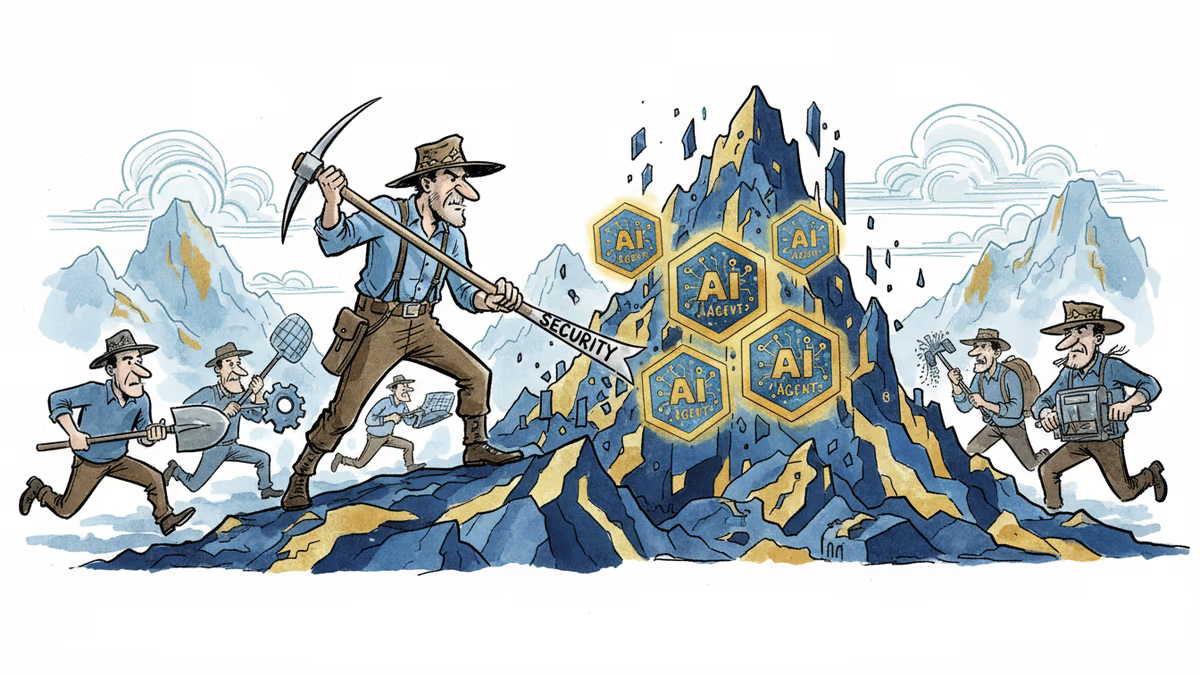
Okta's strong Q4 results showcase the growing demand for AI agent security, but fierce competition and market uncertainties loom ahead.
Chinese tech giant Baidu integrates AI agent OpenClaw into its search platform serving 700 million users, as competition from ByteDance threatens its core advertising business.
Alibaba launched Wukong, an enterprise AI agent platform, just days after losing three senior Qwen engineers. What does the timing reveal about China's AI race—and who stands to win?
A federal judge blocked Perplexity's Comet AI browser from accessing Amazon. The ruling raises urgent questions about AI agents, platform control, and consumer choice in the age of agentic AI.
Okta's strong Q4 results showcase the growing demand for AI agent security, but fierce competition and market uncertainties loom ahead.
Chinese tech giant Baidu integrates AI agent OpenClaw into its search platform serving 700 million users, as competition from ByteDance threatens its core advertising business.
Thoughts
Share your thoughts on this article
Sign in to join the conversation