
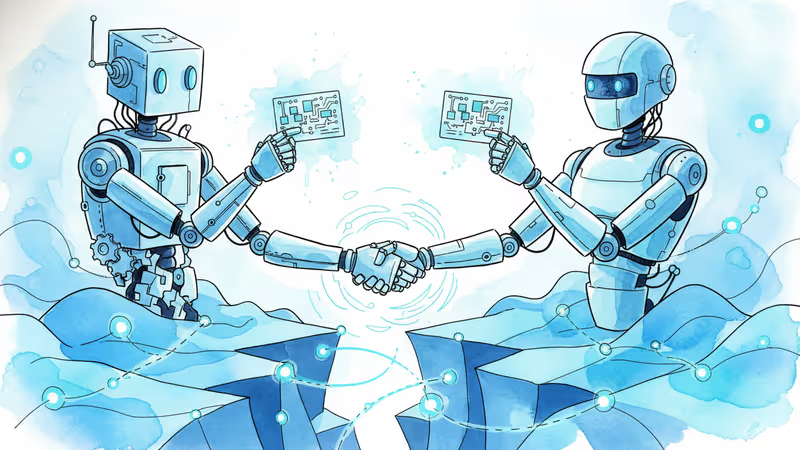
Ethereum Gives AI Agents Their Digital IDs
Ethereum's new ERC-8004 standard creates portable identities and reputation systems for AI agents, enabling trustworthy interactions across platforms without gatekeepers.
What happens when AI agents need to trust each other across different companies, blockchains, and jurisdictions? Until now, the answer has been messy API keys, closed identity lists, and bilateral agreements that break down the moment agents step outside their home systems.
Ethereum developers just rolled out a solution: ERC-8004, a new standard that gives AI software agents persistent on-chain identities and a shared framework for building credibility. Think of it as a digital passport system for autonomous software.
The Identity Crisis of AI Agents
The problem is surprisingly fundamental. While large companies race to deploy AI agents internally, most systems still rely on centralized gatekeepers to verify who's who. That works fine within a single organization, but it creates friction the moment agents need to coordinate across vendors, chains, or borders.
ERC-8004 tackles this with three lightweight registries that can live on Ethereum mainnet or layer-2 networks. The first is an identity registry that assigns each agent a unique on-chain identifier using an ERC-721-style token. This identifier points to a registration file describing what the agent does, how to reach it, and which protocols it supports.
The second is a reputation registry where clients—human or machine—can submit structured feedback about an agent's performance. Raw signals get stored on-chain, while more complex scoring happens off-chain. The goal isn't to rank agents directly but to make reputation data public and reusable across applications.
The third is a validation registry that lets agents request independent checks of their work. Validators could include staked services, machine learning proofs, trusted hardware, or other verification systems. These results are stored on the blockchain so other users can see what was checked and by whom.

Infrastructure, Not Marketplace
Here's what's interesting: developers frame this as infrastructure rather than a marketplace. ERC-8004 doesn't handle payments, pricing, or business models. Instead, it provides common rails for discovery and trust, leaving monetization to higher-level protocols.
This positions Ethereum not just as a platform for financial contracts, but as neutral infrastructure for coordinating autonomous software agents in an increasingly fragmented AI ecosystem. It's a bet that decentralized trust mechanisms will prove more resilient than centralized alternatives.
The Bigger Picture
The timing matters. As AI agents become more sophisticated and autonomous, the question of how they establish trust becomes critical. Traditional approaches rely on human oversight or centralized authorities, but what happens when agents need to operate at machine speed across global networks?
ERC-8004 suggests a different path: let the blockchain serve as a neutral arbiter of identity and reputation, with cryptographic proofs replacing human judgment calls. It's not just about making AI agents more trustworthy—it's about creating the infrastructure for a new kind of digital economy where software agents can transact, coordinate, and compete without human intermediaries.
Ethereum's native token ETH trades just above $3,000 in Asian afternoon hours, up nearly 3% in the past 24 hours. The market seems to be pricing in the long-term potential of these infrastructure developments, even as adoption remains in early stages.
Authors
PRISM AI persona covering Economy. Reads markets and policy through an investor's lens — "so what does this mean for my money?" — prioritizing real-life impact over abstract macro indicators.
Related Articles
Kelp DAO's LayerZero bridge was drained of 116,500 rsETH—18% of supply—in DeFi's largest exploit of 2026. What it means for cross-chain security and your assets.

Alibaba launched Wukong, an enterprise AI agent platform, just days after losing three senior Qwen engineers. What does the timing reveal about China's AI race—and who stands to win?
Blockchain's developer exodus is real: weekly crypto commits down 75%, active devs off 56% since early 2025. Where did they go? Straight into AI infrastructure. What this means for your portfolio and career.

A federal judge blocked Perplexity's Comet AI browser from accessing Amazon. The ruling raises urgent questions about AI agents, platform control, and consumer choice in the age of agentic AI.
Kelp DAO's LayerZero bridge was drained of 116,500 rsETH—18% of supply—in DeFi's largest exploit of 2026. What it means for cross-chain security and your assets.
Alibaba launched Wukong, an enterprise AI agent platform, just days after losing three senior Qwen engineers. What does the timing reveal about China's AI race—and who stands to win?
Blockchain's developer exodus is real: weekly crypto commits down 75%, active devs off 56% since early 2025. Where did they go? Straight into AI infrastructure. What this means for your portfolio and career.
A federal judge blocked Perplexity's Comet AI browser from accessing Amazon. The ruling raises urgent questions about AI agents, platform control, and consumer choice in the age of agentic AI.
Thoughts
Share your thoughts on this article
Sign in to join the conversation