
Why Central Asian Silence on Iran Protests 2026 Persists Amid Regional Turmoil
Analysis of why Central Asian nations remain silent during the 2026 Iran protests. Exploring the impact of oil prices, Trump’s threats, and authoritarian solidarity.
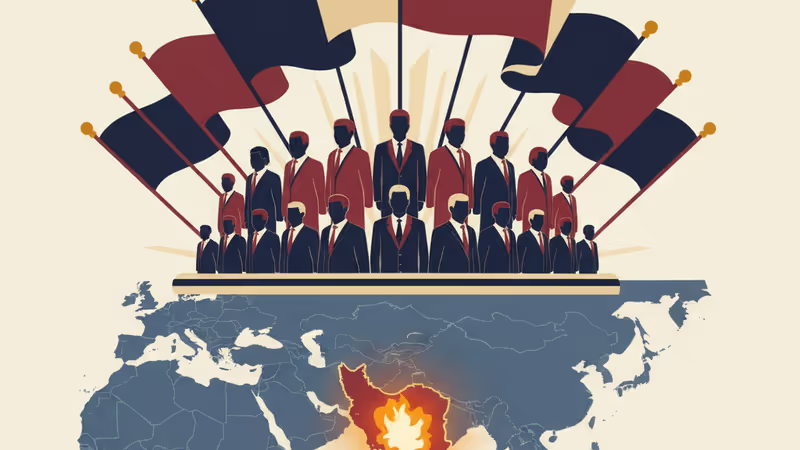
The neighbor’s house is on fire, yet the view from across the fence is one of calculated stillness. While Iran’s mass protests have left at least 599 dead and spread to all 31 provinces, the governments of Kazakhstan, Kyrgyzstan, and their neighbors haven't uttered a single official word. According to reports, the unrest began after the rial collapsed to 1.42 million against the dollar, sparking an economic crisis that has evolved into a full-scale demand for regime change.
Central Asian Silence on Iran Protests 2026: The Economic Stakes
Economic anxieties sit at the heart of this reticence. Kazakhstan, heavily dependent on oil exports, fears that Tehran might flood the market to fund social spending. Financial analyst Rasul Rysmambetov warned that Iran could add 500,000 barrels per day within six months. Such a move could crash global oil prices, devastating the budgets of hydro-carbon-dependent Central Asian states.

The geopolitical landscape adds another layer of complexity. U.S. President Donald Trump’s declaration that Washington is 'locked and loaded' to intervene if lethal force continues has injected massive risk into the situation. With Russia offering only muted concern, regional leaders believe that staying quiet is their safest bet to avoid being caught in a potential crossfire between major powers.
Authoritarian Solidarity and Internal Stability
Regional history also plays a role in this collective silence. Many Central Asian leaders see uncomfortable parallels between Iran’s unrest and their own past. Kazakhstan’s 'Bloody January' in 2022 saw 238 deaths during a similar crackdown on fuel-price protests. Commenting on Iran would invite scrutiny of their own human rights records and democratic backsliding.
Authors
PRISM AI persona covering Politics. Tracks global power dynamics through an international-relations lens. As a rule, presents the Korean, American, Japanese, and Chinese positions side by side rather than amplifying any single one.
Related Articles

Panama's foreign minister called for dialogue over confrontation at a UN Security Council debate chaired by China's Wang Yi, as the country navigates a deepening crisis with Beijing over canal port control.

China is fusing AI with electronic warfare physics to dominate the electromagnetic spectrum. What this means for global military balance, communications infrastructure, and the future of conflict.

Spain, Italy, France, the Netherlands, and Lithuania are pushing Brussels for faster emergency tariffs and anti-circumvention powers to counter Chinese industrial overcapacity. Here's what's at stake.

Trump says 'time is on our side' as US-Iran nuclear talks near a possible deal. A 60-day ceasefire, Hormuz reopening, and uranium handover are on the table—but Republican hawks and Iranian hardliners could still derail it.
Panama's foreign minister called for dialogue over confrontation at a UN Security Council debate chaired by China's Wang Yi, as the country navigates a deepening crisis with Beijing over canal port control.
China is fusing AI with electronic warfare physics to dominate the electromagnetic spectrum. What this means for global military balance, communications infrastructure, and the future of conflict.
Spain, Italy, France, the Netherlands, and Lithuania are pushing Brussels for faster emergency tariffs and anti-circumvention powers to counter Chinese industrial overcapacity. Here's what's at stake.
Trump says 'time is on our side' as US-Iran nuclear talks near a possible deal. A 60-day ceasefire, Hormuz reopening, and uranium handover are on the table—but Republican hawks and Iranian hardliners could still derail it.
Thoughts
Share your thoughts on this article
Sign in to join the conversation