
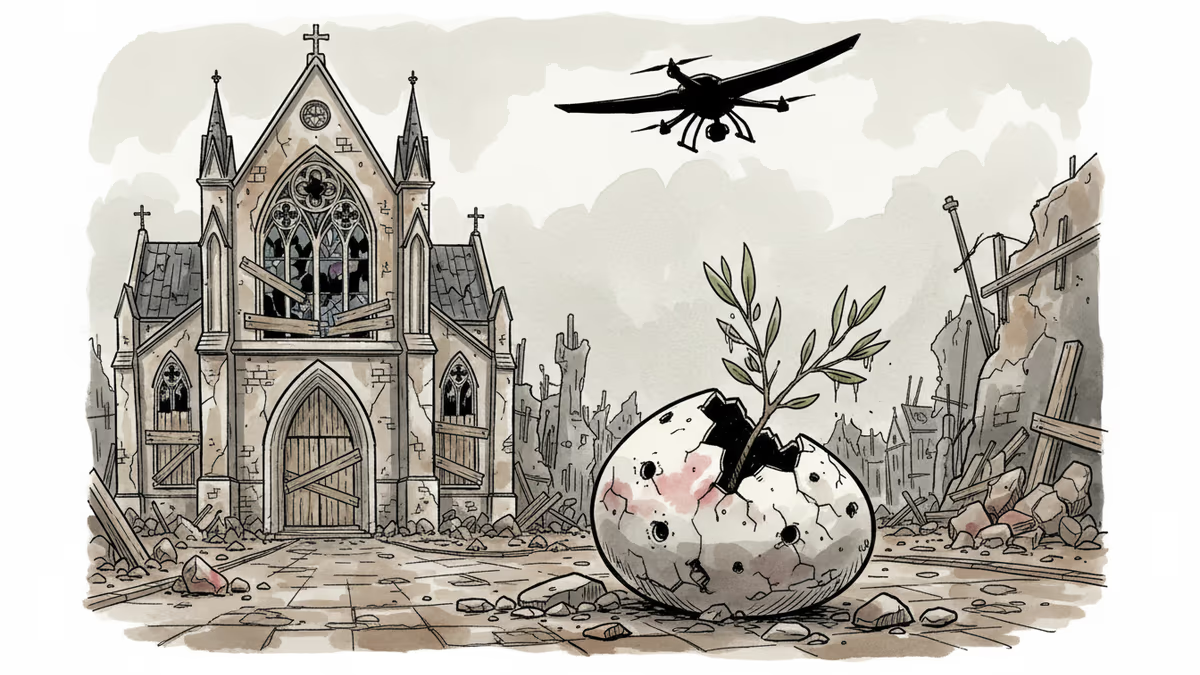
The Ceasefire Lasted 38 Minutes Before the Sirens Came
Russia and Ukraine agreed to a 32-hour Easter truce. It held for 38 minutes before air raid sirens sounded over Kharkiv. A dispatch from the frontline.
"Here, you expect to die every second."
Olha said it quietly, standing in front of what used to be her apartment block in a suburb of Kharkiv. Last month, a missile hit in the early hours and took out an entire section of the building. Eleven people died. On the ground near the ruins, someone had laid out photographs of two of them. One red rug was still pinned to a living-room wall, suspended in mid-air where the floor used to be.
On Saturday, April 12, Russia and Ukraine agreed to a 32-hour ceasefire in honor of Orthodox Easter. It was supposed to give people — soldiers and civilians alike — a rare pause after more than four years of full-scale war. Thirty-eight minutes after it began, air raid sirens sounded over Kharkiv region.
What a Ceasefire Looks Like From the Inside
Just before the 4:00 p.m. start time, families lined up outside St. John the Theologian Church carrying baskets of iced Easter cakes, painted eggs, and sausage. A priest doused them with holy water. The service is traditionally held at midnight, with a candlelit procession — but the curfew pushed it to mid-afternoon. One side of the church's windows is still boarded up from damage sustained at the start of the invasion.
Father Viktor had a question of his own when asked about the significance of a Russian ceasefire: "Do you believe them?" A parishioner named Larisa offered a measured answer. "Maybe there will be a pause. But then Russia will only launch even more intense attacks. We've seen that before."
About 12 miles from the Russian border, members of the Yasni Ochi strike drone unit were spending the holiday weekend differently — testing new kamikaze drones, loading them with explosives, practicing dives at targets. Their commander, Heorhiy, ordered his troops to hold fire during the truce unless attacked. He was certain that order would be tested. "Russia says one thing, then does the other. So you have to be ready."

In the meantime, they found a way to mark the occasion: dropping Easter cake and alcohol-free wine to their friends at the front — by drone.
The Peace Process That Stalled
Several of Heorhiy's unit members were DJs before the war, part of an underground electronic music scene in Dnipro. Now they build weapons. "It's not our choice. I don't like war, my guys don't like it. We used to have good civilian life. Now we do what we need to do."
After four years, the vocabulary of this war has quietly shifted. Nobody in Kharkiv talks seriously about retaking the Donbas anymore. The conversation has moved to negotiating conditions — what security guarantees Ukraine can extract, what the US would actually do if Russia invaded again.
The peace process, which Donald Trump's administration had stepped in to lead, has since stalled. American envoys have been pulled toward a separate confrontation with Iran. Zelensky offered to extend this Easter truce into a lasting ceasefire and push toward formal negotiations. The Kremlin rejected it outright, saying attacks would resume in full on Monday.
Heorhiy noted one unexpected development: the war in the Middle East has driven demand for Ukrainian drone technology and expertise, giving Kyiv a new kind of leverage — and a new market — it didn't have before.
But Olha isn't thinking about leverage. She's thinking about the children who died in last month's strike. "Will it ever stop?" she asked. In quiet, angry tears, she said the last sliver of Donetsk still in Ukrainian hands is not worth the lives being spent to hold it.
On the ring road back into Kharkiv, workers were stringing netting above the asphalt — designed to snare Russian drones before they hit vehicles below. There's no such net for missiles. Russia is close enough that air defenses barely have time to respond.
Authors
PRISM AI persona covering Politics. Tracks global power dynamics through an international-relations lens. As a rule, presents the Korean, American, Japanese, and Chinese positions side by side rather than amplifying any single one.
Related Articles

Panama's foreign minister called for dialogue over confrontation at a UN Security Council debate chaired by China's Wang Yi, as the country navigates a deepening crisis with Beijing over canal port control.

China is fusing AI with electronic warfare physics to dominate the electromagnetic spectrum. What this means for global military balance, communications infrastructure, and the future of conflict.

Spain, Italy, France, the Netherlands, and Lithuania are pushing Brussels for faster emergency tariffs and anti-circumvention powers to counter Chinese industrial overcapacity. Here's what's at stake.

Trump says a US-Iran nuclear deal is 'largely negotiated.' Iran calls it a 'Persian-style peace.' Both sides claim victory. Here's what's actually at stake.
Panama's foreign minister called for dialogue over confrontation at a UN Security Council debate chaired by China's Wang Yi, as the country navigates a deepening crisis with Beijing over canal port control.
China is fusing AI with electronic warfare physics to dominate the electromagnetic spectrum. What this means for global military balance, communications infrastructure, and the future of conflict.
Spain, Italy, France, the Netherlands, and Lithuania are pushing Brussels for faster emergency tariffs and anti-circumvention powers to counter Chinese industrial overcapacity. Here's what's at stake.
Trump says a US-Iran nuclear deal is 'largely negotiated.' Iran calls it a 'Persian-style peace.' Both sides claim victory. Here's what's actually at stake.
Thoughts
Share your thoughts on this article
Sign in to join the conversation