
CapCut Gets AI Video — Everywhere Except Where It Matters Most
ByteDance's Dreamina Seedance 2.0 is now live in CapCut for seven markets. The US is missing. Here's what that tells us about AI video's biggest unsolved problem — and what it means for creators.
OpenAI quietly killed its Sora app. ByteDance just shipped a competitor to hundreds of millions of CapCut users.
On Thursday, ByteDance confirmed that Dreamina Seedance 2.0 — its combined audio and video generation model — is now rolling out inside CapCut, the editing app that's become the default tool for a generation of short-form creators. Type a few words. Upload a sketch. Point it at a reference clip. The model handles the rest: visuals, motion, lighting, audio sync.
There's just one catch. The rollout covers Brazil, Indonesia, Malaysia, Mexico, the Philippines, Thailand, and Vietnam. Not the US. Not the UK. Not the EU.
That omission is the whole story.
What Seedance 2.0 Actually Does
This isn't a filter or a one-click effect. Seedance 2.0 is a full text-to-video and image-to-video generation engine embedded directly into CapCut's editing workflow. ByteDance says it can produce clips without any reference image at all — a text description is enough. The model handles realistic textures, movement, and lighting across multiple angles, which has historically been where AI video models fall apart.
At launch, it supports clips up to 15 seconds across six aspect ratios — a spec clearly designed for TikTok, Reels, and Shorts. Use cases ByteDance highlights include cooking tutorials, fitness content, product demos, and action-heavy videos. The model integrates across CapCut's AI Video and Video Studio features, and will also appear in Pippit (ByteDance's marketing platform) and Dreamina (its standalone AI generation platform). In China, the same model already runs inside Jianying, ByteDance's domestic editing app.
The practical implication: a creator with no camera, no crew, and no budget can now generate polished short-form video inside the same app they already use to edit. That's a meaningful shift in the cost of content production.
Why the US Isn't on the List

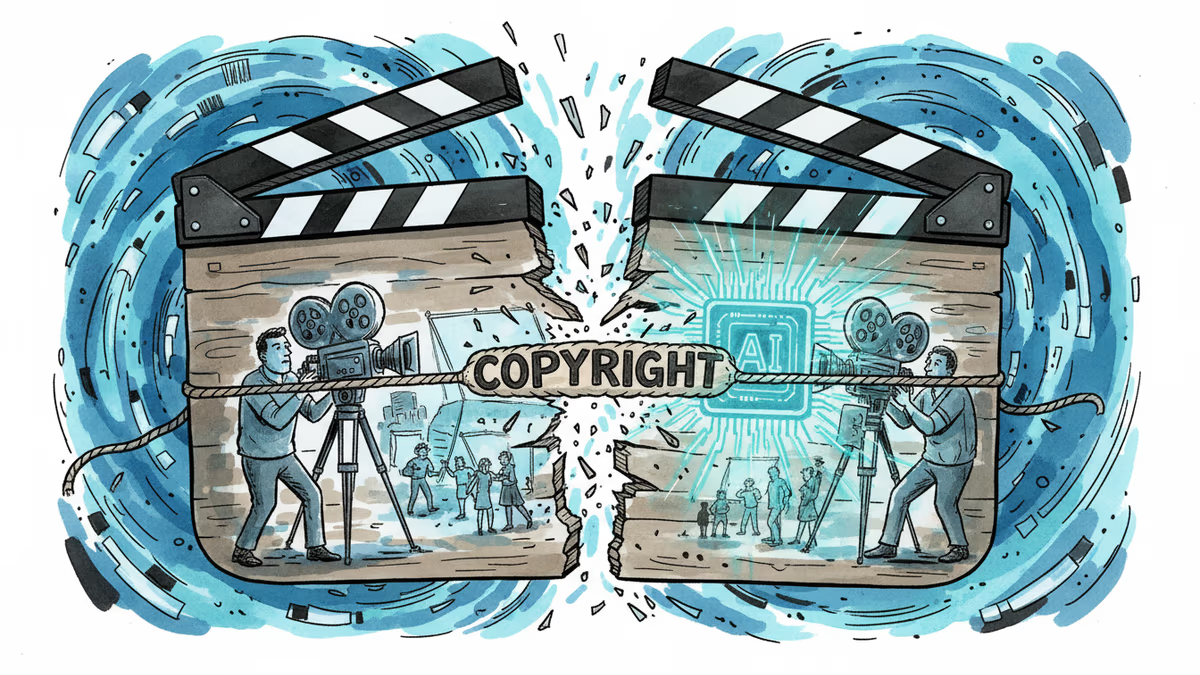
Earlier reports indicated that Seedance 2.0's global rollout had been paused to address intellectual property concerns. Hollywood had raised flags over alleged copyright infringement in the model's training data — a complaint that's become a pattern across the AI industry, from image generators to music models to now video.
ByeDance's response was to add guardrails: the model won't generate video from inputs containing real human faces, and it blocks unauthorized reproduction of protected IP. Every piece of content produced gets an invisible watermark to help identify AI-generated material when it circulates off-platform — useful for rights holders filing takedown requests.
These restrictions are why the seven launch markets were chosen. They're also why the US isn't among them. ByteDance is, in effect, running a controlled rollout in markets with less aggressive IP enforcement while it continues to refine the safety layers needed to operate in jurisdictions where studios and labels have active legal teams.
The honest read: the copyright problem isn't solved. It's deferred.
Three Ways to Read This Launch
For creators, the upside is obvious. CapCut already has a user base that no standalone AI video startup can match. Integrating generation directly into the editing workflow — rather than requiring a separate tool — removes friction. The question is whether AI-generated clips devalue the craft that built those creator audiences in the first place. When everyone can produce the same polished 15-second clip from a text prompt, what's the differentiator?
For the industry, the timing is pointed. OpenAI retreating from the consumer video space while ByteDance advances suggests that the competitive advantage in AI video isn't model quality alone — it's distribution. Sora may be technically impressive, but it doesn't live inside an app that hundreds of millions of people open every day. CapCut does.
For regulators and rights holders, invisible watermarks and face-detection blocks are a start, but they raise their own questions. Watermarks can be stripped. Face detection can be circumvented. And the seven-market rollout strategy — launching where IP enforcement is softer — looks less like a principled rollout plan and more like regulatory arbitrage while the harder jurisdictions are figured out.
The Bigger Pattern
Every major AI video launch in the past 18 months has run into the same wall: training data, copyright, and the gap between what a model can generate and what it's legally permitted to generate. Stability AI, Runway, OpenAI, and now ByteDance are all navigating the same tension between capability and compliance.
What's different here is scale. CapCut isn't a niche creative tool — it's mass-market infrastructure for short-form content. When AI video generation reaches that distribution layer, the volume of potentially infringing content that could be produced isn't a niche concern. It's a structural challenge for how copyright works in an era of generative media.
The US market entry, whenever it comes, will be the real test. That's where the studios are, where the lawyers are, and where the precedents will be set.
Authors
Related Articles
Anthropic has launched a research preview letting Claude autonomously operate your Mac—opening files, browsing the web, running dev tools. Here's what it means for work, privacy, and the AI agent race.
OpenArt and Fanvue are launching the first AI Personality of the Year contest. It's a sign that the AI influencer economy is no longer a novelty — it's a business.
Generative AI tools dominated GDC 2026 — but most developers aren't shipping them in real games. What's holding the industry back, and what does that gap reveal?
Apple quietly blocks all ByteDance apps for US-based iPhones, even with Chinese App Store accounts. This goes beyond TikTok—it's about platform power in geopolitical conflicts.
Anthropic has launched a research preview letting Claude autonomously operate your Mac—opening files, browsing the web, running dev tools. Here's what it means for work, privacy, and the AI agent race.
OpenArt and Fanvue are launching the first AI Personality of the Year contest. It's a sign that the AI influencer economy is no longer a novelty — it's a business.
Generative AI tools dominated GDC 2026 — but most developers aren't shipping them in real games. What's holding the industry back, and what does that gap reveal?
Apple quietly blocks all ByteDance apps for US-based iPhones, even with Chinese App Store accounts. This goes beyond TikTok—it's about platform power in geopolitical conflicts.
Thoughts
Share your thoughts on this article
Sign in to join the conversation