
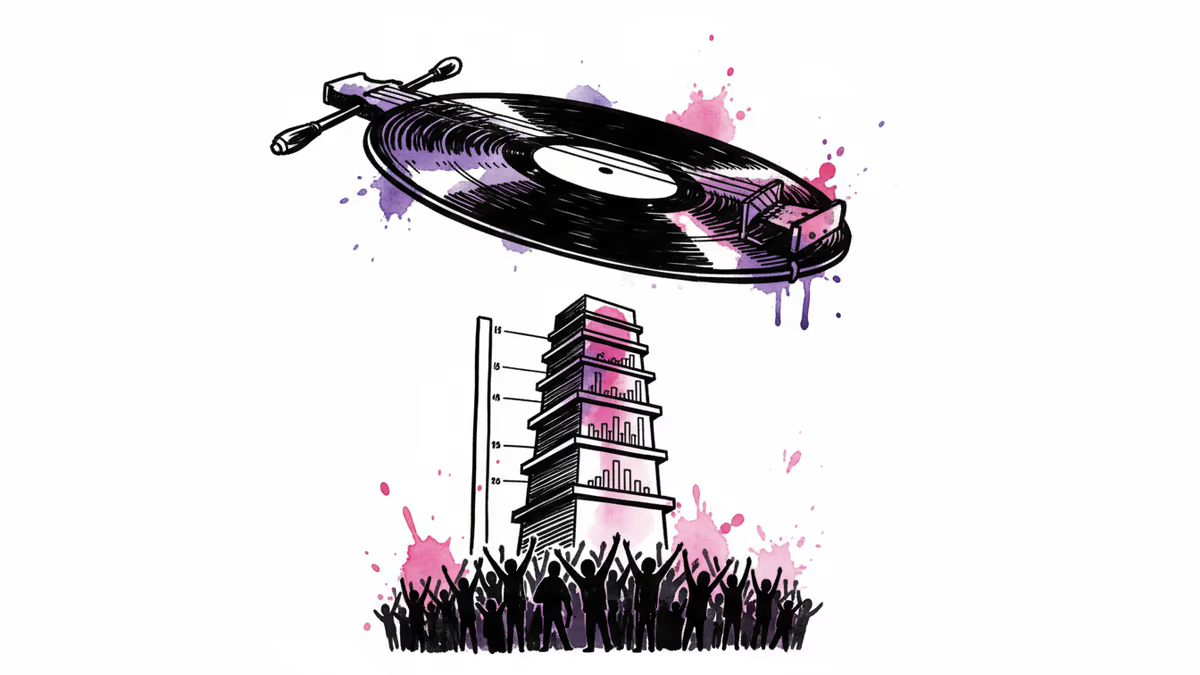
BTS's "ARIRANG" Holds Top 5 on Billboard 200 for Six Straight Weeks
BTS's album ARIRANG stays in the Billboard 200 Top 5 for a record sixth consecutive week. We break down what's driving the longevity — and what it reveals about the K-pop industry's new playbook.
Six weeks in the Top 5 of the Billboard 200 isn't a streak — it's a structural argument.
BTS's latest studio album ARIRANG held at No. 5 on the Billboard 200 as of May 3, marking its sixth consecutive week inside the chart's Top 5. For a non-English-language act, sustained residence at that tier — well past the first-week sales surge — is essentially without modern precedent in the chart's history. The album didn't just open big and fade. It stayed.
Why the Title Matters as Much as the Chart Position
The decision to name the album ARIRANG — after one of Korea's most recognized traditional folk songs — is worth pausing on. BTS spent years navigating the tension between accessibility and identity: Map of the Soul (2020), BE (2020), and Proof (2022) leaned on English titles or neutral shorthand. Choosing a Korean folk song title for a 2026 global release signals something has shifted.
The shift isn't artistic bravado. It's a calculated read of the audience. ARMY, the group's fanbase, has long treated Korean vocabulary as a shared cultural currency — streaming Korean-language content, using Korean phrases natively on social media, and building algorithm-friendly search clusters around Korean-language keywords. By 2026, the Korean title isn't a barrier to entry; it's the brand. What was once a localization challenge has become a differentiation asset.
This mirrors a broader reversal in K-pop's global strategy. The industry spent the early 2010s softening Korean-language content for Western markets. Now, the cultural specificity is the product.

The Longevity Equation: Fandom Plus Platform
The Billboard 200 combines physical sales, track-equivalent albums (TEA), and streaming-equivalent albums (SEA). A sixth-week Top 5 position means general-listener streaming is sustaining the album well beyond the initial fan-purchase wave. That's the harder number to manufacture.
HYBE's platform architecture plays a direct role here. Weverse — the company's fan engagement platform — enables staggered exclusive content drops, member solo activity cycles, and direct artist-to-fan communication that keeps streaming behavior active between major release moments. Competing acts from SM Entertainment (aespa) and JYP (Stray Kids) are targeting the U.S. market in the same quarter, but neither has replicated this kind of extended Top 5 residency. The gap isn't just about fanbase size — it's about how deeply the ecosystem is engineered to sustain consumption over time.
The Return Narrative and Its Commercial Weight
ARIRANG is the first full-group studio album released after all BTS members completed their mandatory South Korean military service. That context creates a consumption dynamic that goes beyond fandom loyalty — it's a reunion narrative, and reunion narratives have historically outsized commercial gravity.
The album title amplifies this. Arirang as a folk song carries themes of parting, longing, and return. The alignment between the group's real-world arc — separation through military service, then collective comeback — and the emotional register of the title wasn't accidental. Fans picked up on the symbolism immediately and circulated it organically across social platforms, generating algorithmic reach that no marketing budget could have directly purchased.
This is the part of BTS's commercial model that's hardest to replicate: the convergence of a real biographical moment with a cultural artifact that resonates across generations of Korean listeners and global fans simultaneously.
This content is AI-generated based on source articles. While we strive for accuracy, errors may occur. We recommend verifying with the original source.
Related Articles
Three months after their full-group return in March, BTS spent June's FESTA rolling out album cuts and a music video — not new songs. Come Over cracked a global top 5 with zero new music behind it. Did the play work?
PRISM Trend Pipeline caught LE SSERAFIM's YouTube KR trending peak. Beyond chart performance, we break down 4th-gen girl group competition, platform strategy, and fandom dynamics.
&TEAM's 'We on Fire' debuted on the Billboard 200 for the first time. Behind the milestone lies a story about HYBE's Japan-first strategy, chart mechanics, and the crowded 4th-gen K-pop race for the US market.

BABYMONSTER announces digital single 'SUGAR HONEY ICE TEA' for June 8. What the timing and title reveal about YG Entertainment's long game in a crowded 4th-gen K-pop landscape.
Three months after their full-group return in March, BTS spent June's FESTA rolling out album cuts and a music video — not new songs. Come Over cracked a global top 5 with zero new music behind it. Did the play work?
PRISM Trend Pipeline caught LE SSERAFIM's YouTube KR trending peak. Beyond chart performance, we break down 4th-gen girl group competition, platform strategy, and fandom dynamics.
&TEAM's 'We on Fire' debuted on the Billboard 200 for the first time. Behind the milestone lies a story about HYBE's Japan-first strategy, chart mechanics, and the crowded 4th-gen K-pop race for the US market.
BABYMONSTER announces digital single 'SUGAR HONEY ICE TEA' for June 8. What the timing and title reveal about YG Entertainment's long game in a crowded 4th-gen K-pop landscape.
Thoughts
Share your thoughts on this article
Sign in to join the conversation