
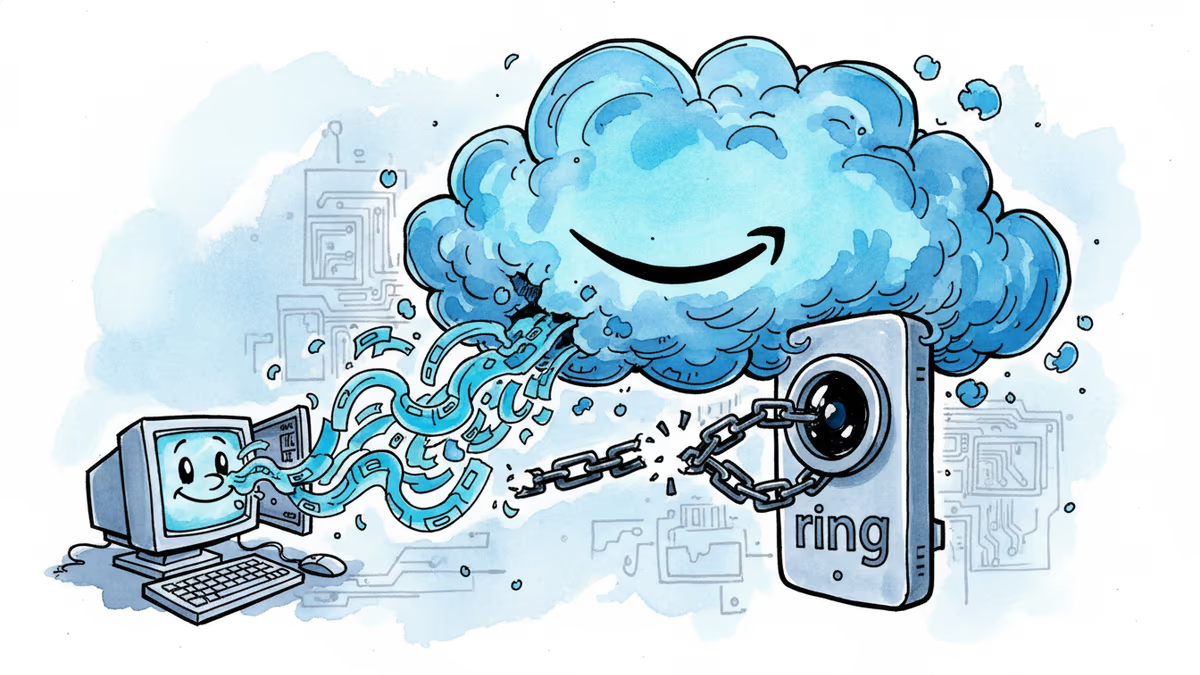
$10K Bounty: Hackers Wanted to Free Ring Doorbells from Amazon
Consumer advocacy group offers $10,000 to integrate Ring doorbells with local servers, bypassing Amazon's cloud entirely. Can smart home devices escape subscription dependency?
$10,000 to Hack Your Way Out of Amazon's Grip
A consumer advocacy group is offering $10,000 to anyone who can break Ring doorbells free from Amazon's servers. But this isn't your typical hacking bounty – it's about giving users complete control over their own doorbell footage.
The Fulu Foundation, co-founded by YouTuber Louis Rossmann, wants developers to integrate Ring devices with local PCs or servers while completely cutting off access to Amazon's cloud infrastructure. No more subscription fees, no more wondering what Amazon does with your front door footage.
Currently, Ring users must pay monthly fees to store recordings in Amazon's cloud. While Ring Edge offers local storage, it's limited to the Ring Alarm Pro and still requires server connections to Amazon.
Why the Rebellion Started Now
This bounty stems from fierce backlash over Ring's Search Party feature – a program that creates mesh networks using neighbors' Ring devices to help find lost items. Users weren't thrilled about their doorbells being conscripted into Amazon's tracking network without explicit consent.
The privacy concerns run deeper. Police departments have accessed Ring footage without warrants in thousands of cases. Amazon has partnerships with over 2,000 law enforcement agencies, raising questions about surveillance overreach.
"We bought the hardware, we should control the data," argues the growing movement of privacy-conscious users. The sentiment echoes broader concerns about Big Tech's grip on personal information.
Developers: Excited but Skeptical

The open-source community is buzzing with interest. Home Assistant developers and hardware hackers are already exploring possibilities. The project aligns with the broader "local-first" movement in smart home technology.
But the technical challenges are daunting. Ring devices are deeply integrated with Amazon's infrastructure at the firmware level. Success would likely require completely replacing the device's operating system – essentially creating a new doorbell from the inside out.
"This isn't just hacking, it's rebuilding," notes one developer. The $10,000 bounty might be just the starting fund for what could become a much larger project.
The Subscription Trap Question
This initiative highlights a fundamental question about modern smart devices: Why do we keep paying for hardware we already own?
The subscription model has become ubiquitous in smart home tech. Nest, Arlo, Ring – they all require ongoing payments for basic features like cloud storage. What happens when these services shut down or change terms?
Some users are already building DIY alternatives using Raspberry Pi computers and open-source software. But most consumers want plug-and-play solutions, not weekend coding projects.
Beyond Ring: A Bigger Movement
This bounty represents more than just Ring frustration – it's part of a broader "right to repair" and "data sovereignty" movement. If successful, it could inspire similar projects for other smart home devices.
Companies like Framework and Fairphone are already proving that consumer electronics can be designed for user control rather than vendor lock-in. Could smart home devices follow suit?
Authors
Related Articles

Nvidia shipped roughly a billion RISC-V cores in 2024, then announced it would run CUDA on the open standard. We break down how royalty-free instruction sets and open software stacks are trying to route around CUDA's lock-in. Part 2 of the Semiconductor Sovereignty series.
Tinder now rewards users who scan their irises at a World orb with free in-app boosts. As AI agents flood dating apps, 'being human' is becoming a verified status — and a business model.
Wisconsin Governor Tony Evers vetoed an age verification bill for adult sites, citing privacy concerns. With 25+ states going the other way, the debate cuts to the heart of online freedom vs. child protection.
CBP admits buying location data from ad industry while Meta contractors watch users in bathrooms through smart glasses. The digital privacy boundary is crumbling.
Nvidia shipped roughly a billion RISC-V cores in 2024, then announced it would run CUDA on the open standard. We break down how royalty-free instruction sets and open software stacks are trying to route around CUDA's lock-in. Part 2 of the Semiconductor Sovereignty series.
Tinder now rewards users who scan their irises at a World orb with free in-app boosts. As AI agents flood dating apps, 'being human' is becoming a verified status — and a business model.
Wisconsin Governor Tony Evers vetoed an age verification bill for adult sites, citing privacy concerns. With 25+ states going the other way, the debate cuts to the heart of online freedom vs. child protection.
CBP admits buying location data from ad industry while Meta contractors watch users in bathrooms through smart glasses. The digital privacy boundary is crumbling.
Thoughts
Share your thoughts on this article
Sign in to join the conversation