

BNY's AI Gambit: Why Arming 20,000 Employees with OpenAI is a Ticking Clock for Wall Street
BNY's move to give 20,000 employees OpenAI tools is more than an upgrade—it's a radical bet on 'citizen AI' that could reshape enterprise tech. Here's what it means.
The Lede: This Isn't About Tech, It's About Scale
BNY Mellon's decision to empower over 20,000 employees to build their own AI agents using OpenAI technology isn't just another corporate tech initiative. It's a radical strategic pivot that signals the end of one era and the beginning of another. By decentralizing AI development, BNY is placing a high-stakes bet that the cumulative intelligence and creativity of its entire workforce will vastly outperform a traditional, centralized team of data scientists. For every tech leader and investor, the message is clear: the new competitive moat isn't just having AI, but deploying it at massive scale, instantly.
Why It Matters: The Second-Order Effects
Most will see this as a story about efficiency. The real story is about the seismic shifts it triggers across the financial and enterprise tech landscape. This move creates a new benchmark for digital transformation, forcing competitors to question their own top-down, slow-moving AI strategies.
- The Pressure Cooker Effect: Rivals like JPMorgan, Goldman Sachs, and State Street, who have historically relied on elite 'AI Centers of Excellence', now face a new kind of threat. BNY's strategy isn't about building one perfect algorithm; it's about enabling thousands of small, context-aware automations. How do you compete with an organization that has 20,000 people looking for micro-efficiencies every single day?
- The Enterprise Software Model is Fraying: This signals a shift away from buying monolithic, one-size-fits-all AI solutions. The future is providing platforms and APIs (like OpenAI's) that empower a company's own talent. Enterprise SaaS vendors who don't adapt to this 'platform-as-a-service' model risk becoming obsolete.
- Talent War 2.0: The war for talent is no longer just about hiring PhDs in machine learning. It's about attracting, retaining, and upskilling employees who possess both domain expertise (in finance, law, operations) and the ability to leverage AI tools. BNY is effectively turning its entire workforce into a new class of 'citizen AI developers'.

The Analysis: A New Blueprint for the Enterprise
The End of the AI Ivory Tower
For the past decade, the dominant model for enterprise AI has been the 'Center of Excellence'—a centralized team of high-priests who hold the keys to the algorithmic kingdom. This model is slow, expensive, and often disconnected from the day-to-day realities of the business units it's meant to serve. BNY's Eliza platform inverts this. It’s a bet on democratization over specialization. This has been tried before with mixed success in the 'low-code/no-code' software movement, but the power and accessibility of Large Language Models (LLMs) make this attempt fundamentally different. The barrier to entry for creating a useful AI agent is now astonishingly low.
Governance: The Billion-Dollar Tightrope Walk
While the upside is immense, the risks are equally staggering. Empowering 20,000 employees to build AI agents is an IT and compliance nightmare waiting to happen. Our analysis suggests the primary challenge for BNY won't be adoption, but control. How do you prevent sensitive client data from being used in prompts? How do you ensure agents comply with complex financial regulations like SEC or FINRA rules? How do you stop the proliferation of thousands of redundant or poorly-built 'shadow AI' tools? BNY's success or failure will hinge entirely on its ability to create a robust governance framework—a 'guardrail' system for mass innovation. This is the challenge every CISO and CTO is now grappling with.
PRISM's Take
BNY Mellon's enterprise-wide AI rollout is one of the most significant strategic experiments in modern finance. It's a calculated gamble that the managed chaos of mass empowerment will generate more value than the rigid control of a central authority. While OpenAI provides the technological engine, the real innovation here is organizational. BNY is betting its future not on a handful of brilliant coders, but on the collective intelligence of its entire workforce. If they succeed in balancing innovation with governance, they won't just have improved their P&L; they will have written the blueprint for the 21st-century knowledge-work corporation. Every legacy institution, from banking to insurance to law, should be watching—and worrying.
This content is AI-generated based on source articles. While we strive for accuracy, errors may occur. We recommend verifying with the original source.
Related Articles
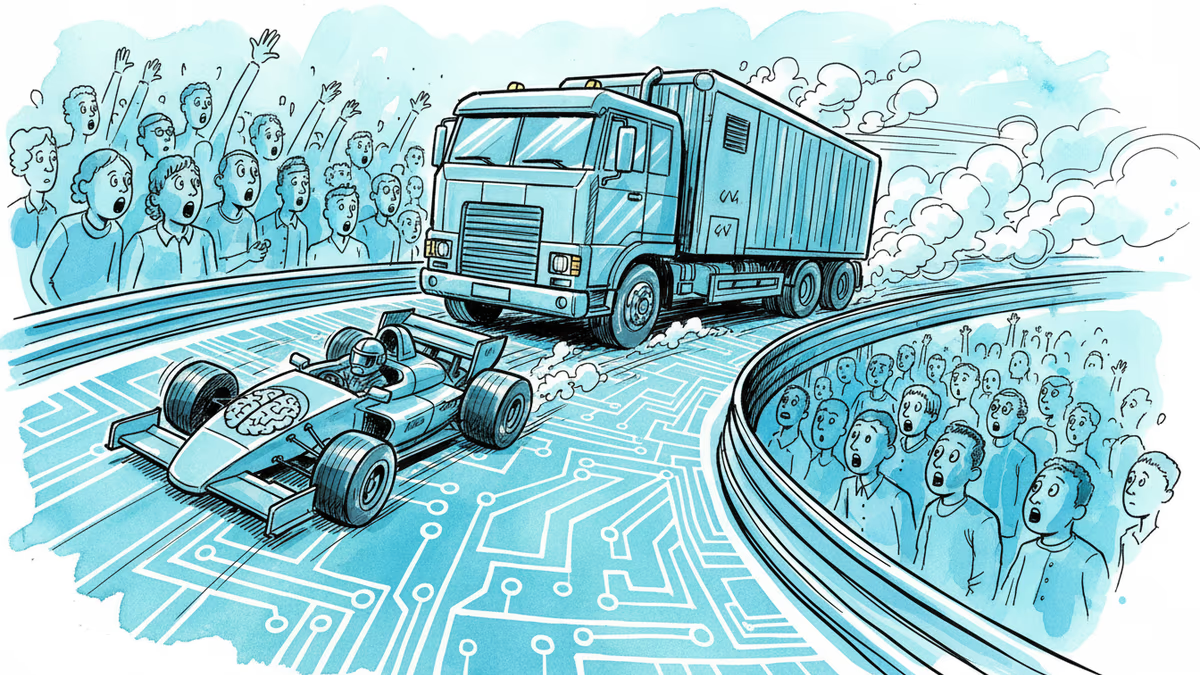
Cerebras Systems has refiled for an IPO targeting mid-May, backed by a $23B valuation, a reported $10B OpenAI deal, and an AWS partnership. What does this mean for Nvidia's dominance and the AI chip landscape?
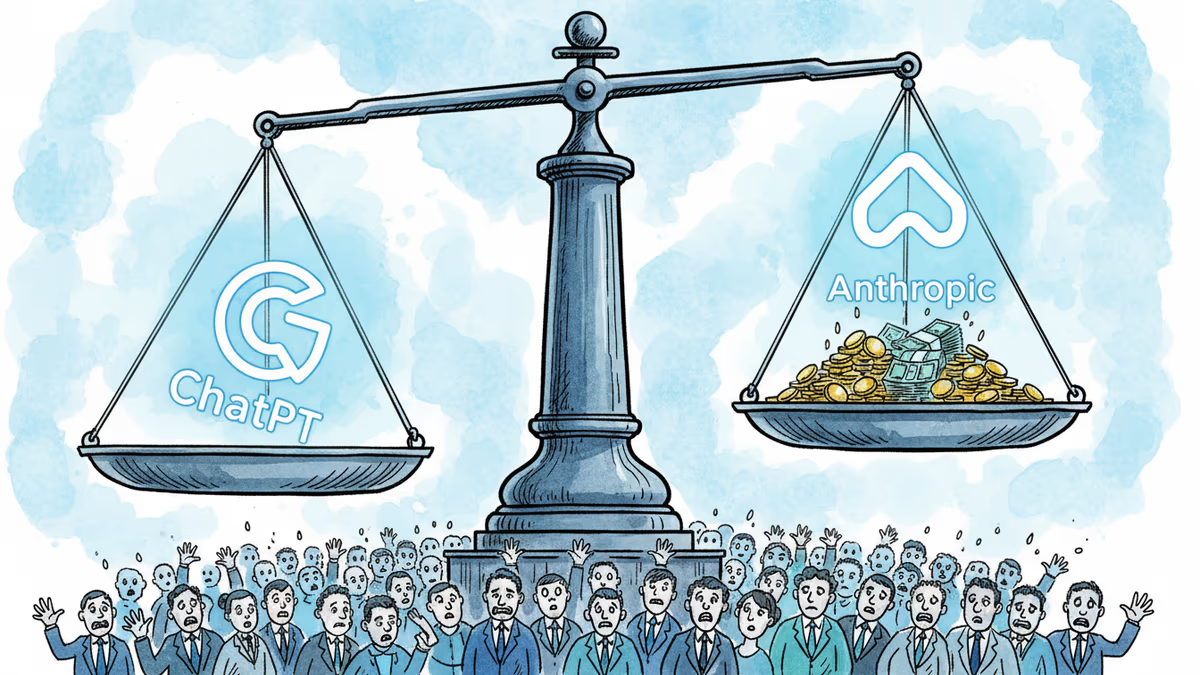
OpenAI's $852B valuation is drawing skepticism from its own backers as Anthropic's ARR tripled in three months. The secondary market is already voting with its feet.
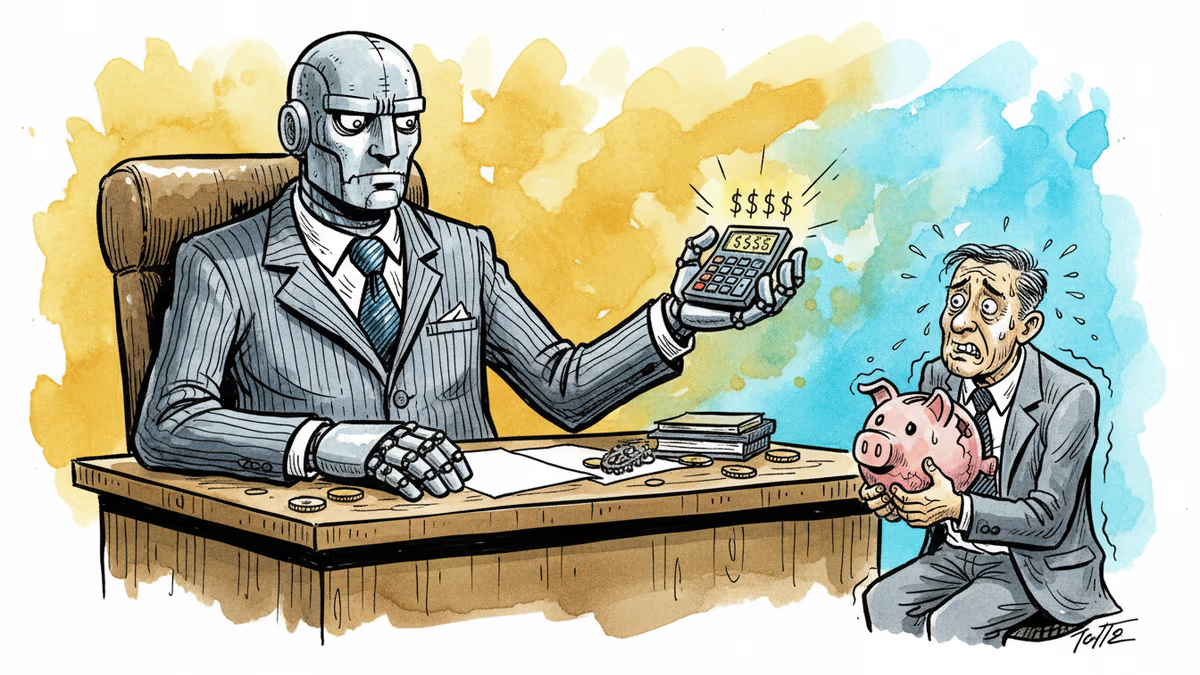
OpenAI acquired Hiro Finance, an AI-powered personal finance startup. Is this just a talent grab, or is the ChatGPT maker quietly building a financial services empire?

OpenAI CEO Sam Altman's San Francisco residence was attacked twice in three days — first a Molotov cocktail, then a shooting. What does this say about tech power, public anger, and the real-world risks facing AI leaders?
Cerebras Systems has refiled for an IPO targeting mid-May, backed by a $23B valuation, a reported $10B OpenAI deal, and an AWS partnership. What does this mean for Nvidia's dominance and the AI chip landscape?
OpenAI's $852B valuation is drawing skepticism from its own backers as Anthropic's ARR tripled in three months. The secondary market is already voting with its feet.
OpenAI acquired Hiro Finance, an AI-powered personal finance startup. Is this just a talent grab, or is the ChatGPT maker quietly building a financial services empire?
OpenAI CEO Sam Altman's San Francisco residence was attacked twice in three days — first a Molotov cocktail, then a shooting. What does this say about tech power, public anger, and the real-world risks facing AI leaders?
Thoughts
Share your thoughts on this article
Sign in to join the conversation