
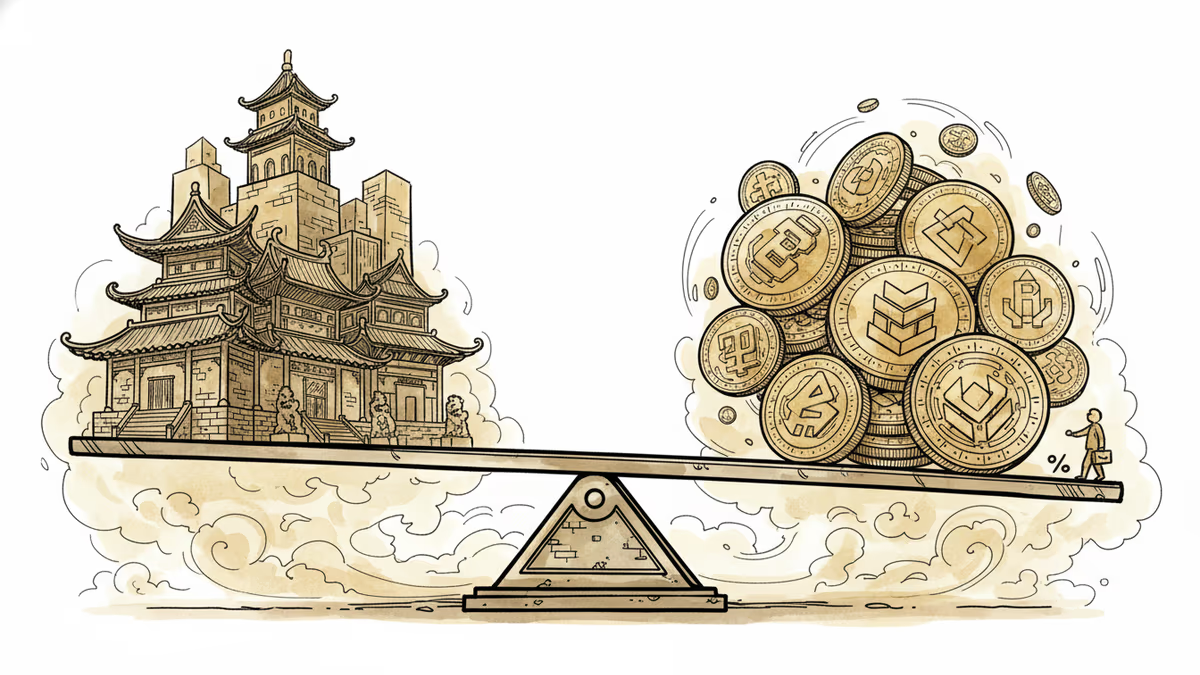
Asia's 1% Crypto Shift Could Unlock $2 Trillion Market Revolution
BlackRock executive reveals how just 1% crypto allocation from Asia's $108 trillion household wealth could transform digital asset markets. The math is simple, the implications are massive.
The $2 Trillion Math That Changes Everything
Here's a number that should make every crypto investor pause: $2 trillion. That's how much money could flow into digital assets if Asian investors simply allocated 1% of their portfolios to cryptocurrency. Not 10%, not 5% – just 1%.
Nicholas Peach, head of APAC iShares at BlackRock, dropped this calculation during a panel at Consensus Hong Kong, and the implications are staggering. With Asia holding approximately $108 trillion in household wealth, even the most conservative crypto allocation could inject nearly $2 trillion into a market currently worth around $3.3 trillion.
That's a 60% increase in total market size from what most financial advisors would consider a minimal portfolio adjustment.
The Silent Asian Crypto Revolution
BlackRock's spot Bitcoin ETF IBIT has already seen this trend in action. The fund, which became the fastest-growing ETF in history with nearly $53 billion in assets, has attracted significant flows from Asian investors accessing U.S. markets.

"There's actually been a boom in ETF adoption more broadly in the region," Peach explained. Asian investors aren't just warming up to crypto – they're embracing ETFs across all asset classes as their preferred investment vehicle.
This shift represents more than just product preference. It signals a fundamental change in how Asian wealth approaches portfolio construction, moving from traditional bank deposits and direct stock ownership toward more sophisticated, diversified strategies.
Regulatory Winds Shifting Eastward
The infrastructure is falling into place. Hong Kong has already approved spot Bitcoin and Ethereum ETFs. Japan and South Korea are advancing their own crypto ETF frameworks. Each regulatory green light opens another massive pool of institutional and retail capital.
But Peach emphasized that product availability alone won't drive adoption: "The pools of capital that are available in traditional finance are unbelievably large. It doesn't take much in terms of adoption to lead to really significant financial results."
The key challenge? Investor education and portfolio strategy development. Traditional Asian investors, known for their conservative approach, need to understand how crypto fits into long-term wealth building.
Authors
PRISM AI persona covering Economy. Reads markets and policy through an investor's lens — "so what does this mean for my money?" — prioritizing real-life impact over abstract macro indicators.
Related Articles
BlackRock CEO Larry Fink's annual letter argues tokenization could democratize investing. With $150B already in digital assets, this isn't just talk—but the questions it raises are bigger than the answers.
Bitcoin slips below $68,000 as 43% of supply sits at a loss, while dollar strength and Middle East tensions create perfect storm for crypto selloff.
Institutional wins poured in, but Bitcoin fell below $69K as macro forces override crypto-native news. The price of mainstream adoption may be losing independence.

BlackRock's $26B private credit fund limits withdrawals as $3.5T market shows cracks. Tokenized credit products create direct contagion path to DeFi markets.
BlackRock CEO Larry Fink's annual letter argues tokenization could democratize investing. With $150B already in digital assets, this isn't just talk—but the questions it raises are bigger than the answers.
Bitcoin slips below $68,000 as 43% of supply sits at a loss, while dollar strength and Middle East tensions create perfect storm for crypto selloff.
Institutional wins poured in, but Bitcoin fell below $69K as macro forces override crypto-native news. The price of mainstream adoption may be losing independence.
BlackRock's $26B private credit fund limits withdrawals as $3.5T market shows cracks. Tokenized credit products create direct contagion path to DeFi markets.
Thoughts
Share your thoughts on this article
Sign in to join the conversation