
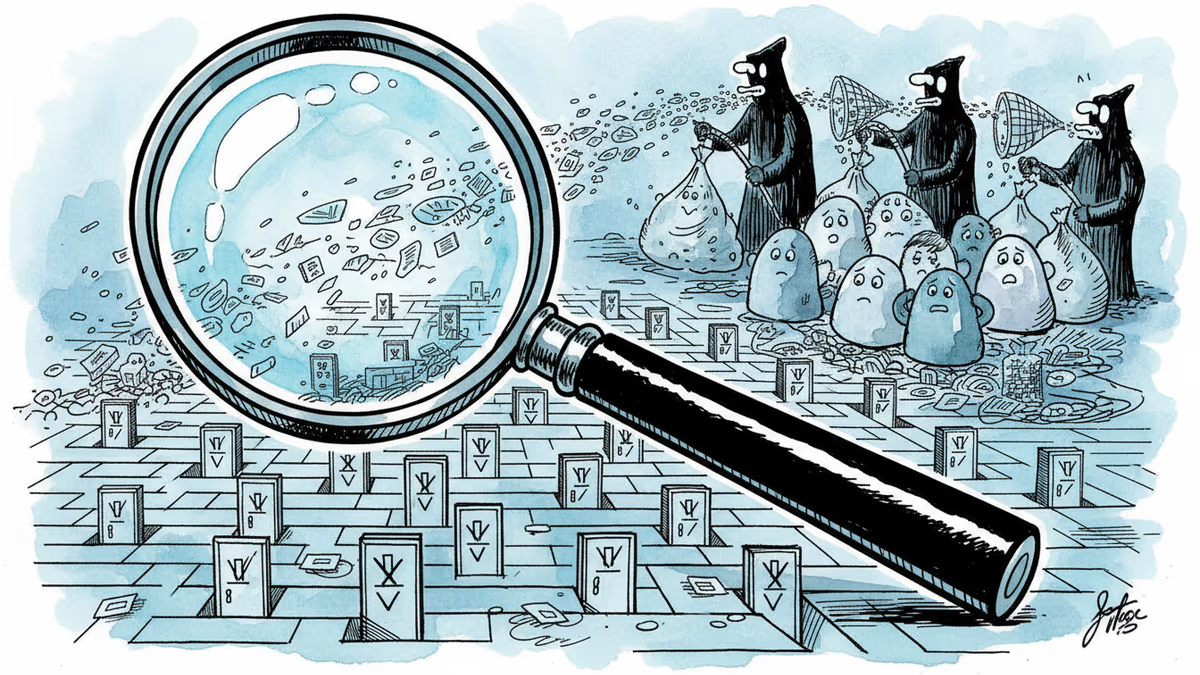
$20.9 Billion Stolen Through Hidden Unsubscribe Buttons
Congressional investigation reveals data brokers deliberately hid opt-out tools from search engines, contributing to massive identity theft losses totaling $20.9 billion across four major breaches.
$20.9 Billion Gone in Plain Sight
Your personal data is worth more than you think—and the proof is devastating. Congressional Democrats have traced $20.9 billion in consumer losses to identity theft connected to just four major data broker breaches. But here's the kicker: some of these companies were deliberately hiding the tools that could have protected you.
A months-long investigation led by Senator Maggie Hassan uncovered a disturbing pattern. Data brokers—companies that collect and sell everything from your birthday to your Social Security number—were using "no index" codes to hide opt-out pages from Google and other search engines.
Translation: Even if you desperately searched "how to delete my data" or "opt out personal information," you'd never find their removal pages.
The Search Engine Shell Game
The investigation, sparked by reporting from The Markup and CalMatters, targeted five major players: Comscore, Findem, IQVIA Digital, Telesign, and 6Sense Insights. These aren't household names, but they're the invisible middlemen turning your digital footprint into profit.
Here's how the scam worked: Companies would create opt-out pages to comply with privacy laws, then use technical tricks to ensure consumers could never find them. It's like putting an emergency exit behind a hidden door—technically there, practically useless.
The timing matters. This investigation launched in August 2024, just as AI-powered scams were exploding. Criminals use the exact type of detailed personal data these brokers collect—dates of birth, addresses, family connections—to craft convincing fraud attempts.
Four Companies, Four Different Excuses
When confronted, the companies' responses revealed everything about their priorities.
Comscore played the "oops" card. They found "no index" code on their "Data Subject Rights" page dating back to 2003—over two decades of "accidental" hiding. The company claimed they couldn't remember why it was added but insisted it wasn't intentional. Twenty years is a long time for an accident.

Telesign blamed a third-party SEO tool's default settings. But investigators found their privacy policy exceeded 9,000 words, forcing consumers to hunt through a novella-length document for basic opt-out information.
6Sense took a split approach—admitting their "Privacy Policy" page carried "no index" code while insisting their main "Privacy Center" was visible. They were the only company reporting third-party audits of their opt-out processes, suggesting they knew visibility was an issue.
IQVIA quietly replaced their entire opt-out system a month after the original reporting, moving to a new vendor-hosted page without the problematic code. They even suggested users could find opt-out information through Google's AI Overview feature—a suggestion investigators found unreliable since AI outputs vary.
Then there's Findem—the company that simply refused to respond. Not to Hassan's initial inquiry, not to follow-up requests, nothing. Their 2024 disclosures show they failed to process 80% of consumer privacy requests, citing "insufficient data." The silence speaks volumes.
The $200 Median That Hides $20,000 Maximums
The $20.9 billion figure comes from analyzing four massive breaches: Equifax (2017), Exactis (2018), National Public Data (2023), and TransUnion (2025). The scale is staggering—from 4.4 million affected Americans in TransUnion's incident to 270 million in National Public Data's breach.
The math is grimly precise: About 30% of breach victims experience identity theft, and 58-69% of those suffer financial losses. The median loss sits around $200, but that number masks the real damage.
Consider the 2017 Equifax settlement: $425 million total, with some claimants receiving up to $20,000 for damages including unauthorized charges, credit monitoring costs, and professional fees. That's not just stolen money—it's lives disrupted, credit destroyed, opportunities lost.
The Pressure That Actually Works
Here's what's fascinating: Congressional pressure worked. Four of five companies improved their opt-out access after Hassan's inquiry. They removed "no index" codes, added prominent links, and posted clearer guidance on privacy rights.
This suggests the problem wasn't technical limitations—it was priorities. These companies could make opt-out tools findable; they just chose not to until forced.
Hassan frames this as evidence that "public pressure can prompt companies to improve access to privacy tools." But it also raises uncomfortable questions about what happens when no one's watching.
The investigation proves that meaningful privacy protection requires more than laws on paper—it demands constant vigilance. Because when your data is worth billions, some companies will always choose profits over your protection, until the spotlight forces their hand.
Authors
Related Articles
UK Visa Portal, a private immigration service mistaken for an official government site, has been exposing passport scans and selfies of over 100,000 applicants. The breach remains unpatched.
Tinder now rewards users who scan their irises at a World orb with free in-app boosts. As AI agents flood dating apps, 'being human' is becoming a verified status — and a business model.
Wisconsin Governor Tony Evers vetoed an age verification bill for adult sites, citing privacy concerns. With 25+ states going the other way, the debate cuts to the heart of online freedom vs. child protection.
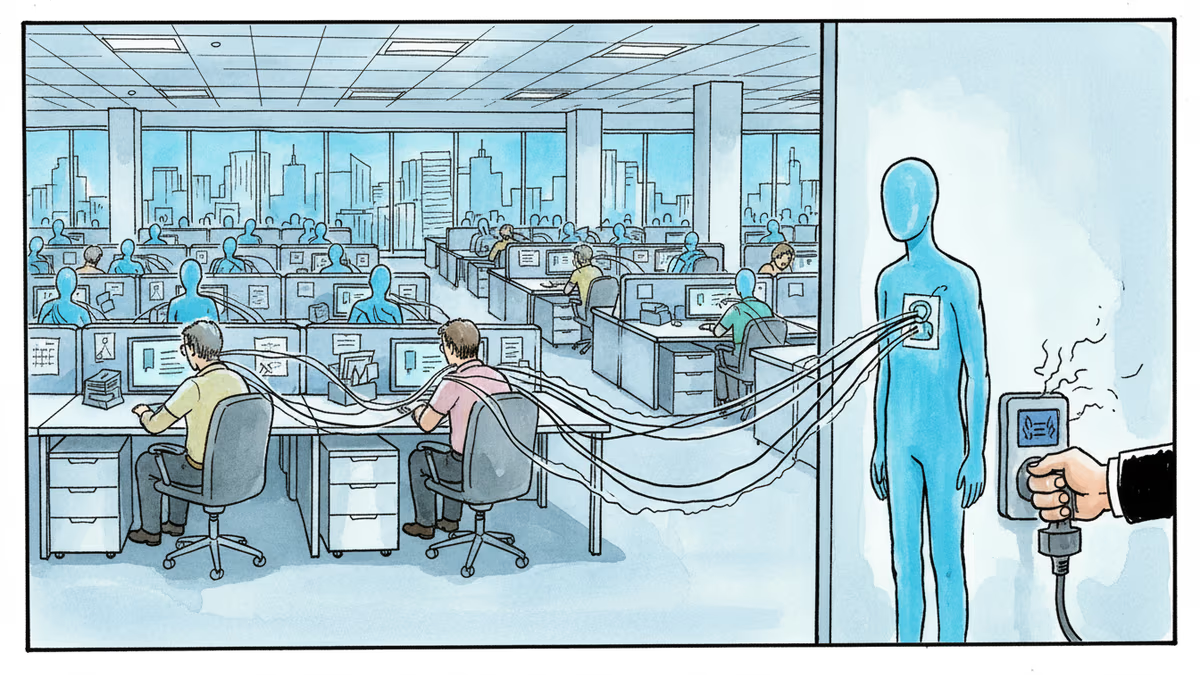
Okta CEO Todd McKinnon on why AI agents need identity management, the SaaSpocalypse threat, and why the kill switch might be the most important button in enterprise tech.
UK Visa Portal, a private immigration service mistaken for an official government site, has been exposing passport scans and selfies of over 100,000 applicants. The breach remains unpatched.
Tinder now rewards users who scan their irises at a World orb with free in-app boosts. As AI agents flood dating apps, 'being human' is becoming a verified status — and a business model.
Wisconsin Governor Tony Evers vetoed an age verification bill for adult sites, citing privacy concerns. With 25+ states going the other way, the debate cuts to the heart of online freedom vs. child protection.
Okta CEO Todd McKinnon on why AI agents need identity management, the SaaSpocalypse threat, and why the kill switch might be the most important button in enterprise tech.
Thoughts
Share your thoughts on this article
Sign in to join the conversation