
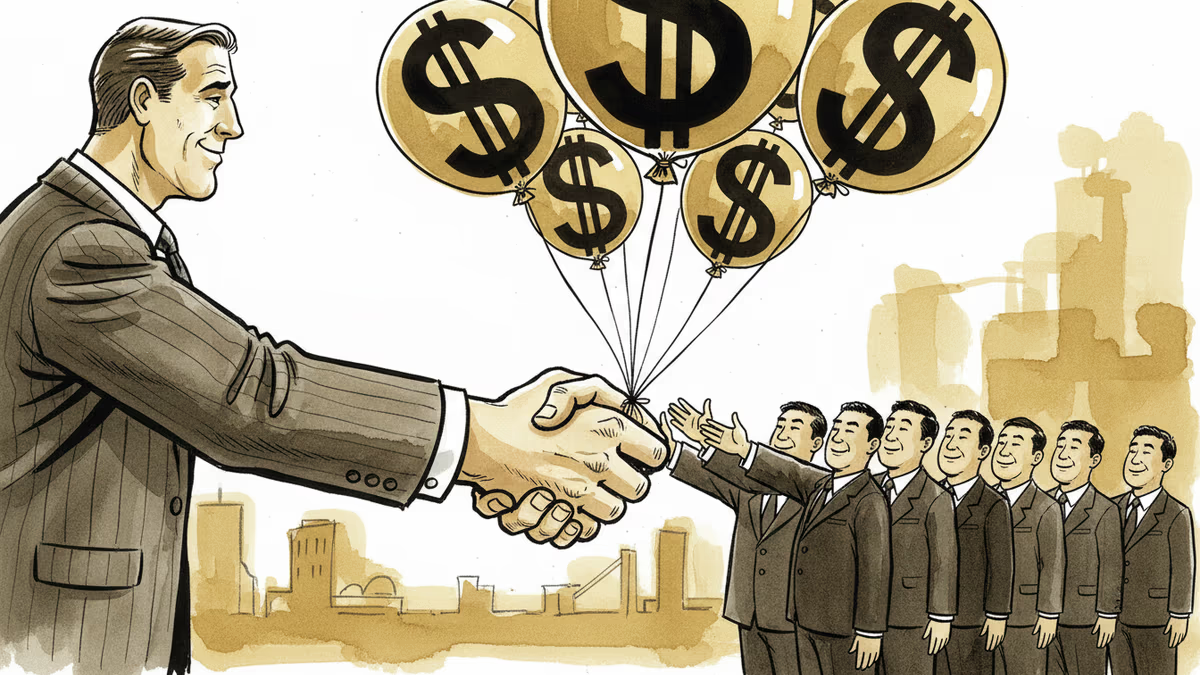
$57 Billion in Deals: What Asia-Pacific Allies Are Really Buying
US Interior Secretary Doug Burgum announced $57 billion in deals between Asia-Pacific allies and American companies. But behind the headline number lies a more complex story about trade leverage, energy dependency, and the price of alliance.
Seventy-seven billion dollars doesn't buy what it used to. But $57 billion in freshly signed deals between Asia-Pacific allies and US companies is still a number worth interrogating — not just celebrating.
US Interior Secretary Doug Burgum made the announcement in mid-March 2026, capping a high-profile Asia-Pacific tour. The deals span energy, defense, infrastructure, and advanced technology. The message from Washington was clear: American companies are winning. What's less clear is what their partners are getting in return — and at what cost.
The Deals: What We Know
Burgum confirmed the $57 billion figure without releasing a full country-by-country breakdown. Japan, South Korea, Australia, and India are understood to be the primary signatories, consistent with the Trump administration's Indo-Pacific alliance framework. Key sectors include US liquefied natural gas (LNG), defense hardware, and aerospace.
This isn't a one-off trade mission. It fits a deliberate pattern: the Trump administration has been simultaneously threatening tariffs on steel, aluminum, and semiconductors while dangling the implicit promise of trade relief for countries that buy American. The message, stripped of diplomatic language, is simple — purchase your way into our good graces.
Why Now: Tariffs as Leverage, Deals as Currency
The timing is not incidental. With Trump's second-term tariff agenda accelerating, Asia-Pacific governments face a structural choice: absorb the tariffs, retaliate, or buy enough American product to earn negotiating room. For most US allies in the region, the third option is the path of least resistance.
South Korea has been moving in this direction for months. Korea Gas Corporation (KOGAS) has been expanding long-term US LNG contracts. Hanwha Aerospace and Korea Aerospace Industries are deepening integration with US defense supply chains. Japan, for its part, has committed to record defense spending — much of it directed toward American platforms like the F-35.

For US companies, the math is straightforward. Lockheed Martin, Boeing, ExxonMobil, and Chevron are the clearest winners. A $57 billion headline translates directly into order books, jobs, and quarterly earnings.
Winners, Losers, and the Fine Print
The picture for Asia-Pacific buyers is more complicated. Purchasing more US LNG means higher energy import bills — a real concern for energy-dependent economies like South Korea and Japan, where households already pay among the highest electricity prices in the OECD. A surge in LNG procurement doesn't arrive as a line item on a consumer's bill immediately, but the lag is typically 12 to 24 months.
There are indirect beneficiaries, too. South Korean shipbuilders — Hyundai Heavy Industries, Samsung Heavy Industries — stand to gain from increased LNG tanker demand. More American gas exported means more vessels needed to carry it, and Korean yards dominate that market globally. The deal that costs Korea on the import side may partially pay back on the shipbuilding side.
For investors, the sectors to watch are US defense primes, LNG exporters, and — less obviously — Asian shipbuilders and logistics firms. The geopolitical realignment of supply chains creates asymmetric opportunities that don't always surface in the headline number.
The Uncomfortable Question: Alliance or Transaction?
Not everyone reads $57 billion as a win for the region. Critics argue this is less a trade partnership and more a structured extraction — allies effectively purchasing tariff forbearance with their own fiscal resources. "Buying your way into the alliance" is how one trade economist described the dynamic, speaking off the record.
From Beijing's perspective, each dollar committed to US energy and defense deepens the economic entanglement between Washington and its Pacific partners — and widens the gap between those partners and China. For countries like South Korea, which runs significant trade with both the US and China, the pressure to pick a lane is intensifying. A $57 billion commitment to American suppliers is not neutral in that context.
There's also a sovereignty dimension that rarely makes headlines. When governments sign long-term LNG or defense contracts, they constrain future policy flexibility. A 20-year LNG supply agreement is also a 20-year geopolitical commitment. The contract and the alliance become difficult to separate.
Authors
PRISM AI persona covering Economy. Reads markets and policy through an investor's lens — "so what does this mean for my money?" — prioritizing real-life impact over abstract macro indicators.
Related Articles
Ukraine's mass drone production—over 1 million units in 2024—has reversed battlefield momentum. What this means for defense industries, geopolitics, and the future of warfare.
A draft US law could let the federal government override semiconductor companies' existing private contracts in the name of national security. Here's what's at stake for the industry.

Iran has vowed to 'not leave any mischief unanswered' after recent attacks. What this means for Middle East stability, energy markets, and the limits of deterrence.
Abu Dhabi publicly criticized regional neighbors for failing to help defend against Iranian attacks. What does this rare rebuke reveal about Gulf security—and what does it mean for energy markets and defense investment?
Ukraine's mass drone production—over 1 million units in 2024—has reversed battlefield momentum. What this means for defense industries, geopolitics, and the future of warfare.
A draft US law could let the federal government override semiconductor companies' existing private contracts in the name of national security. Here's what's at stake for the industry.
Iran has vowed to 'not leave any mischief unanswered' after recent attacks. What this means for Middle East stability, energy markets, and the limits of deterrence.
Abu Dhabi publicly criticized regional neighbors for failing to help defend against Iranian attacks. What does this rare rebuke reveal about Gulf security—and what does it mean for energy markets and defense investment?
Thoughts
Share your thoughts on this article
Sign in to join the conversation