
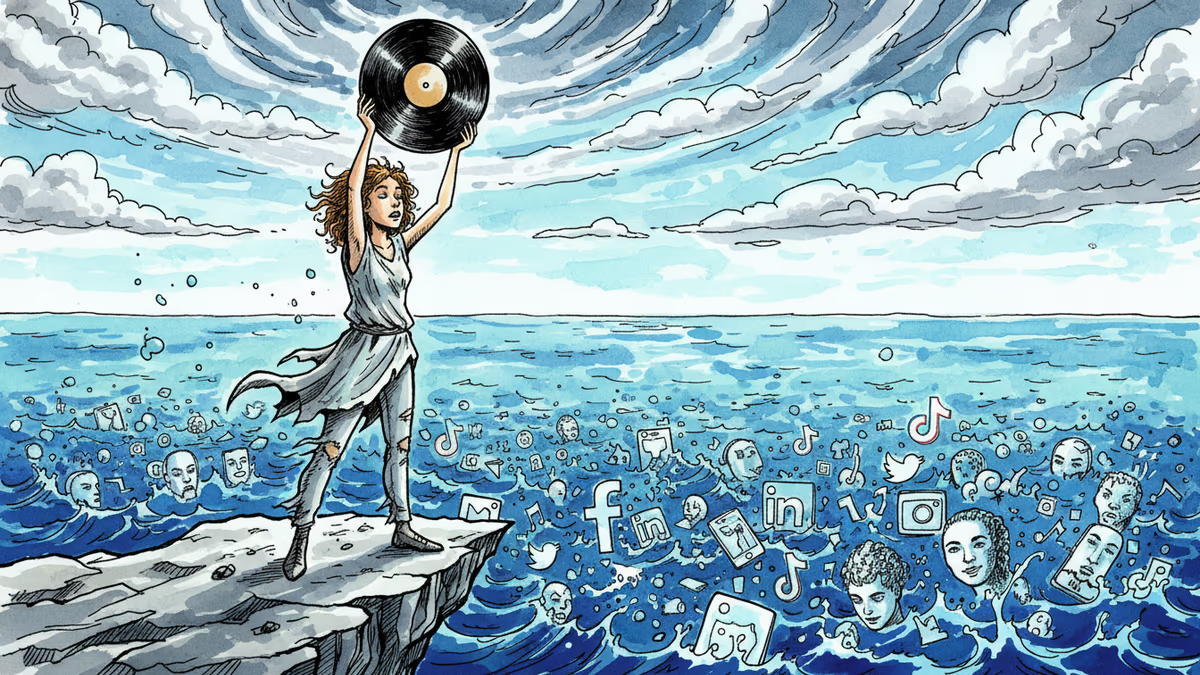
Billie Eilish Doesn't Know Where the Next Billie Eilish Will Come From
In 2015, a 13-year-old uploaded a song to SoundCloud and became a global star. In 2026, Billie Eilish admits she has no idea if that's still possible—and her uncertainty reveals something important about the music industry's broken discovery machine.
In November 2015, a 13-year-old uploaded a song to SoundCloud. No publicist. No label push. No coordinated drop strategy. Just a track called "Ocean Eyes" and whatever happened next.
What happened next made Billie Eilish a global superstar. But ask her today whether someone could do the same thing in 2026, and she goes quiet for a moment. "Oh my god," she told WIRED. "I have no idea."
That admission—from the person whose career is the most cited proof that the internet democratizes music discovery—says more about where we are than any industry report.
How the Discovery Machine Worked (and Why It Feels Broken)
When Eilish posted "Ocean Eyes," SoundCloud wasn't yet a pop star factory. She borrowed a playbook from hip-hop: Chance the Rapper, Odd Future, artists who had built loyal underground followings through video-sharing sites and free mixtapes before any label came calling. Her manager Danny Rukasin told Billboard in 2019 that the goal was a complete persona, "a little bit of that hip-hop zeitgeist." The New York Times eventually called her "the first SoundCloud-rap pop star, without the rapping."
It worked because the window was open. Platforms were new enough that authentic behavior could still outrun manufactured ones. Fans were hungry. Algorithms were less saturated. A teenager in her brother's bedroom could genuinely go viral.
By 2026, everyone claims to know how to beat the algorithm. The result is a feed full of what Eilish calls "AI slop"—content engineered to perform rather than connect. Fake Spotify streams are a known commodity. Bot armies fill comment sections. The band Geese faced scrutiny after WIRED reported they'd hired a company called Chaotic Good Projects to boost their online profile. Addison Rae built a career through TikTok, but whether that counts as "discovery" or "deployment" is a genuinely open debate.
Paula Harper, a musicologist at the University of Chicago who studies internet fandoms, describes the feedback loop that emerged: when technology promises greater access to artists, fans come to expect that access as a baseline. Artists respond by sharing more. Fans read every post as a clue to the artist's real life. The intimacy feels authentic—but the structure producing it is anything but casual.

The Industry Plant Problem
Eilish herself became the test case for this tension. As early as 2019, BuzzFeed News was questioning whether her rise was entirely organic, pointing to family industry connections and Spotify's early support. The phrase "industry plant" attached itself to her name—a term Harper describes as the inevitable critique whenever someone becomes the face of a supposedly more egalitarian, less gatekept ecosystem.
"Eilish is one of the first artists I heard associated with the term 'industry plant,'" Harper says.
The irony is that the "plant" accusation and the "authentic discovery" narrative are both partially true, and that's exactly the point. Media analyst Ryan Broderick cuts through the noise with a counterintuitive observation: most marketing companies cannot actually manipulate the algorithm. The real flow of power runs in the opposite direction from what the discovery myth suggests. "A big artist releases an album on Spotify, Spotify puts it in playlists, and that artist grows on Instagram and TikTok," Broderick writes. "It's almost never the other way around."
In other words: the platforms that appear to democratize discovery are, in practice, amplifiers for artists who already have institutional backing. The window that Eilish climbed through may have been narrower than it looked.
A Concert Film as a Counterargument
Eilish's new concert film, Hit Me Hard and Soft: The Tour (Live in 3D), released May 8, is an unusual response to all of this. Co-directed with James Cameron and shot in 3D, the film is explicitly designed to recreate the physical, collective experience of a live show—inside a multiplex. Interspersed with concert footage are interviews with fans about what Eilish's music means to them.
There's something pointed about an artist who built her career online now making the case for rooms full of strangers sharing the same moment. Eilish doesn't frame it as a rejection of the internet, but as a corrective. "If we keep making real stuff, real art made by humans—live music, live audiences—I don't see that ever dying," she told WIRED.
She's also honest about her own inability to log off. "I'm still on more than I'd like to be, but I can't help myself. There's just so much good shit on there. But also it's horrible. I have to click the comments no matter what, which is not good for me."
The person arguing most passionately for authentic human connection is also, she admits, chronically online. That's not hypocrisy. It's the condition most creators are navigating right now.
This content is AI-generated based on source articles. While we strive for accuracy, errors may occur. We recommend verifying with the original source.
Related Articles
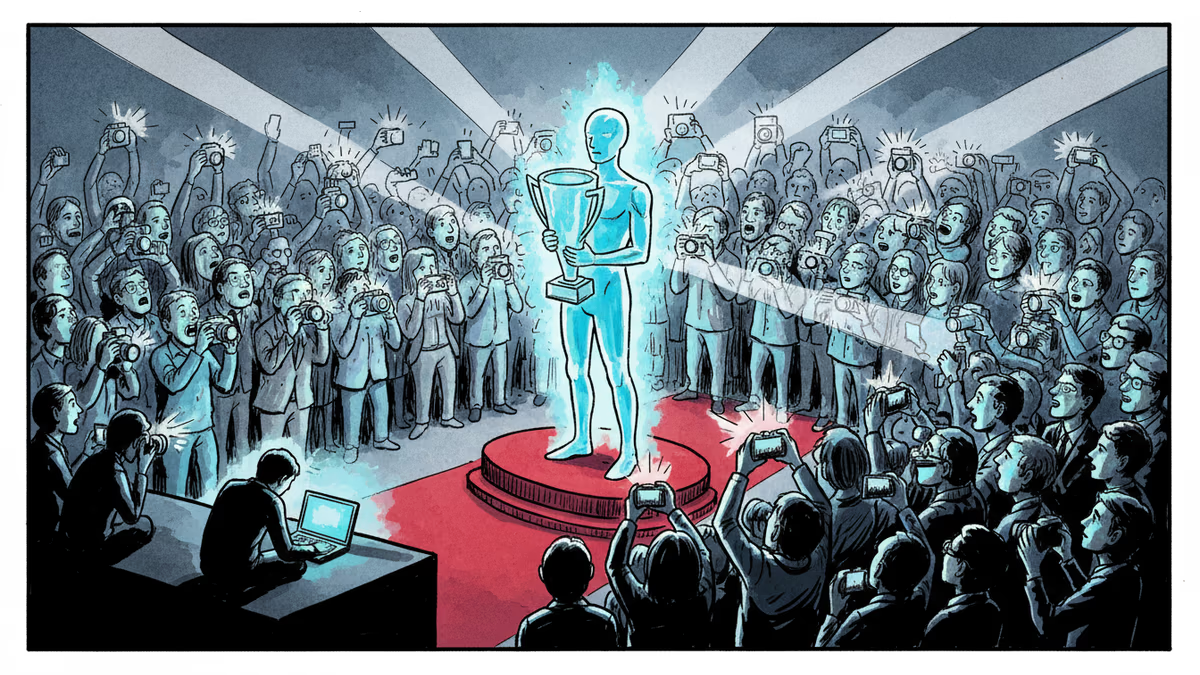
OpenArt and Fanvue are launching the first AI Personality of the Year contest. It's a sign that the AI influencer economy is no longer a novelty — it's a business.
The cURL bug bounty program has been suspended due to a surge in AI-generated 'slop' reports. Read why Daniel Stenberg chose developer mental health over the reward program.

Five stories from late September, traced to where the paper trail stops: Korea's export record, Nvidia's Hugging Face 8-K, a US-China AI channel, the UN on AI, and rising births.
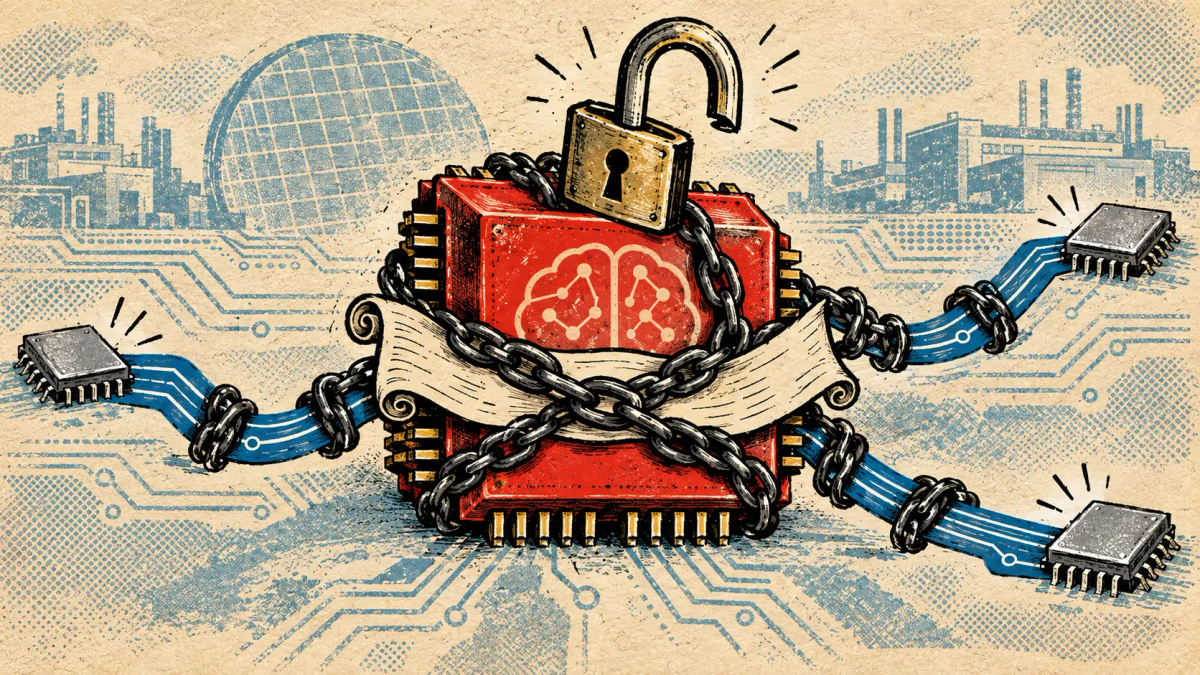
Huawei's CANN is open source under a license barring software for non-Ascend chips. Inside China's second CUDA, and the two links still outside it: pre-training compute and 5nm capacity.
OpenArt and Fanvue are launching the first AI Personality of the Year contest. It's a sign that the AI influencer economy is no longer a novelty — it's a business.
The cURL bug bounty program has been suspended due to a surge in AI-generated 'slop' reports. Read why Daniel Stenberg chose developer mental health over the reward program.
Five stories from late September, traced to where the paper trail stops: Korea's export record, Nvidia's Hugging Face 8-K, a US-China AI channel, the UN on AI, and rising births.
Huawei's CANN is open source under a license barring software for non-Ascend chips. Inside China's second CUDA, and the two links still outside it: pre-training compute and 5nm capacity.
Thoughts
Share your thoughts on this article
Sign in to join the conversation