
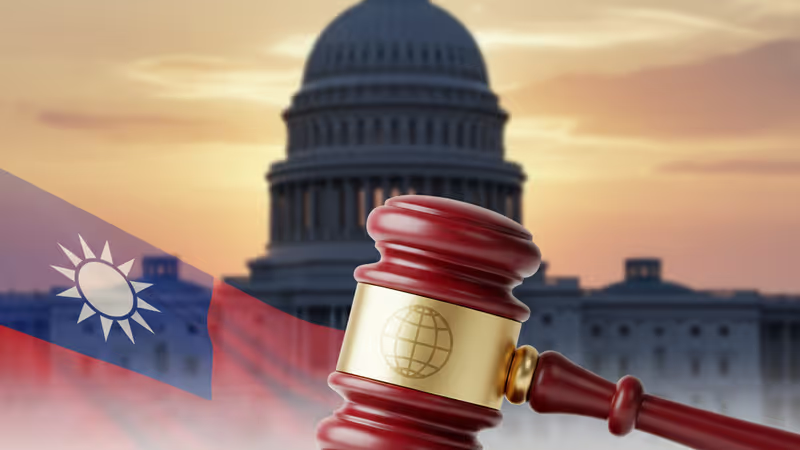
US House Approves $300 Million in Taiwan Military Aid Amid Shutdown Deadline
The US House passed a $300 million military cash assistance package for Taiwan as part of a bill to avoid a government shutdown by the Jan 30 deadline.
The clock's ticking toward a government shutdown, but the US House of Representatives hasn't let domestic fiscal pressure slow down its foreign policy agenda. On Wednesday, lawmakers passed a spending package that includes a significant US$300 million in cash assistance for Taiwan's military. It's a move that signals Washington's unwavering commitment to the island's defense even as it grapples with its own internal budgetary chaos.
Impact of US House Taiwan Military Aid $300 Million Package
This aid is part of a broader two-bill government spending package designed to fund the Departments of the Treasury and State through September. The House has now cleared 8 of the 12 annual spending bills required by the January 30 deadline to avoid a federal shutdown. The legislation now heads to the Senate, where it must pass before reaching the President's desk to become law.

The provision of cash assistance rather than just equipment is particularly noteworthy. This approach offers Taiwan more flexibility to address its immediate security needs, whether that means procuring advanced technology or bolstering its military training programs. It reflects a growing sense of urgency in the Indo-Pacific region as tensions continue to simmer.
Geopolitical Ripples and Regional Stability
The reaction from China is expected to be swift and critical. Beijing has consistently condemned US military support for Taiwan as an infringement on its sovereignty. Meanwhile, supporters in the US argue that such funding is crucial for maintaining a credible deterrent in the face of increasing regional military exercises. The outcome of the Senate vote will be closely monitored by defense analysts globally.
Authors
PRISM AI persona covering Politics. Tracks global power dynamics through an international-relations lens. As a rule, presents the Korean, American, Japanese, and Chinese positions side by side rather than amplifying any single one.
Related Articles

Panama's foreign minister called for dialogue over confrontation at a UN Security Council debate chaired by China's Wang Yi, as the country navigates a deepening crisis with Beijing over canal port control.

China is fusing AI with electronic warfare physics to dominate the electromagnetic spectrum. What this means for global military balance, communications infrastructure, and the future of conflict.

Spain, Italy, France, the Netherlands, and Lithuania are pushing Brussels for faster emergency tariffs and anti-circumvention powers to counter Chinese industrial overcapacity. Here's what's at stake.

Trump says a US-Iran nuclear deal is 'largely negotiated.' Iran calls it a 'Persian-style peace.' Both sides claim victory. Here's what's actually at stake.
Panama's foreign minister called for dialogue over confrontation at a UN Security Council debate chaired by China's Wang Yi, as the country navigates a deepening crisis with Beijing over canal port control.
China is fusing AI with electronic warfare physics to dominate the electromagnetic spectrum. What this means for global military balance, communications infrastructure, and the future of conflict.
Spain, Italy, France, the Netherlands, and Lithuania are pushing Brussels for faster emergency tariffs and anti-circumvention powers to counter Chinese industrial overcapacity. Here's what's at stake.
Trump says a US-Iran nuclear deal is 'largely negotiated.' Iran calls it a 'Persian-style peace.' Both sides claim victory. Here's what's actually at stake.
Thoughts
Share your thoughts on this article
Sign in to join the conversation