
Beyond the Hype: Why BNY's 'AI Factory' Is the New Blueprint for Enterprise AI
BNY's enterprise-wide AI platform is more than a tech upgrade—it's a new blueprint for finance. Discover why their 'AI factory' approach will reshape the industry.
The Lede
While most of the world is distracted by consumer-facing AI chatbots, BNY Mellon, a 240-year-old financial institution, has quietly built what could be the definitive blueprint for enterprise AI adoption. By creating an internal platform called 'Eliza' that empowers over 20,000 employees to build their own AI agents using OpenAI technology, BNY isn't just experimenting with AI—it's industrializing it. This move signals a seismic shift from isolated AI projects to a full-stack, enterprise-wide 'AI factory' model, setting a new competitive benchmark for the entire financial sector and beyond.
Why It Matters
This isn't another story about a bank launching a chatbot. BNY's strategy represents a fundamental change in how large, regulated enterprises will deploy and scale artificial intelligence. For investors and IT leaders, this is a critical signal.
- The Competitive Moat Deepens: Companies that successfully build an internal AI development platform gain a massive efficiency and innovation advantage. Rivals still debating pilot projects are already years behind. This forces the hand of competitors like State Street, JPMorgan, and Goldman Sachs to accelerate their own enterprise-wide AI strategies.
- The 'Build vs. Buy' Equation Flips: Why purchase dozens of niche AI-powered SaaS tools when you can empower your own business units to build bespoke, integrated solutions faster and cheaper? The rise of internal AI factories poses a direct existential threat to a generation of enterprise software vendors.
- A New Talent Paradigm: The focus shifts from hiring a small team of elite AI scientists to upskilling a massive workforce. The most valuable employees will be those who combine deep domain expertise (in finance, legal, operations, etc.) with the ability to build and deploy AI agents to solve their own problems.
The Analysis
From Pilot to Platform: The 'Eliza' Strategy

The most crucial detail in BNY's announcement is the existence of the 'Eliza' platform. Historically, enterprise software adoption has been a top-down, IT-led process—slow, expensive, and often disconnected from business needs. BNY has inverted this model. Eliza acts as a governed sandbox, a controlled environment that provides access to powerful foundation models (like OpenAI's) while wrapping them in the non-negotiable layers of security, compliance, and data privacy required in finance.
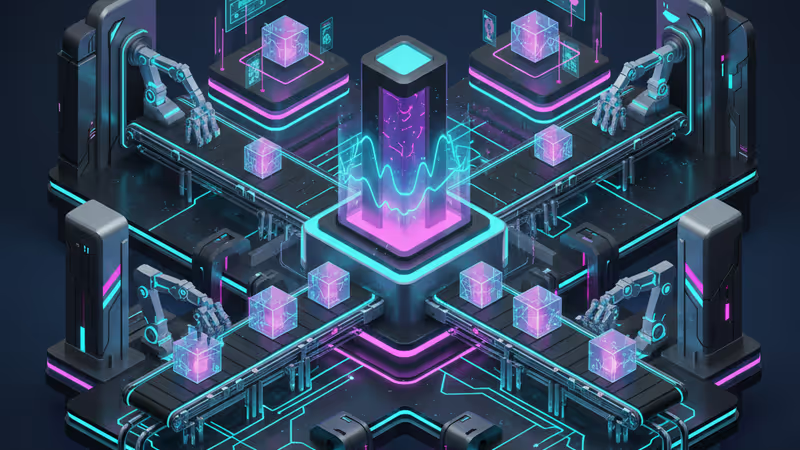
This platform approach solves the central dilemma of enterprise GenAI: how to unlock innovation without unleashing chaos. By providing pre-approved data connectors, standardized components, and embedded audit trails, Eliza allows a business analyst in risk management to build a compliance-checking agent with the same ease as a developer, but without the risk of exposing sensitive client data. It's an assembly line for AI, transforming the bank from a consumer of technology into a producer of intelligent automation.
The Citizen Developer Tsunami in a High-Stakes World
The concept of the 'citizen developer'—empowering non-technical staff with low-code tools—has been an IT trend for years. However, its application in highly regulated industries like finance has been limited by risk. Generative AI changes this dynamic. Instead of writing complex code, employees can use natural language to define tasks, processes, and workflows for AI agents.
This is the Excel macro revolution on an exponential scale. Where a macro could automate a spreadsheet, a BNY employee can now build an agent that summarizes complex financial reporting, drafts client communications, or flags anomalies across thousands of documents. This isn't just about incremental efficiency; it's about creating new capabilities that were previously impossible at scale without a dedicated software development team.
- For Financial Institutions: Companies like BNY that invest in platform infrastructure are building a long-term defensible advantage. Their operational leverage will compound as thousands of employees continuously optimize their own workflows. Investors should scrutinize earnings calls for language around 'platforms' and 'AI scalability' versus 'pilot projects'.
- For The Tech Sector: The biggest winners are the foundational model providers like OpenAI, Microsoft Azure, Google Cloud, and Anthropic. Their strategy of providing powerful APIs to enterprise clients is validated. The losers may be the niche application-layer AI companies, as their functionality gets absorbed and replicated inside enterprise platforms like Eliza.
- For The Labor Market: This signals a massive, impending need for reskilling. Pure domain expertise is no longer enough. The fusion of business knowledge with 'AI agent-building' skills will become the new power-law for career progression in corporate environments.
PRISM's Take
BNY Mellon's enterprise-wide AI initiative is a declaration that the experimental phase of generative AI in business is over. The competitive frontier has moved from isolated proofs-of-concept to the strategic challenge of building 'AI agent factories'. This is not a technology story; it's a story about organizational structure, competitive strategy, and the reinvention of corporate productivity. For Wall Street and every other knowledge-based industry, the race to build their own 'Eliza' has officially begun.
Authors
Related Articles

OpenAI has reorganized for the second time in a month, merging ChatGPT and Codex into a single agentic platform under president Greg Brockman's unified product leadership.
After two weeks of witnesses calling him a liar, OpenAI CEO Sam Altman testified in his own defense, claiming Elon Musk tried to kill the company twice.

Sam Nelson, 19, died after following ChatGPT's advice to mix Kratom and Xanax. His parents are suing OpenAI for wrongful death, raising urgent questions about AI trust, liability, and design.

OpenAI's new Daybreak initiative uses the Codex AI agent to find and patch security vulnerabilities before attackers do—putting it in direct competition with Anthropic's secretive Claude Mythos.
OpenAI has reorganized for the second time in a month, merging ChatGPT and Codex into a single agentic platform under president Greg Brockman's unified product leadership.
After two weeks of witnesses calling him a liar, OpenAI CEO Sam Altman testified in his own defense, claiming Elon Musk tried to kill the company twice.
Sam Nelson, 19, died after following ChatGPT's advice to mix Kratom and Xanax. His parents are suing OpenAI for wrongful death, raising urgent questions about AI trust, liability, and design.
OpenAI's new Daybreak initiative uses the Codex AI agent to find and patch security vulnerabilities before attackers do—putting it in direct competition with Anthropic's secretive Claude Mythos.
Thoughts
Share your thoughts on this article
Sign in to join the conversation