
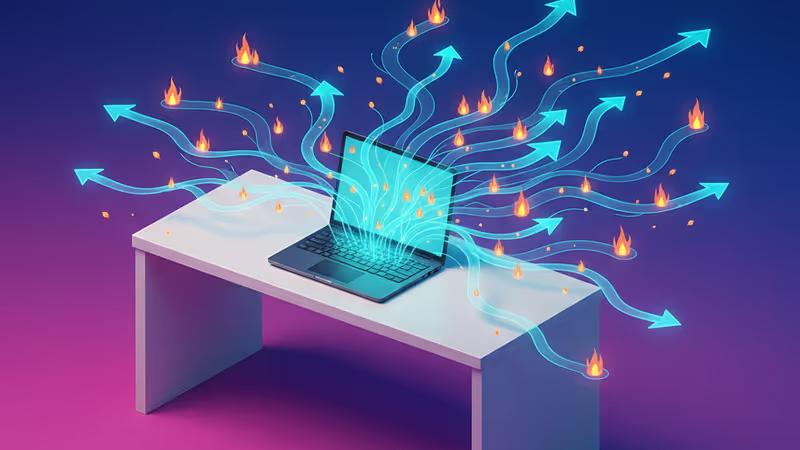
Beyond Burnout: The New Frontline in the War for Talent Is the Living Room
A viral Reddit story about a marital dispute over a work event reveals a critical new challenge for corporate leaders: the battle for employee commitment at home.
The Lede: A Micro-Drama Signals a Macro-Shift
A viral social media post about a marital dispute isn't typically on a CEO's radar. But a recent story—a primary breadwinner wife choosing a critical work event over a family function, leading her husband to threaten divorce—is more than just domestic drama. It's a data point from the new frontline in the war for talent: the household. This conflict reveals the dangerous collision between escalating corporate demands for loyalty and the fragile, evolving nature of modern domestic partnerships. For leaders, ignoring these signals is to misunderstand the fundamental pressures shaping your workforce's stability and commitment.
Why It Matters: The ROI of Domestic Stability
The traditional concept of work-life balance is obsolete. We are now in an era of work-life integration, and the seams are tearing. The second-order effects of these domestic conflicts have a direct impact on your bottom line:
- The New Resignation Driver: Employee burnout is well-documented, but we are now seeing the rise of "relationship burnout" as a direct consequence of professional pressure. When an employee's home life implodes, their productivity, engagement, and loyalty to the company follow. This is a critical, and often invisible, retention risk.
- Eroding Psychological Safety: An employee embroiled in a high-stakes domestic conflict over their job cannot bring their full, innovative self to work. The cognitive load from such stress decimates focus and creativity. The expectation to be "always on" for the company is creating an "always off" partner at home, a fundamentally unsustainable equation.
- The Gender Dynamic Amplified: In this case, the woman is the breadwinner. This flips traditional scripts and adds a complex layer to the conflict. Companies that champion female leadership but fail to acknowledge the unique socio-economic pressures they face outside the office are engaging in performative support. The husband's reaction highlights a societal lag in adapting to female economic power, a friction point that corporations must now navigate.
The Analysis: The Collapse of Old Contracts
For decades, the corporate world operated on an implicit understanding based on the single-income household model: the company demanded loyalty from its employee, and a support system (typically a spouse) managed the domestic sphere. That model is broken. Today's high-value employee is often part of a dual-career partnership or, as in this case, is the primary earner, completely upending the old contract.
The husband's ultimatum isn't just about a missed party; it's a panicked reaction to a perceived loss of status and a breakdown in the unwritten rules of the relationship. He feels his role is being usurped not by another person, but by her corporate identity. This Reddit post is a microcosm of a global workforce struggling to write new rules for love, labor, and loyalty without a playbook. Companies continue to design events, travel schedules, and career paths based on an outdated domestic reality, creating inevitable, explosive collisions in their employees' homes.
PRISM Insight: The Rise of Relationship-as-a-Service (RaaS) Tech
The next frontier for HR and wellness technology isn't just about mental health apps or meditation sessions; it's about actively supporting the domestic infrastructure of employees. We're seeing the nascent stages of a new tech category aimed at mitigating this friction:
- Integrated Calendaring Platforms: Beyond Google Calendar, think AI-powered schedulers that negotiate between corporate, family, and personal commitments, flagging potential conflicts and suggesting compromises before they become relationship-ending arguments.
- Next-Gen EAPs: Employee Assistance Programs are expanding to offer subsidized or free access to couples counseling, financial planning for non-traditional households, and conflict resolution services. Companies like Modern Health are already broadening the definition of mental wellness.
- The "Third Space" as a Service: With remote work blurring lines, the need for neutral, productive spaces is paramount. While WeWork targeted the individual, future platforms will target the "work-life unit," offering integrated solutions for childcare, elder care, and domestic logistics as a corporate benefit.
The smart investment is in technology that de-risks an employee's personal life, recognizing it as a mission-critical dependency for their professional output.
PRISM's Take: Redesign for Reality
This viral story is a warning flare. The executive mindset that sees an employee's personal life as an externality is dangerously obsolete. The most competitive companies of the next decade will be those that move from demanding loyalty to earning it by designing a workplace culture that strengthens, rather than cannibalizes, its employees' domestic lives.
This means rethinking everything from the timing of mandatory events to promotion criteria that implicitly penalize those with significant family commitments. The question for leaders is no longer "How do we get the most out of our people?" but "How do we build a corporate structure that allows our people, and their relationships, to thrive?" The company that solves for the living room wins the war for talent in the boardroom.
Related Articles
Beyond cute photos, the independent nature of cats offers a powerful blueprint for the future of AI, UX design, and low-overhead business models. Analysis for leaders.
Beyond viral fluff: Discover why authentic employee photos are a powerful, untapped asset for employer branding, talent acquisition, and corporate strategy.
Discover how the simple act of peeling a banana reveals the hidden cognitive friction and behavioral debt crippling your organization's productivity and innovation.
Beyond the meme: How the 'chaotic good' alignment is becoming a key strategy for disruption, brand loyalty, and even ethical AI design.