
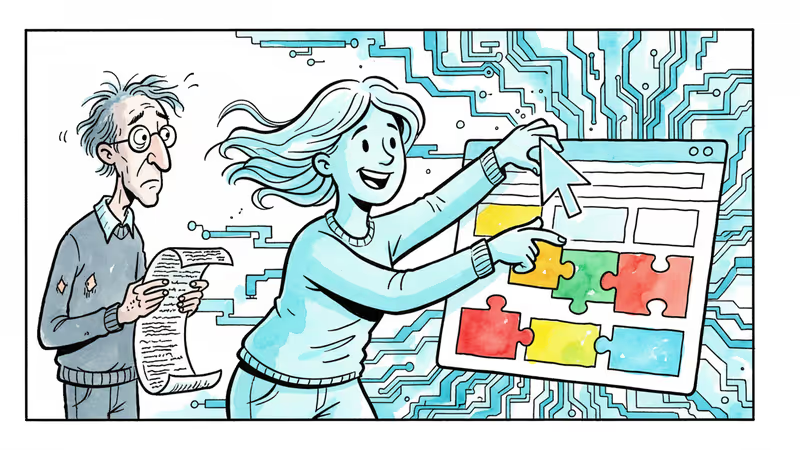
Website Builders Hit Their Stride: The End of Coding Barriers
2026 website builder landscape analysis. From Squarespace to Hostinger, which platform serves small business owners and entrepreneurs best?
Building a professional website for $276 a year would have sounded like a fantasy a decade ago. Back then, small business owners faced a stark choice: shell out thousands to web developers or settle for amateur-looking DIY attempts. Today's website builders have eliminated that dilemma entirely, transforming web creation from a technical hurdle into a creative playground.
The Big Four Reshape the Market
Squarespace continues to dominate the middle ground with its $276 annual Core plan. The platform's recent AI push includes Blueprint, an AI design tool, and Squarespace GPT, which builds websites through chat conversations. While these features can sometimes produce overly ambitious results, they excel at turning vague ideas into concrete designs. The real strength lies in Squarespace's fluid interface—within an hour, users can set up course pages, appointment scheduling, and payment processing without touching code.
Hostinger disrupts from the budget end with its $54 Business plan. This isn't just cheap hosting with a website builder tacked on—it's a surprisingly robust platform with PayPal, Stripe, and Square integrations, plus Printful support for print-on-demand merchandise. The catch? Some AI features require additional credits, though you'll still save significantly compared to premium alternatives.
Wix flexes its muscle with 2,000+ templates and hundreds of plugins, positioning itself as the power user's choice at $348 annually. The new Harmony AI builder can generate multi-page websites from text descriptions, though the $29 monthly minimum makes it pricier than competitors.
Strikingly stands alone in offering a genuinely useful free tier—500MB storage, 5GB monthly bandwidth, and even single-product e-commerce with 5% transaction fees.
The Small Business Revolution

This shift matters most for the 33 million small businesses in the US that previously couldn't justify professional web development costs. The pandemic accelerated online adoption, but many entrepreneurs remained locked out by technical barriers and expense.
Website builders now offer enterprise-level features at consumer prices. Automated email marketing, inventory management, appointment booking, and payment processing—capabilities that once required multiple software subscriptions—come bundled in single platforms.
The impact extends beyond cost savings. Speed matters in business, and launching a professional website in hours rather than weeks can mean the difference between capturing market opportunities and watching them slip away.
The Democratization Dilemma
Website builders represent technology democratization at its finest. Complex web development becomes accessible to anyone willing to spend an afternoon learning drag-and-drop interfaces. AI features further level the playing field, helping design-challenged entrepreneurs create visually appealing sites.
But democratization carries consequences. The web development industry faces disruption as simple website projects migrate to DIY platforms. Developers must pivot toward complex applications and custom solutions that builders can't handle.
There's also the homogenization risk. When thousands of businesses use identical templates, differentiation becomes harder. AI-generated designs, while improving rapidly, tend toward similar aesthetic patterns that could create a sea of look-alike websites.
The regulatory landscape adds another layer of complexity. As website builders handle more sensitive business functions—payment processing, customer data, marketing automation—they face increasing scrutiny over privacy, security, and compliance obligations.
Authors
Related Articles
DocuSign CEO Allan Thygesen reveals how 7,000 employees are transforming electronic signatures into AI-powered contract intelligence, and why the biggest opportunity lies beyond just getting documents signed.

Five stories from late September, traced to where the paper trail stops: Korea's export record, Nvidia's Hugging Face 8-K, a US-China AI channel, the UN on AI, and rising births.

Huawei's CANN is open source under a license barring software for non-Ascend chips. Inside China's second CUDA, and the two links still outside it: pre-training compute and 5nm capacity.
Samsung Electronics' union branch revealed that 84% of survey respondents oppose the government's roughly $290 billion (₩400 trillion) semiconductor megaproject in Gwangju. Government, management, the union and shareholders are all reading the same national project in sharply different ways.
DocuSign CEO Allan Thygesen reveals how 7,000 employees are transforming electronic signatures into AI-powered contract intelligence, and why the biggest opportunity lies beyond just getting documents signed.
Five stories from late September, traced to where the paper trail stops: Korea's export record, Nvidia's Hugging Face 8-K, a US-China AI channel, the UN on AI, and rising births.
Huawei's CANN is open source under a license barring software for non-Ascend chips. Inside China's second CUDA, and the two links still outside it: pre-training compute and 5nm capacity.
Samsung Electronics' union branch revealed that 84% of survey respondents oppose the government's roughly $290 billion (₩400 trillion) semiconductor megaproject in Gwangju. Government, management, the union and shareholders are all reading the same national project in sharply different ways.
Thoughts
Share your thoughts on this article
Sign in to join the conversation