
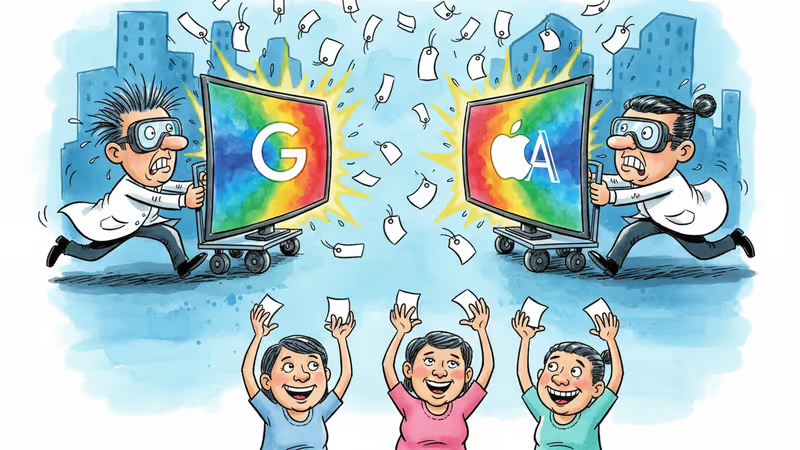
OLED TVs Hit Sweet Spot as Samsung and LG Battle Transforms Market
2026's OLED TV market sees Samsung's QD-OLED clash with LG's 4-stack panels, bringing premium picture quality to mainstream prices. How this tech war changes everything for consumers and the display industry.
$1,000 for a 65-inch OLED TV. Just a few years ago, that price would've been laughable—premium OLED displays routinely commanded $3,000 or more. Today, it's reality, and it's reshaping how we think about home entertainment.
The Tech War That Changed Everything
LG's latest G5 model showcases breakthrough four-stack panel technology, layering multiple color elements to achieve brightness levels that rival traditional LED displays while maintaining OLED's signature perfect blacks. The result? A searing 4K@165Hz experience that stops you mid-scroll through Netflix.
Meanwhile, Samsung doubles down on QD-OLED technology with the S90F, prioritizing color accuracy and natural reproduction over peak brightness wars. While it skips Dolby Vision support, the 4K@144Hz gaming performance and comprehensive Tizen smart system create a compelling alternative approach.
This isn't just incremental improvement—it's a fundamental shift in what OLED can deliver. The contrast between perfect blacks and white-hot highlights creates visual impact that traditional LED displays simply can't match, even with mini-LED backlighting and quantum dot enhancements.
Burn-In Fears Fade Away
OLED's historical Achilles' heel—burn-in susceptibility—has largely become a non-issue for mainstream users. Modern panels incorporate screen savers, static image detection, and hardware-level image retention correction. Unless you're gaming 12+ hours daily with static HUDs, burn-in concerns are mostly theoretical.

Even budget-friendly options like LG's B5 series deliver comprehensive HDMI 2.1 support across all four ports, ensuring VRR and ALLM gaming features work regardless of which input you use. The democratization of premium features means you're not sacrificing functionality for affordability.
Market Implications Beyond Pretty Pictures
This OLED evolution reflects broader shifts in consumer electronics. As streaming services invest heavily in HDR content and gaming consoles push higher frame rates, display technology has become the bottleneck in home entertainment experiences.
The price compression also pressures traditional LED manufacturers. TCL and Hisense built their strategies around offering "good enough" picture quality at aggressive prices. When OLED drops to $1,000, that value proposition gets complicated.
For consumers, the calculation has shifted. Instead of choosing between picture quality and price, you're now choosing between different approaches to premium performance. Do you want Samsung's color accuracy or LG's peak brightness? Gaming-focused features or streaming optimization?
The Bright Room Problem Solved
Historically, OLED struggled in bright environments—perfect blacks meant little when ambient light washed out the screen. The latest generation changes that equation. Advanced anti-glare coatings and significantly higher peak brightness make OLED viable in spaces that would've been LED-only territory just two years ago.
This opens OLED to suburban living rooms with large windows, apartments with unavoidable light sources, and commercial spaces where ambient lighting can't be controlled. The addressable market expands dramatically when environmental constraints disappear.
Authors
Related Articles

Samsung and SK unveiled a chip and AI investment package worth thousands of trillions of won on June 29. The headline number swings wildly by outlet, but the real contest isn't capital — it's water and power.
40,000 Samsung union workers rallied at its Pyeongtaek chip plant, threatening an 18-day strike over wages. With AI-driven RAM shortages already lifting consumer prices, the timing couldn't be worse.

Memory makers can't build fabs fast enough. By end of 2027, supply will cover just 60% of demand. Here's why the shortage could last until 2030—and what it means for AI, your devices, and the chip industry.

Samsung's Galaxy S26 now supports AirDrop through Quick Share, making cross-platform file sharing seamless. What does it mean when Android starts dismantling one of Apple's most beloved moats?
Samsung and SK unveiled a chip and AI investment package worth thousands of trillions of won on June 29. The headline number swings wildly by outlet, but the real contest isn't capital — it's water and power.
40,000 Samsung union workers rallied at its Pyeongtaek chip plant, threatening an 18-day strike over wages. With AI-driven RAM shortages already lifting consumer prices, the timing couldn't be worse.
Memory makers can't build fabs fast enough. By end of 2027, supply will cover just 60% of demand. Here's why the shortage could last until 2030—and what it means for AI, your devices, and the chip industry.
Samsung's Galaxy S26 now supports AirDrop through Quick Share, making cross-platform file sharing seamless. What does it mean when Android starts dismantling one of Apple's most beloved moats?
Thoughts
Share your thoughts on this article
Sign in to join the conversation