
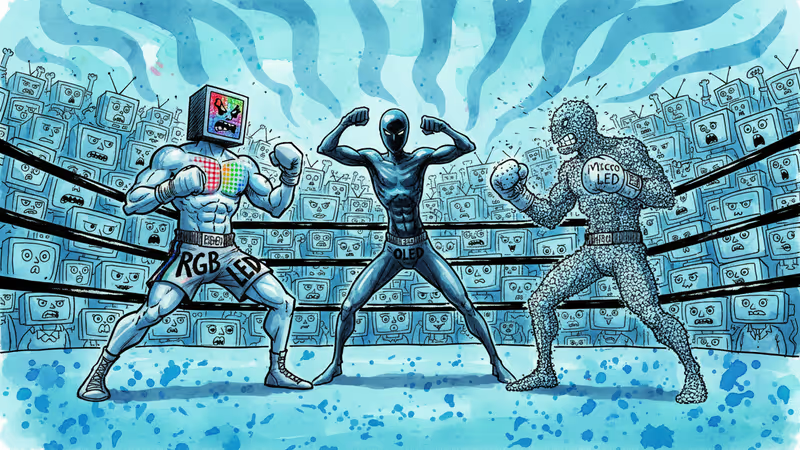
The Display Wars Heat Up: RGB LED Could Challenge OLED's Throne
Hisense and Sony unveil RGB LED TVs promising 10,000 nits brightness and superior color accuracy. Could this new tech reshape the premium display market dominated by OLED?
10,000 nits. That's the peak brightness Hisense claims for its new 116-inch RGB LED TV unveiled at CES 2025—roughly five times brighter than today's best OLED displays. But the real story isn't just about blinding brightness; it's about a fundamental shift in how TVs create the colors we see.
While the tech world has been obsessed with OLED's perfect blacks and micro-LED's theoretical perfection, a quieter revolution has been brewing. RGB LED technology promises to deliver the brightness advantages of traditional LED TVs while matching—and potentially exceeding—OLED's color accuracy and contrast performance.
The Color Revolution Behind the Brightness
Traditional LED TVs work like a flashlight shining through colored glass. They produce white or blue light, then filter it through layers to create colors—an inherently inefficient process that leads to light spillage and washed-out contrast. Even the best models with thousands of dimming zones can't eliminate the telltale "haloing" around bright objects on dark backgrounds.
RGB LED flips this approach entirely. Instead of filtering white light, these displays use thousands of individual red, green, and blue LED modules to produce what Hisense calls "pure colors directly at the source." The result? Hisense claims its UX Trichroma TV can reproduce 97 percent of the BT.2020 color space—the most expansive display standard available.
Sony, not to be outdone, revealed its own RGB LED prototype in Tokyo with similar ambitions. The company promises "faithful reproduction of delicate hues and subtle gradations of light" while achieving what they claim is "challenging for existing OLED panels: the expression of colors with moderate brightness and saturation."
During brief demonstrations at both CES and Sony's Tokyo labs, the advantages were immediately apparent. Colors appeared more saturated and accurate than comparable OLED displays, while maintaining the deep blacks that have made OLED the gold standard for premium TVs.
OLED's Brightness Ceiling
For all its picture quality dominance, OLED has one persistent weakness: brightness. Today's flagship OLED TVs from Samsung, LG, and Panasonic can reach nearly 2,000 nits peak brightness—impressive by historical standards, but still limited compared to premium LED displays that routinely exceed 4,000 nits.

This brightness gap matters more than it might seem. As content creators gain access to tools like Sony's HX3110 master monitor, which supports up to 4,000 nits mastering, the next generation of HDR content will demand displays capable of reproducing those extreme highlights—think sunlight reflecting off water or car headlights at night.
RGB LED's 10,000 nits peak brightness provides substantial headroom for this content evolution while maintaining high average picture levels across the entire screen. Traditional LED TVs might hit similar peak numbers, but they can't sustain high brightness across larger portions of the image without compromising contrast.
The brightness advantage extends beyond future-proofing. As Sony engineer Hugo Gaggioni explains, properly controlled brightness "becomes a new color accuracy weapon." Higher brightness capabilities allow for more precise color reproduction, especially in mixed lighting conditions where both bright and dark elements coexist.
The Micro-LED Reality Check
Theoretically, micro-LED should be the ultimate display technology. Like OLED, each pixel can turn on or off individually for perfect contrast. Unlike OLED, it doesn't use organic compounds that degrade over time, eliminating burn-in concerns while achieving extreme brightness levels.
But theory and practice remain worlds apart. Micro-LED's manufacturing complexity—requiring millions of individually placed microscopic LEDs—has kept it prohibitively expensive. Samsung's consumer micro-LED TVs start at six-figure price points, while Apple abandoned the technology for the Apple Watch due to production challenges.
Even Hisense's impressive 136-inch micro-LED display at CES 2025 revealed the technology's current limitations. Up close, visible gaps between modular panels disrupted the viewing experience—a reminder that manufacturing perfection remains elusive.
RGB LED sidesteps these production nightmares. It's significantly easier to manufacture than micro-LED while delivering many of the same benefits. The thousands of RGB LED clusters can't match micro-LED's pixel-level control, but they provide enough precision for dramatic improvements over traditional LED displays.
The Competitive Landscape Shifts
Samsung has also entered the RGB LED race with its own "RGB MicroLED" prototype, though the company remains characteristically vague about technical details. "This breakthrough technology marks the future of display technology," claims Lydia Cho, Samsung's head of product for home entertainment, "showcasing the potential for even more color accuracy and vibrancy."
The simultaneous emergence of RGB LED from multiple major manufacturers suggests this isn't experimental technology—it's a coordinated industry response to OLED's limitations and micro-LED's production challenges.
For consumers, this competition could accelerate innovation across all display types. OLED manufacturers will likely push brightness levels higher, while RGB LED producers will work to improve contrast and reduce costs. The display wars of 2025 and beyond promise to benefit everyone.
Authors
Related Articles

2026's OLED TV market sees Samsung's QD-OLED clash with LG's 4-stack panels, bringing premium picture quality to mainstream prices. How this tech war changes everything for consumers and the display industry.
Every TV manufacturer is suddenly pushing RGB LED TVs in 2026. But are they doing it for the right reasons, or just following trends?
How 8K TVs failed to gain market traction despite industry-wide support, revealing the gap between technological capability and consumer demand.

Nvidia is introducing new G-Sync Pulsar monitors that automatically adapt brightness and color temperature to ambient room lighting, providing a smarter viewing experience.
2026's OLED TV market sees Samsung's QD-OLED clash with LG's 4-stack panels, bringing premium picture quality to mainstream prices. How this tech war changes everything for consumers and the display industry.
Every TV manufacturer is suddenly pushing RGB LED TVs in 2026. But are they doing it for the right reasons, or just following trends?
How 8K TVs failed to gain market traction despite industry-wide support, revealing the gap between technological capability and consumer demand.
Nvidia is introducing new G-Sync Pulsar monitors that automatically adapt brightness and color temperature to ambient room lighting, providing a smarter viewing experience.
Thoughts
Share your thoughts on this article
Sign in to join the conversation