
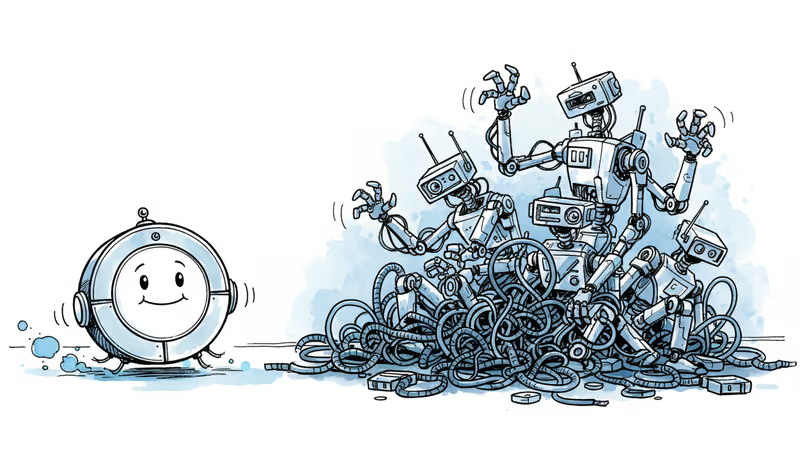
Robot Vacuums Are Getting Simpler—And That's Exactly What We Need
As robot vacuums add more AI features, budget models prove that sometimes less is more. Here's why simple cleaning bots might be the smarter choice for most homes.
While premium robot vacuums boast AI-powered cameras that distinguish popcorn from poop and robotic arms that pick up socks, a quiet revolution is happening in the budget segment. Simple cleaning bots are proving that sometimes, less technology means more value.
The latest budget robot vacuums, priced between $160 and $400, are delivering surprisingly sophisticated features without the complexity—or price tag—of their premium cousins. TP-Link's Tapo RV30 Max Plus, for instance, offers room-specific cleaning and lidar navigation for just $300, while Eufy's 11S Max deliberately avoids Wi-Fi connectivity entirely, appealing to users who want cleaning without the digital complexity.
The Sweet Spot of Smart Cleaning
Budget robot vacuums have found their sweet spot by focusing on core functionality rather than feature bloat. The Tapo RV30 Max Plus demonstrates this philosophy perfectly, combining 5,300Pa suction power with smart mapping and an auto-empty dock—features typically reserved for robots costing twice as much.
What makes these budget bots compelling isn't what they can do, but what they choose not to do. They skip AI-powered obstacle detection, assuming users can pick up their socks before cleaning. They forgo heated mop washing stations, betting that effective water distribution matters more than temperature. This trade-off approach has created a new category: capable robots for responsible users.
The Roborock Q10 S5 takes this concept further, offering 10,000Pa suction and vibrating mops while maintaining budget-friendly pricing. Its ability to automatically lift mops when transitioning to carpet shows how manufacturers are prioritizing practical intelligence over flashy AI features.
Why Simple Might Be Smarter

The appeal of basic robot vacuums extends beyond price. The Eufy 11S Max, which deliberately omits Wi-Fi connectivity, represents a growing counter-trend to the Internet of Things. At $160, it offers a 600ml dustbin and quiet operation without requiring app setup, software updates, or privacy concerns about home mapping data.
This approach resonates with users experiencing smart home fatigue. While premium robots promise to navigate around pet waste and identify specific objects, they also require constant software updates, troubleshooting connectivity issues, and managing increasingly complex mobile apps. Budget bots eliminate these friction points by returning to the original promise of robot vacuums: autonomous floor cleaning.
The Shark Navigator RV2120 exemplifies another budget advantage—repairability. Unlike many premium models with proprietary parts and sealed components, budget robots often feature replaceable batteries, wheels, and brushes. This extends their lifespan and reduces long-term ownership costs, making the initial savings even more significant.
The Hidden Costs of Complexity
Premium robot vacuums' advanced features come with hidden costs beyond the initial purchase price. AI-powered obstacle detection requires regular software updates and can malfunction, leaving expensive robots stranded. Self-washing mop stations need cleaning solution refills and maintenance. Voice integration adds another layer of potential technical issues.
Budget robots sidestep these complications through intentional simplicity. The trade-off is clear: users handle basic obstacle removal in exchange for reliable, straightforward operation. For many households, this division of labor makes more sense than paying premium prices for features that may not work consistently.
The battery life comparison is particularly telling. While the Tapo RV30 manages 100 minutes with its smaller battery, the Roborock Q10 S5 extends this to 150 minutes. Both require users to maintain clear floors, but neither promises the impossible task of navigating around every household obstacle autonomously.
Authors
Related Articles

Kohler's new recirculating smart shower system promises luxury and water conservation. But the price tag raises questions about who gets access to green tech.
Consumer advocacy group offers $10,000 to integrate Ring doorbells with local servers, bypassing Amazon's cloud entirely. Can smart home devices escape subscription dependency?
After Super Bowl ad backlash and AI surveillance features, Ring's founder explains himself. But the real issue isn't the ads—it's the technology itself.

Security researcher discovers DJI robot vacuum vulnerability allowing remote control and surveillance of thousands of devices globally
Kohler's new recirculating smart shower system promises luxury and water conservation. But the price tag raises questions about who gets access to green tech.
Consumer advocacy group offers $10,000 to integrate Ring doorbells with local servers, bypassing Amazon's cloud entirely. Can smart home devices escape subscription dependency?
After Super Bowl ad backlash and AI surveillance features, Ring's founder explains himself. But the real issue isn't the ads—it's the technology itself.
Security researcher discovers DJI robot vacuum vulnerability allowing remote control and surveillance of thousands of devices globally
Thoughts
Share your thoughts on this article
Sign in to join the conversation