
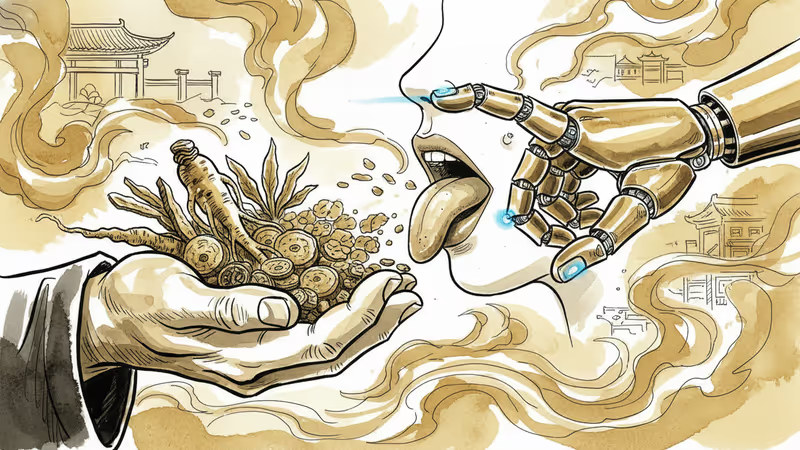
Ancient Wisdom Meets Silicon Valley: AI Transforms Traditional Chinese Medicine
As China pushes TCM globally with AI-powered diagnostics and robotic acupuncture, can technology bridge the gap between ancient wisdom and modern healthcare standards?
Walk into Que Tang Yu Fang in Nanjing, and you'll think you're ordering bubble tea. But before you get your drink, an AI system scans your tongue, measures your pulse, and assesses your yin, yang, and qi levels to create a custom blend. It's traditional Chinese medicine meeting Silicon Valley—and it's happening across China at unprecedented scale.
As generative AI transforms manufacturing, education, and automotive sectors in China, it's also revolutionizing TCM, a practice that treats over 1 billion people annually. The transformation goes far beyond novelty tea shops: AI now handles clinical diagnostics, robots perform acupuncture, and machine learning makes ancient medical texts accessible to a new generation.
The Scale of China's TCM-AI Push
The numbers tell the story of a government-backed revolution. Since 2012, China has launched nearly 30 major TCM policies, with funding hitting a record 22 billion yuan ($3 billion) in 2024. Over 1,200 research platforms have been established nationwide, using AI to analyze molecular compositions and map interactions between traditional remedies and modern pharmaceuticals.
"With this modern technology, TCM now has the chance to experience significant breakthroughs in treating patients, curing diseases, and discovering more accurate scientific explanations," Zhou Bin, deputy director of TCM at Pudong Gongli Hospital in Shanghai, told Rest of World. The goal is ambitious: making TCM as scientifically rigorous and globally accepted as Western medicine.
The timing isn't coincidental. China faces a practitioner shortage—just 0.75 TCM doctors per 10,000 people in 2022—while dealing with quality inconsistencies in remedies. AI promises to standardize diagnosis, automate routine procedures, and make expert knowledge accessible where human practitioners are scarce.
Going Global with Ancient Wisdom

China's TCM-AI strategy extends far beyond domestic healthcare. The government has established 30 overseas TCM centers and signed agreements with over 40 governments to promote the practice internationally. At the recent Consumer Electronics Show in Las Vegas, Link2Care's TCM-based smartwatches drew crowds, targeting health-conscious Western consumers who find standard fitness trackers insufficient.
"Our initial traction was in Asia, but we're rapidly expanding into Western markets, especially among the health-conscious tech community," says Tony Chung from Dayton Industrial. While Asia remains TCM's biggest market, North America is its fastest-growing, driven partly by social media influencers sharing their TCM experiences.
This expansion aligns with China's broader Health Silk Road strategy, launched in 2017 to strengthen the country's role as an international healthcare provider. TCM globalization represents both cultural diplomacy and economic opportunity, riding the wave of Chinese innovation gaining worldwide acceptance—from electric vehicles to social media platforms.
The Fundamental Challenge: Quantifying the Unquantifiable
But can AI truly capture the essence of a medical system built on abstract concepts like qi and holistic pattern recognition? The challenge runs deeper than translation. "Classical TCM texts are rich in knowledge but written in terse, era-specific language, making them difficult to interpret," explains Jinglin He, lead researcher at OpenTCM, an AI system built from 48,000 concepts extracted from classical medical texts.
"TCM diagnosis relies on context-specific information and integrating patterns in the constitution, emotions, and lifestyle," notes Lam Lai-Kwan, a postdoctoral fellow at the Chinese University of Hong Kong. "These elements are hard to capture reliably, and even harder to interpret without flattening the clinical meaning."
The standardization required for AI risks oversimplifying TCM's nuanced approach. Practitioners like Zhou acknowledge that while AI handles routine procedures well, "highly individualized cases with significant variability could prove challenging for its capabilities."
Even patients remain skeptical. Xinmin Han, a longtime TCM user in Suzhou, tried AI tongue diagnosis but isn't convinced: "I still prefer seeing a real doctor—someone who can check my pulse, look at my complexion, and evaluate me in a more holistic way."
Authors
Related Articles
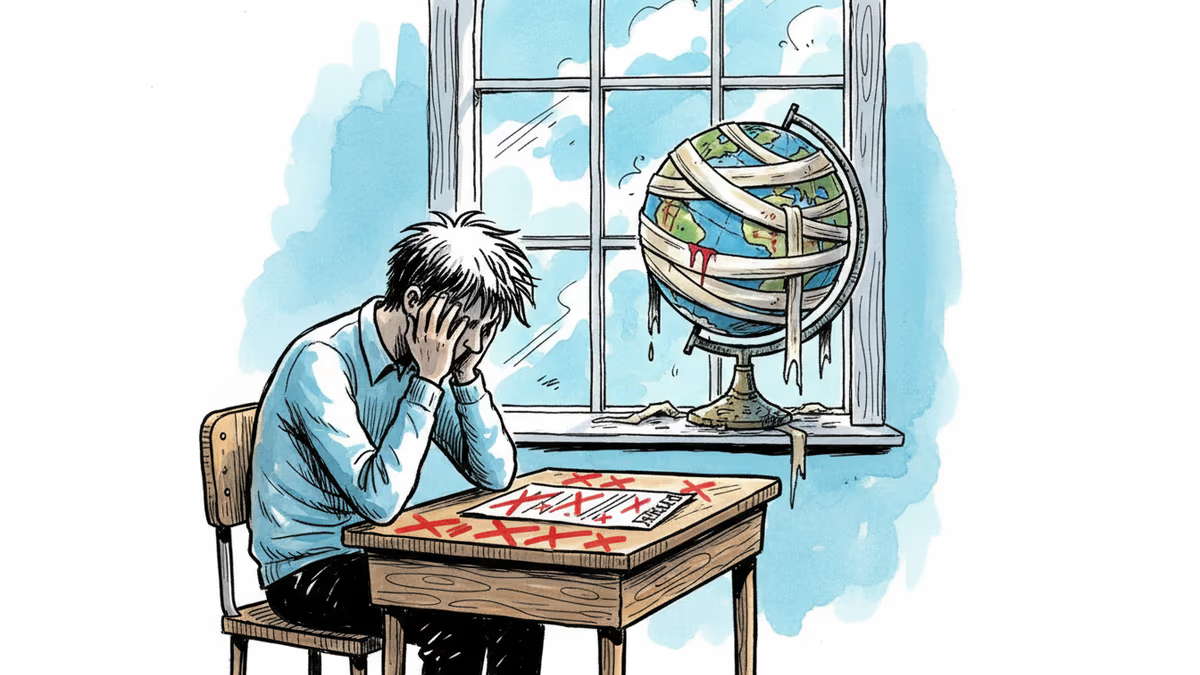
WHO's 2026 global health statistics report shows HIV, tuberculosis, and malaria targets are badly off track. What went wrong—and what does it mean for 2030?
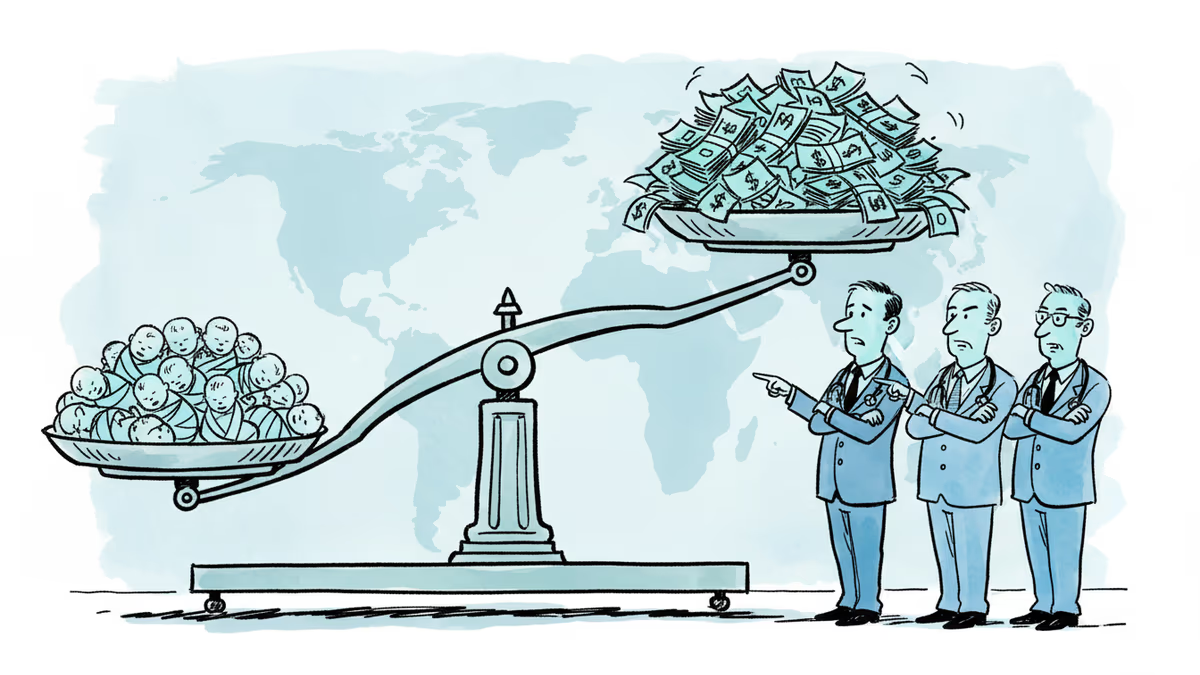
WHO condemns US-funded vaccine trial as unethical for withholding proven hepatitis B vaccines from African newborns. What happens when anti-vaccine politics drives medical research?
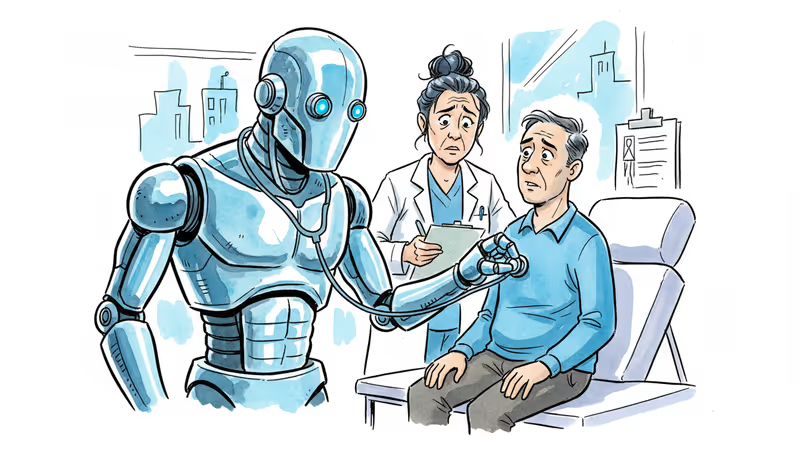
Lotus Health AI raises $35M to build an AI-powered primary care practice. As AI handles medical decisions, what happens to the doctor-patient relationship?
230 million people are using AI for health queries as OpenAI officially launches ChatGPT Health. Meanwhile, the US faces a massive battle over AI regulation 2026.
WHO's 2026 global health statistics report shows HIV, tuberculosis, and malaria targets are badly off track. What went wrong—and what does it mean for 2030?
WHO condemns US-funded vaccine trial as unethical for withholding proven hepatitis B vaccines from African newborns. What happens when anti-vaccine politics drives medical research?
Lotus Health AI raises $35M to build an AI-powered primary care practice. As AI handles medical decisions, what happens to the doctor-patient relationship?
230 million people are using AI for health queries as OpenAI officially launches ChatGPT Health. Meanwhile, the US faces a massive battle over AI regulation 2026.
Thoughts
Share your thoughts on this article
Sign in to join the conversation