
Barbara Walters Was Wrong About the Kardashians
In 2011, Barbara Walters told the Kardashians they had no talent. Fourteen years later, that verdict looks less like an insult and more like a misreading of what talent now means.
"You don't have any—forgive me—any talent." In 2011, Barbara Walters said this to four members of the Kardashian family, live on television, while ostensibly paying them a compliment. She had just placed them on her annual "10 Most Fascinating People" list. Then she handed them the award and the invoice at the same time.
Khloé Kardashian didn't flinch. "But we're still entertaining people." Kim followed: "Do you know how hard it is to make people fall in love with you for being you?"
Their composure, in retrospect, was the whole argument. Walters was wrong—not because the Kardashians secretly possess conventional talent, but because she was measuring them against a definition of talent that was already expiring.
What Walters Missed
Keeping Up With the Kardashians premiered in 2007 to a particular kind of contempt. Critics noted, correctly, that the show followed wealthy, attractive people in their pursuit of becoming wealthier and more attractive. The fact that viewers kept watching seemed, to detractors, like an indictment of the viewers themselves. The show became a cultural Rorschach test: what you thought of the Kardashians said something about what you thought of America.
The show ran for 20 seasons. It ended in 2021 not with a whimper but with a pivot—to Hulu, to new formats, to a family enterprise that had long outgrown the television that made it. By then, Kim Kardashian's shapewear brand Skims carried a valuation of $5 billion. Kylie Jenner had sold more than half of her cosmetics company in 2019 for $600 million. The family had become, in the language of business, a conglomerate.
Psychotherapist and author MJ Corey, in her new book Dekonstructing the Kardashians, argues that the family's rise is not despite their lack of conventional talent but because of their early, instinctive grasp of how talent was being redefined. In the attention economy, she writes, the Kardashians understood something fundamental before most institutions did: eyeballs are the asset, and everything else is secondary.
The physical products—the shapewear, the cosmetics, the diet supplements—are, in this reading, almost incidental. They are extensions of an image, not the source of one. The Kardashians don't sell things that happen to be associated with their brand. They sell their brand, and the things are just proof of concept.

The Meritocracy Problem
The deeper reason the Kardashians provoke such persistent irritation has less to do with aesthetics than with ideology. Their success challenges one of American culture's most durable myths: that markets are moral, that talent is rewarded, that hard work gets its due. This is the meritocracy story, and it is also, as the Kardashians demonstrate, a story.
The family was born into wealth—their father, Robert Kardashian, was a prominent attorney; their mother, Kris Jenner, a skilled manager of social capital. Their first significant public exposure came via a sex tape, not a talent showcase. And yet they built something that employs not just the traditional Hollywood retinue of agents and assistants, but personal marketing departments, legal teams, and brand consultants. They are, as Corey puts it, "apex predators" of a stratified media environment—ones who rose not by preying on others, but by proving their willingness to be consumed.
This is what Cosmopolitan was pointing at in 2015 when it called them "America's First Family." Unelected, they shape language, beauty standards, and consumer behavior at a scale that most elected officials cannot. When Walters questioned their talent, she was really questioning the legitimacy of their power. The Kardashians, in their placid response, were suggesting that legitimacy, like talent, is whatever the market decides it is.
Corey draws on Roland Barthes' theory that images are collectively authored—meaning is made not by the producer but by the audience. The Kardashians, on this reading, are less people than texts. They say almost nothing and could therefore mean almost anything. Their opacity is a feature, not a bug. Confusion, on Instagram, functions as engagement.
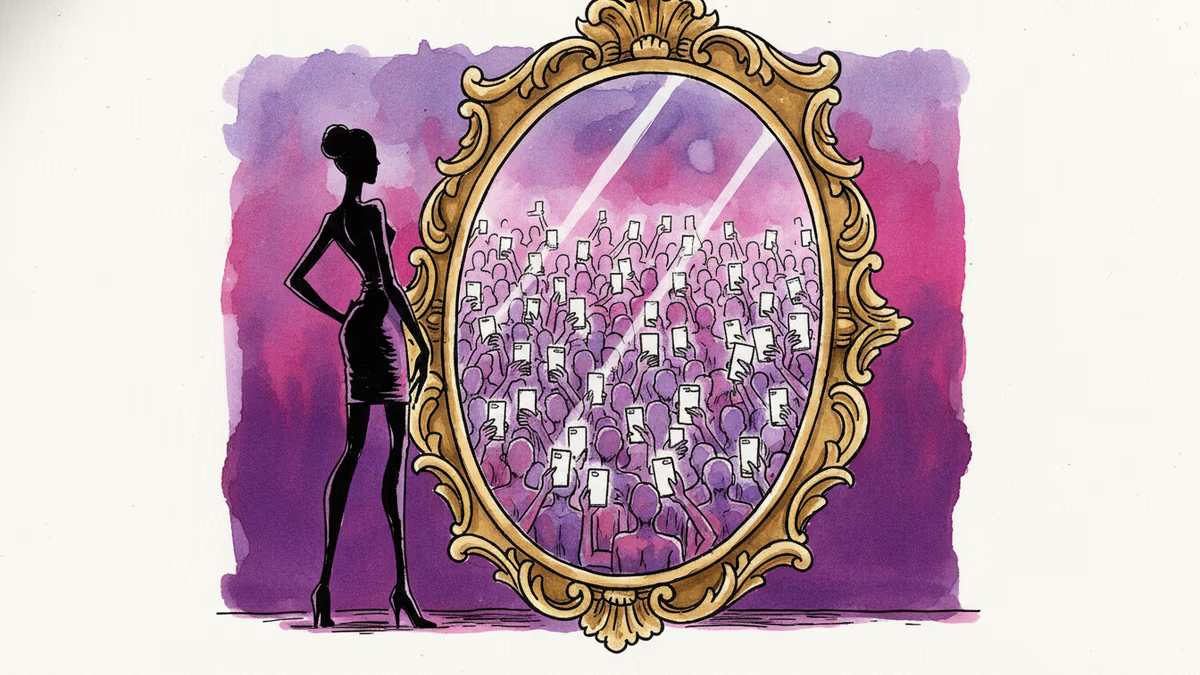
Mirrors, Not Windows
What makes Corey's book worth reading is that it resists the two most common responses to the Kardashians: uncritical celebration and reflexive dismissal. Instead, she uses the family as a lens. The question she's actually asking is not "who are the Kardashians?" but "what does a culture look like when it elevates them?"
The answer is not flattering, but it is clarifying. Societies need shared myths, shared icons, shared lore. The Kardashians provide all three, reliably and at scale. They are, as Corey argues, hyperreal in the way that Las Vegas and Disneyland are hyperreal—fantastical and aspirational and kitsch, all at once. They are fun-house mirrors: their cosmetically enhanced curves reflecting us back to ourselves both as we are and as we might, in our more susceptible moments, hope to be.
The family's willingness to expose everything—the precise make of Kylie's breast implants, the diet Kim used to drop a reported 16 pounds in three weeks, the plastic surgeon who performed Kris's facelift—while revealing, in any meaningful sense, almost nothing, is the central paradox of their appeal. Transparency and opacity, deployed simultaneously. Intimacy as a product.
This is not unique to the Kardashians. It is the grammar of contemporary influencer culture, written large. What the family did was get there first, get there biggest, and refuse to apologize for it—which, in a media environment that rewards confidence and punishes hesitation, turned out to be a competitive advantage.
This content is AI-generated based on source articles. While we strive for accuracy, errors may occur. We recommend verifying with the original source.
Related Articles

Science writer David Epstein found unexpected happiness after a head injury forced him to do one thing at a time. What his experience reveals about the attention economy and why focus has become so rare.
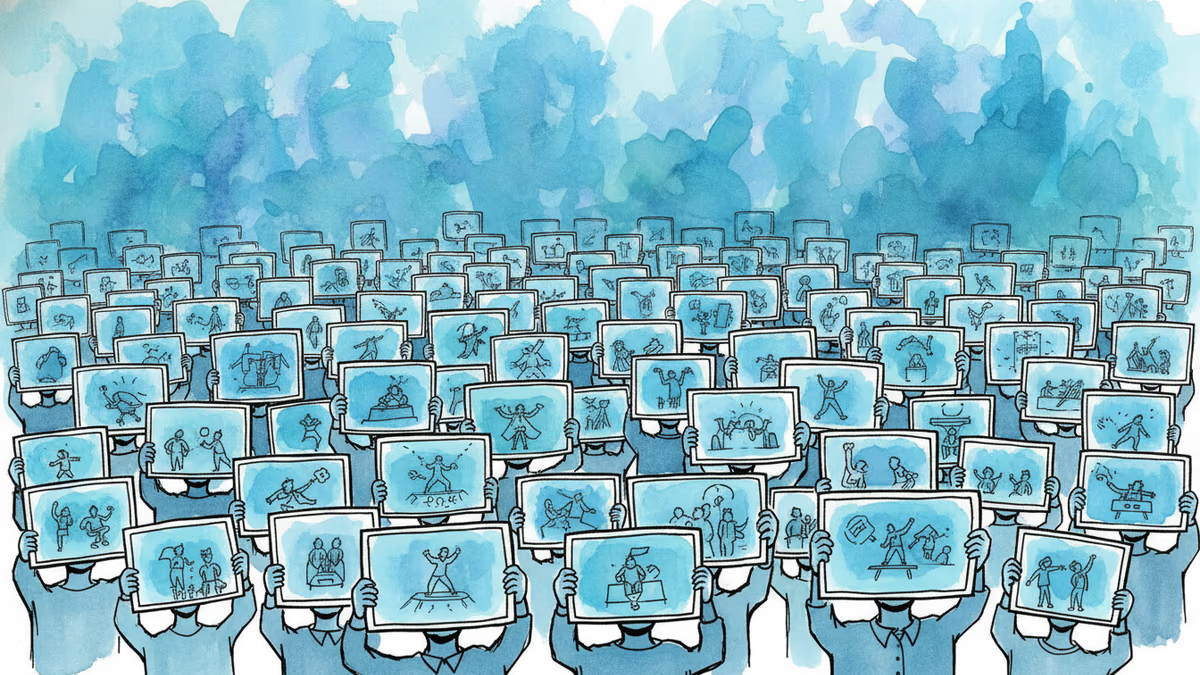
Megan Garber's new book Screen People argues that internet culture has trained us to see each other as characters in an endless show—and that this is making us sick.

Robyn's first album in eight years, Sexistential, arrives loud, messy, and unapologetically middle-aged. What does it say about the Millennials who made her an icon—and who are now facing the same questions she is?

Adult ADHD diagnoses are surging, fueled by social media awareness. But between viral videos and clinical reality, what are we missing?
Science writer David Epstein found unexpected happiness after a head injury forced him to do one thing at a time. What his experience reveals about the attention economy and why focus has become so rare.
Megan Garber's new book Screen People argues that internet culture has trained us to see each other as characters in an endless show—and that this is making us sick.
Robyn's first album in eight years, Sexistential, arrives loud, messy, and unapologetically middle-aged. What does it say about the Millennials who made her an icon—and who are now facing the same questions she is?
Adult ADHD diagnoses are surging, fueled by social media awareness. But between viral videos and clinical reality, what are we missing?
Thoughts
Share your thoughts on this article
Sign in to join the conversation