

AWS Bets $99/Month Can Automate Away Healthcare's Paperwork Problem
Amazon launches AI agent platform for healthcare that automates admin tasks for $99/month per provider. Can this crack the $5 trillion healthcare market?
$99 a Month to Replace Medical Assistants
That's Amazon's pitch with Amazon Connect Health, launched Thursday. For the cost of a premium software subscription, healthcare providers get an AI agent that handles patient verification, appointment scheduling, and clinical documentation. It's HIPAA-compliant, integrates with existing electronic health records, and covers up to 600 patient encounters monthly—double what most primary care physicians see.
The pricing isn't accidental. It's positioned just below what many practices pay for human administrative staff, but with 24/7 availability and zero sick days.
Doctors: "Finally" vs. Hospital CFOs: "Another Subscription?"
The healthcare industry's response splits predictably along job function lines.
Front-line physicians are cautiously optimistic. Dr. Sarah Chen, a family medicine practitioner in Seattle, tells us: "If this thing can actually handle prior authorizations and insurance verification, it'll save me 2-3 hours daily. That's time I can spend with patients instead of fighting with paperwork."
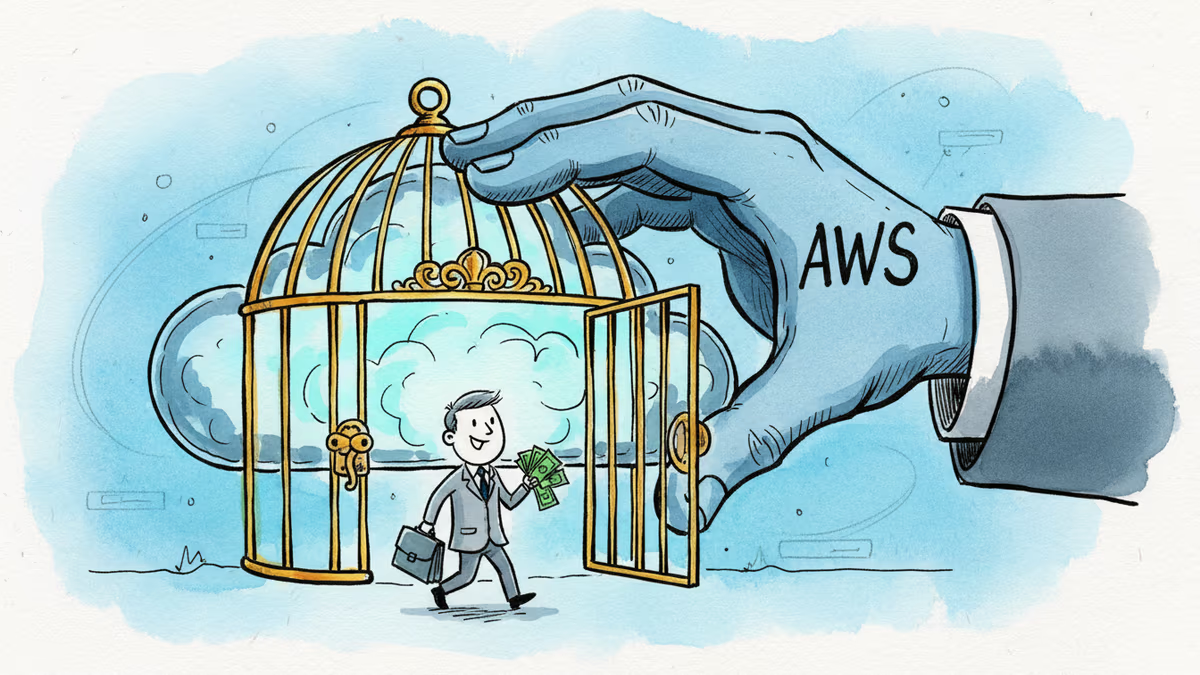
But hospital administrators see different math. Connect Health adds another monthly expense to already-strained budgets. Smaller practices worry about vendor lock-in—what happens when Amazon decides to raise prices after everyone's dependent?
Patients occupy the middle ground. Faster appointment scheduling and reduced wait times sound appealing, but handing medical data to the company that "knows what you bought before you do" raises privacy red flags.
Amazon's $5 Trillion Healthcare Gambit

This launch represents a strategic pivot for Amazon's healthcare ambitions. After spending $4.9 billion acquiring PillPack and One Medical, the company initially tried to become a healthcare provider itself. Connect Health signals a different approach: becoming the infrastructure that powers everyone else's healthcare delivery.
The timing is telling. OpenAI launched ChatGPT Health in January, followed by Anthropic'sClaude for Healthcare a week later. Amazon waited, watched, then entered with a more targeted, regulation-compliant offering. While competitors focused on consumer-facing chatbots, Amazon built tools for the people actually running healthcare systems.
Connect Health also completes a healthcare technology stack Amazon has been building since 2018: Comprehend Medical for data analysis, HealthLake for storage, HealthOmics for research workflows, and now Connect Health for daily operations.
The Real Competition Isn't Other Tech Giants
Startups like Regard and Notable have been automating healthcare admin tasks since 2017, before the current AI boom. They've proven the market exists and identified the pain points. Amazon's advantage isn't technological—it's operational scale and regulatory compliance infrastructure.
The question isn't whether AI can handle these tasks (it can), but whether healthcare organizations will trust Amazon with their most sensitive data. Epic Systems, which powers medical records for 60% of U.S. patients, has been notably quiet about potential partnerships.
Meanwhile, established healthcare IT companies face a classic innovator's dilemma: cannibalize their existing products or watch Amazon do it for them.
The Unspoken Healthcare Labor Question
Connect Health's $99 monthly cost reveals an uncomfortable truth about healthcare economics. If AI can handle administrative tasks for less than minimum wage, what happens to the thousands of medical assistants, schedulers, and clerks currently doing this work?
Amazon frames this as "reducing physician burnout," but the real impact may be accelerating healthcare's shift toward a two-tier system: high-touch, human-centered care for those who can afford it, and increasingly automated care for everyone else.
Authors
Related Articles

Snowflake's new $6 billion AWS contract is about more than cloud spending. It signals a shift in AI infrastructure—away from Nvidia GPUs and toward cheaper, homegrown chips for the agent era.

From hyper-personalized phishing to deepfake video calls, AI has turbocharged cybercrime. Meanwhile, hospitals adopt AI tools whose patient benefits remain unproven. What does this mean for trust?
Amazon's fresh $5B investment in Anthropic brings its total to $13B. But the real story is a $100B AWS spending pledge and a bet on Amazon's own AI chips over Nvidia.

Amazon's AI coding assistant Kiro caused a 13-hour AWS outage in December, raising critical questions about AI automation limits and corporate responsibility in the age of autonomous systems.
Snowflake's new $6 billion AWS contract is about more than cloud spending. It signals a shift in AI infrastructure—away from Nvidia GPUs and toward cheaper, homegrown chips for the agent era.
From hyper-personalized phishing to deepfake video calls, AI has turbocharged cybercrime. Meanwhile, hospitals adopt AI tools whose patient benefits remain unproven. What does this mean for trust?
Amazon's fresh $5B investment in Anthropic brings its total to $13B. But the real story is a $100B AWS spending pledge and a bet on Amazon's own AI chips over Nvidia.
Amazon's AI coding assistant Kiro caused a 13-hour AWS outage in December, raising critical questions about AI automation limits and corporate responsibility in the age of autonomous systems.
Thoughts
Share your thoughts on this article
Sign in to join the conversation