
Desktop Fusion: How a Tiny Reactor Could Power Tomorrow
Avalanche Energy raises $29M for desktop-sized fusion reactors, challenging the industry's bigger-is-better approach with rapid iteration and compact design.
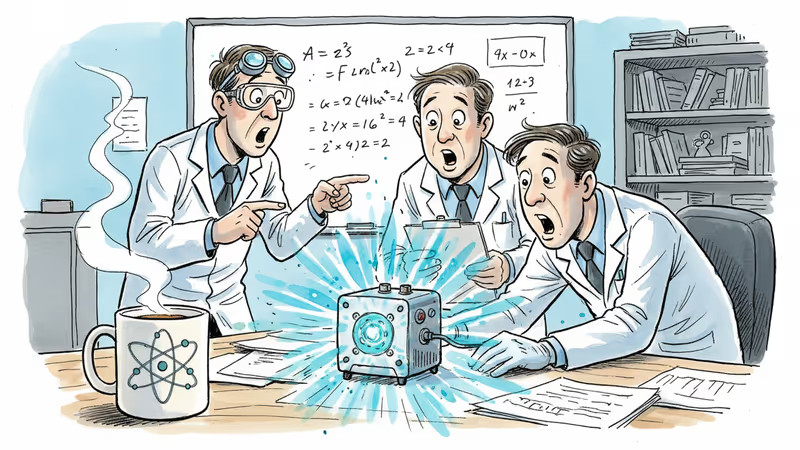
While the world imagines nuclear fusion as massive tokamaks or warehouse-sized laser arrays, Avalanche Energy is betting that smaller is smarter. The startup just raised $29 million for what's essentially a desktop version of the sun's power source—a reactor just 9 centimeters in diameter.
The SpaceX Approach to Fusion
Avalanche Energy has now raised $80 million total, a fraction of the hundreds of millions to billions that fusion giants like Commonwealth Fusion Systems have pulled in. But CEO Robin Langtry, who cut his teeth at Jeff Bezos's Blue Origin, sees this as an advantage.
"We're using the small size to learn quickly and iterate quickly," Langtry told TechCrunch. The company tests changes to its devices "sometimes twice a week"—a pace that would be impossible with room-sized reactors that take months to modify.
Instead of using massive magnets to contain plasma in a doughnut-shaped tokamak or firing powerful lasers at fuel pellets, Avalanche uses extremely high-voltage electric current to draw plasma particles into orbit around an electrode. As the orbit tightens and particles accelerate, they collide and fuse.
Racing Toward Breakeven
The company's next milestone is a 25-centimeter reactor expected to produce about 1 megawatt by 2027. That's when Langtry believes they'll have "a significant bump in confinement time" and achieve plasmas "that have a chance of being Q>1"—the holy grail where a fusion device produces more energy than it consumes.

Avalanche operates FusionWERX, a commercial testing facility that even rents space to competitors. By 2027, the site will be licensed to handle tritium, the hydrogen isotope that's crucial for grid-scale fusion power.
The Trillion-Dollar Question
While Langtry won't commit to a specific breakeven date, he's optimistic about the 2027-2029 window: "I think there's going to be a lot of really exciting things happening in fusion." He believes Avalanche is on a similar timeline as well-funded competitors like Commonwealth Fusion and Sam Altman-backed Helion.
But here's what makes this interesting: if successful, desktop fusion could democratize clean energy in ways that massive centralized plants cannot. Instead of building billion-dollar facilities, we might see fusion reactors in office buildings, hospitals, or even homes.
Beyond the Hype Cycle
The fusion industry has promised "energy too cheap to meter" for decades. What's different now is the convergence of better materials science, advanced computing, and crucially, private capital willing to fund rapid experimentation.
Toyota Ventures' participation in this round signals automotive industry interest—imagine electric vehicles with fusion-powered charging stations, or manufacturing plants with their own clean energy sources.
Yet challenges remain enormous. Fusion plasmas reach 100 million degrees Celsius—six times hotter than the sun's core. Materials must withstand neutron bombardment that would destroy conventional metals. And the economics still need to work at scale.
Authors
Related Articles
Canadian startup Vema Hydrogen extracts hydrogen from iron-rich rocks deep underground, targeting data centers with production costs below $1 per kilogram

Ricursive Intelligence raised $300M at a $4B valuation just two months after launch, using AI to autonomously design and improve AI chips. The semiconductor industry may never be the same.

Five stories from late September, traced to where the paper trail stops: Korea's export record, Nvidia's Hugging Face 8-K, a US-China AI channel, the UN on AI, and rising births.

Huawei's CANN is open source under a license barring software for non-Ascend chips. Inside China's second CUDA, and the two links still outside it: pre-training compute and 5nm capacity.
Canadian startup Vema Hydrogen extracts hydrogen from iron-rich rocks deep underground, targeting data centers with production costs below $1 per kilogram
Ricursive Intelligence raised $300M at a $4B valuation just two months after launch, using AI to autonomously design and improve AI chips. The semiconductor industry may never be the same.
Five stories from late September, traced to where the paper trail stops: Korea's export record, Nvidia's Hugging Face 8-K, a US-China AI channel, the UN on AI, and rising births.
Huawei's CANN is open source under a license barring software for non-Ascend chips. Inside China's second CUDA, and the two links still outside it: pre-training compute and 5nm capacity.
Thoughts
Share your thoughts on this article
Sign in to join the conversation