
AI Discovers 800 Hidden Cosmic Mysteries in Hubble's 35-Year Archive
ESA researchers used AI to uncover over 800 previously unknown astrophysical anomalies in Hubble telescope data, revealing how machine learning transforms space discovery.
What if the greatest space discoveries of our time aren't waiting in the stars, but buried in data we've already collected? Two astronomers at the European Space Agency just proved this might be true, using artificial intelligence to uncover more than 800 previously unknown cosmic anomalies hiding in plain sight within Hubble's35-year archive.
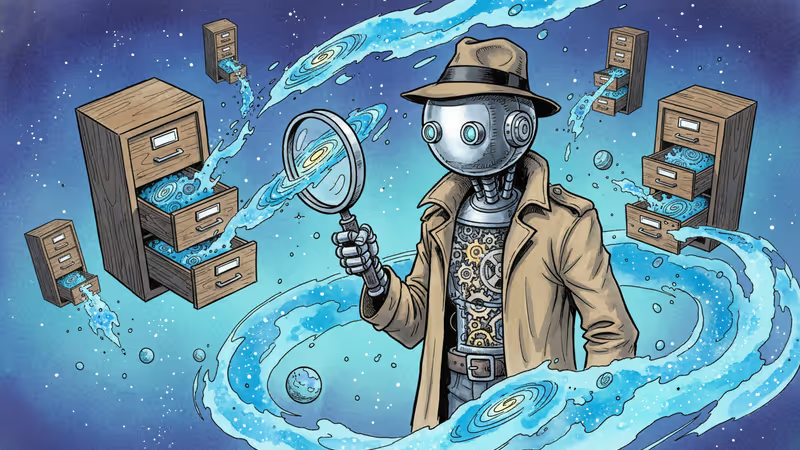
David O'Ryan and Pablo Gómez trained an AI model to methodically scan through decades of Hubble Space Telescope observations, flagging unusual objects that human researchers had missed or overlooked. Their digital detective found what O'Ryan calls "a treasure trove of data in which astrophysical anomalies might be found."
The Needle-in-a-Haystack Problem
Space research has always been about finding the extraordinary in the ordinary. But the sheer volume of data modern telescopes generate creates an almost impossible challenge. Hubble alone has captured millions of images over more than three decades, producing far more information than any research team could thoroughly examine by hand.
The problem isn't just quantity—it's recognition. Cosmic anomalies don't announce themselves with flashing lights. They might appear as subtle brightness variations, unexpected color patterns, or objects that don't fit established categories. Human astronomers, no matter how skilled, can only process so much visual information before fatigue sets in or patterns blur together.
This is where AI excels. The machine learning model doesn't get tired, doesn't have preconceptions about what space "should" look like, and can process thousands of images in the time it takes a human to examine one. It's trained to spot deviations from normal patterns—exactly what makes an astrophysical anomaly interesting.
Beyond Pattern Recognition

What makes this discovery particularly significant isn't just the number of anomalies found, but what it reveals about the untapped potential in existing scientific data. We're living through an era where telescopes and sensors collect information faster than we can analyze it. The James Webb Space Telescope, ground-based observatories, and upcoming missions will only accelerate this data deluge.
The 800 anomalies represent more than just new objects to study. They're proof that our archives contain discoveries we haven't made yet. Each anomaly could be a new type of star, an unusual galaxy formation, evidence of previously unknown physical processes, or something entirely unexpected.
Consider the implications for other fields. If AI can find hidden patterns in space imagery, what about medical scans, climate data, or geological surveys? The methodology developed for Hubble's archive could revolutionize how we approach any large dataset where human pattern recognition hits its limits.
The Human-AI Partnership
The researchers didn't simply let AI run wild through the data. After the algorithm flagged potential anomalies, human experts manually reviewed each candidate to determine whether it represented something genuinely unusual or just a data processing artifact. This human-in-the-loop approach combines AI's tireless pattern recognition with human expertise in distinguishing meaningful signals from noise.
This partnership model might define the future of scientific discovery. AI handles the heavy lifting of data processing, while humans provide context, intuition, and the ability to ask the right questions about what the patterns might mean. Neither could achieve these results alone.
The approach also democratizes discovery. Smaller research teams can now tackle datasets that would have required armies of graduate students to examine manually. This could accelerate the pace of scientific advancement, particularly in fields where data abundance has become a bottleneck rather than an advantage.
Authors
Related Articles

SpaceX's IPO filing puts AI at the center, claiming a $26.5 trillion market opportunity. But can Grok compete with OpenAI and Anthropic for enterprise customers?
AI is everywhere now—but is it helping or hurting? MIT Technology Review diagnoses a new mood: not excitement, not panic, just a creeping, uncomfortable uncertainty.

ByteDance's Seedance 2.0 is shocking China's creative industry, but Hollywood studios are fighting back with cease-and-desist letters. What's driving this cultural divide?
Netflix acquired Ben Affleck's AI company InterPositive, signaling a major shift in how streaming giants plan to revolutionize content production and compete in Hollywood.
SpaceX's IPO filing puts AI at the center, claiming a $26.5 trillion market opportunity. But can Grok compete with OpenAI and Anthropic for enterprise customers?
AI is everywhere now—but is it helping or hurting? MIT Technology Review diagnoses a new mood: not excitement, not panic, just a creeping, uncomfortable uncertainty.
ByteDance's Seedance 2.0 is shocking China's creative industry, but Hollywood studios are fighting back with cease-and-desist letters. What's driving this cultural divide?
Netflix acquired Ben Affleck's AI company InterPositive, signaling a major shift in how streaming giants plan to revolutionize content production and compete in Hollywood.
Thoughts
Share your thoughts on this article
Sign in to join the conversation