
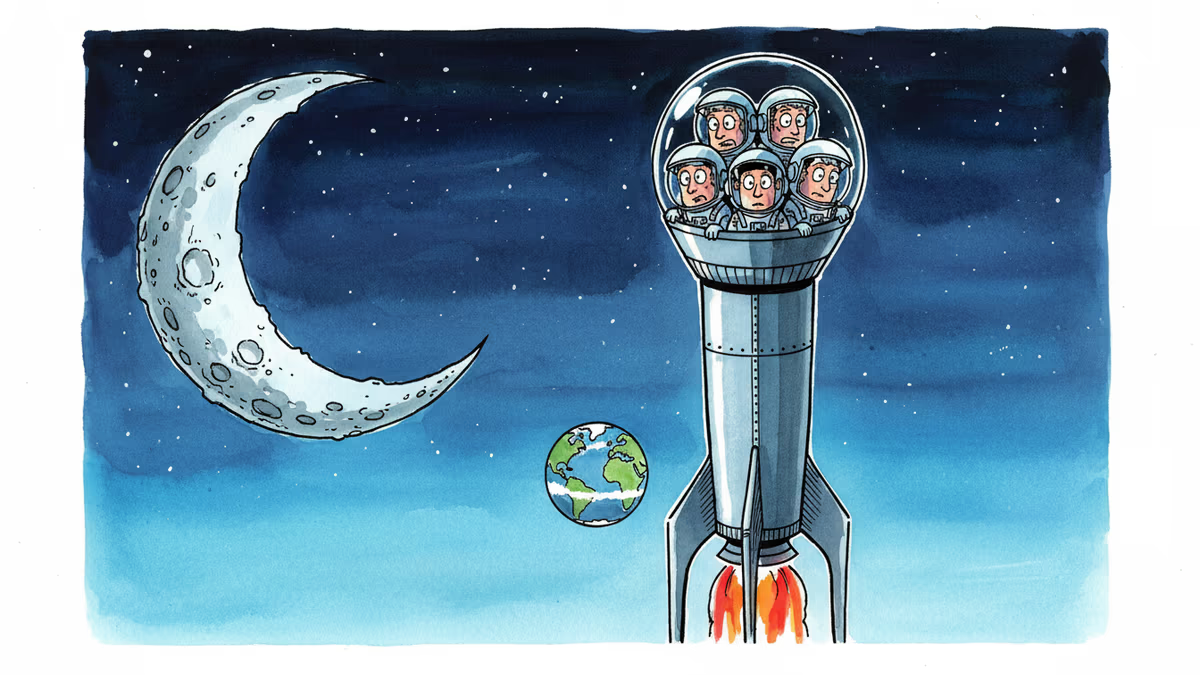
Humans Are Heading Back to the Moon — But Why Now?
NASA's Artemis II launched four astronauts toward lunar orbit on the most powerful rocket ever flown by humans. Here's what's really at stake beyond the spectacle.
8.8 million pounds of thrust. That's more than any rocket ever used to carry human beings — surpassing even the Saturn V that sent Apollo astronauts to the Moon over half a century ago. On Wednesday, that force lifted four people off a Florida launchpad and pointed them toward the lunar orbit. The question worth asking isn't how they got up there. It's why.
The Launch That Took 50 Years to Happen Again
At 6:35 PM EDT on April 2, 2026, NASA's Space Launch System (SLS) rocket ignited at Launch Complex 39B, Kennedy Space Center. Four RS-25 hydrogen engines and two solid rocket boosters fired simultaneously, pushing the 322-foot-tall, nearly 6-million-pound vehicle off the pad. Aboard the Orion capsule: three Americans and one Canadian astronaut, embarking on a nine-day mission that will take them around the Moon and back.
This is Artemis II — and it's important to be precise about what it is and isn't. There will be no Moon landing. No bootprints in the lunar dust. This mission is a crewed dress rehearsal: flying the trajectory, testing the spacecraft, and proving that humans can safely travel to lunar orbit before the actual landing attempt in a future mission. Think of it as the final systems check before the real thing.
Still, the milestone is real. No human being has traveled beyond low Earth orbit since Apollo 17 splashed down in December 1972. That's more than 53 years. An entire generation — actually, two — grew up in a world where the Moon was something humanity had visited and then, quietly, stopped visiting.
So Why Did We Stop? And Why Come Back Now?
The Apollo program was born from Cold War competition. When the Soviet Union collapsed, the geopolitical urgency evaporated, and with it, the budget. Mars became the new dream. The Moon felt like old news.
But the calculus has shifted. China has announced plans for a crewed lunar landing by the 2030s, and its space program has delivered on its timelines with notable consistency. The Moon, it turns out, may hold significant reserves of water ice near its poles — a resource that could support long-term human presence or be split into hydrogen and oxygen for rocket fuel. There's also helium-3, a potential fusion energy source that's vanishingly rare on Earth.
The Moon is no longer just a destination. It's becoming contested terrain.

NASA's Artemis program has cost tens of billions of dollars since its inception. The SLS rocket alone reportedly costs over $4 billion per launch — a figure that critics, including some inside the agency, find difficult to defend in an era when SpaceX's reusable Starship promises a fraction of that cost.
Who's Watching — and Who's Nervous
The reactions to Wednesday's launch split along predictable but important lines.
For aerospace contractors — Lockheed Martin built the Orion capsule, Boeing is the primary SLS contractor — this is a validation of years of work and billions in government contracts. Their interest in the program's continuation is direct and financial.
Scientists are cautiously optimistic. Robotic missions are cheaper, but humans bring adaptability that no rover can match. The potential to study lunar geology up close, investigate the polar ice deposits, and run experiments in deep space has genuine scientific value. The concern is whether the cost-per-science-return ratio justifies the investment compared to what an equivalent budget could achieve with unmanned missions.
Commercial space advocates see Artemis as a proof-of-concept for an eventual cislunar economy — a network of stations, fuel depots, and eventually mining operations in the Earth-Moon system. SpaceX, which is contracted to provide the human landing system for Artemis III, stands to gain enormously if that vision materializes.
Taxpayers and policymakers face a harder question. In a budget environment where domestic priorities compete fiercely for funding, a program that costs billions per flight and has already slipped its schedule multiple times invites scrutiny. The romance of space exploration is real — but so is the opportunity cost.
What Comes Next
If Artemis II completes its nine-day journey successfully, the path leads to Artemis III: the first crewed lunar landing since 1972, and the first ever to include a woman and a person of color on the surface. NASA has framed this explicitly as a statement about who space exploration belongs to.
Beyond that, the agency envisions a permanent lunar Gateway station in orbit and eventually a sustained human presence on the surface. Whether that vision survives budget cycles, political transitions, and the relentless pressure from cheaper commercial alternatives remains genuinely open.
Meanwhile, China and Russia — both absent from the Artemis Accords, the US-led framework for lunar cooperation — are pursuing their own programs. The Moon is becoming a place where Earth's geopolitical fractures are being projected outward.
Authors
Related Articles
NASA's Artemis III has been redesigned as an Earth-orbit mission. SpaceX and Blue Origin say their landers won't be ready until late 2027. What does this mean for the future of lunar exploration?
Flying to Mars means navigating without trees, wind, or GPS. Here's the surprisingly elegant physics behind how spacecraft measure their own velocity in the void.

Artemis II splashed down successfully in the Pacific, marking humanity's first crewed deep space mission in over 50 years. But the harder question isn't whether we can go back — it's why we should.
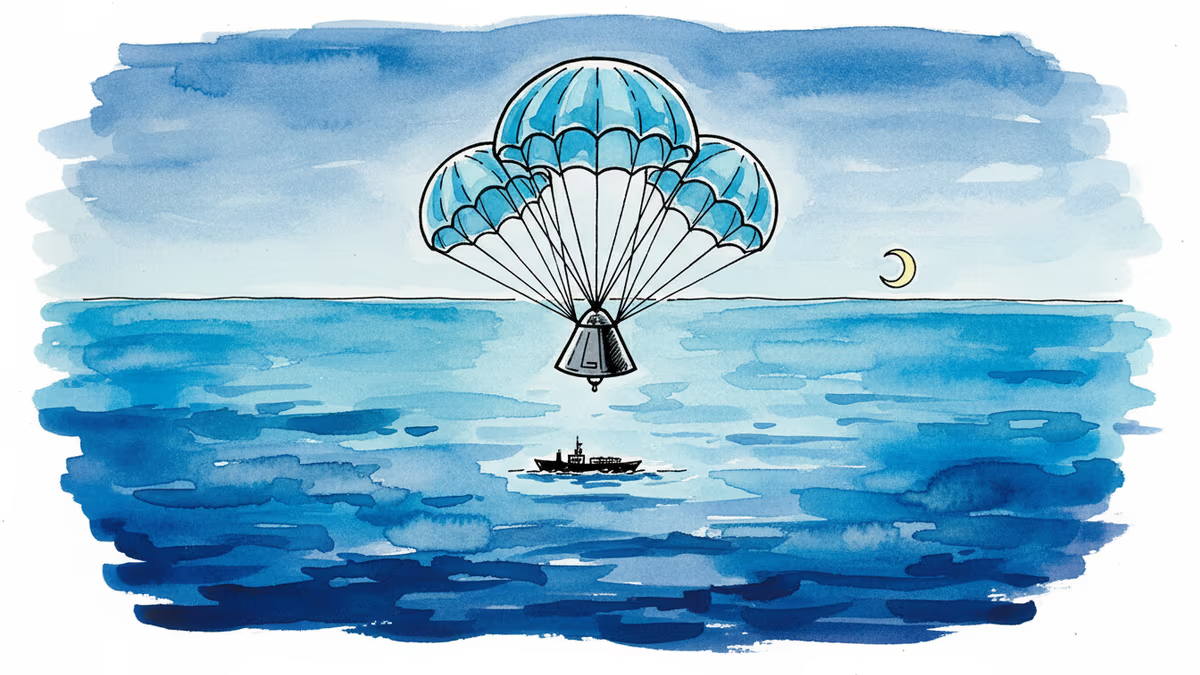
NASA's Orion capsule splashed down safely after humanity's first crewed lunar voyage in 54 years. The mission succeeded. Now the harder questions begin.
NASA's Artemis III has been redesigned as an Earth-orbit mission. SpaceX and Blue Origin say their landers won't be ready until late 2027. What does this mean for the future of lunar exploration?
Flying to Mars means navigating without trees, wind, or GPS. Here's the surprisingly elegant physics behind how spacecraft measure their own velocity in the void.
Artemis II splashed down successfully in the Pacific, marking humanity's first crewed deep space mission in over 50 years. But the harder question isn't whether we can go back — it's why we should.
NASA's Orion capsule splashed down safely after humanity's first crewed lunar voyage in 54 years. The mission succeeded. Now the harder questions begin.
Thoughts
Share your thoughts on this article
Sign in to join the conversation