
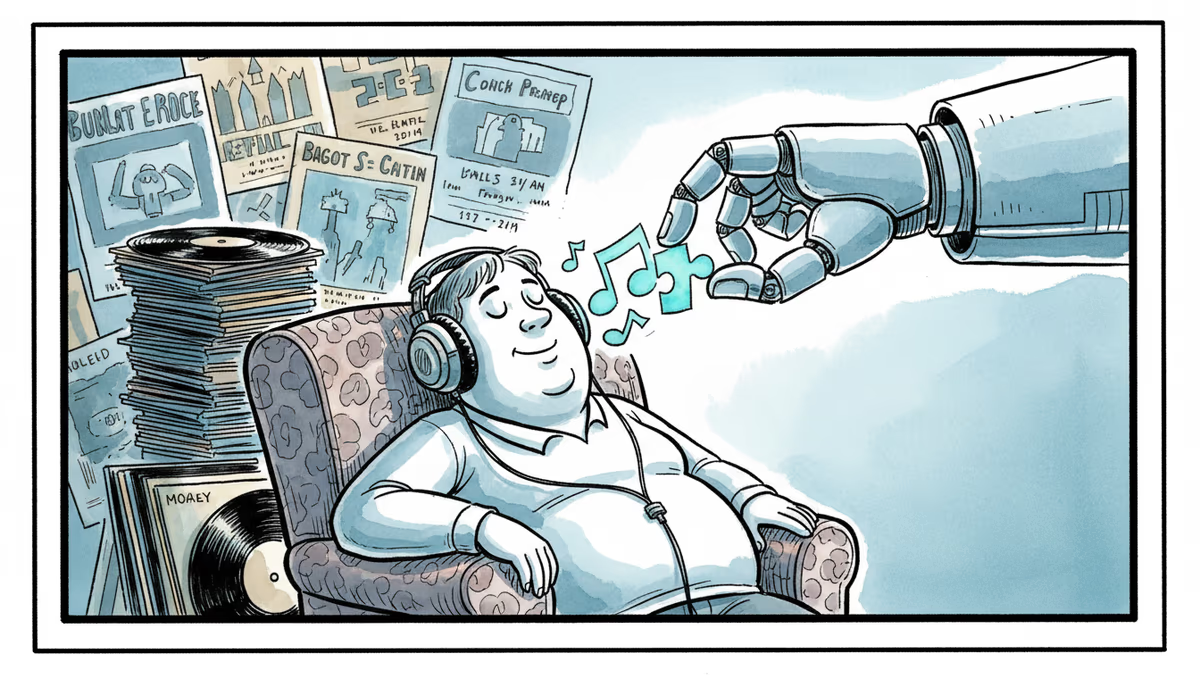
Apple Wants AI to Build Your Playlist. Should You Let It?
iOS 26.4 brings AI-generated playlists to Apple Music. It's convenient, but it raises real questions about taste, discovery, and who controls what you hear.
Type "rainy Monday, need to focus" and Apple Music will hand you a playlist—title, description, tracklist, all of it. You don't browse. You don't choose. You just... receive.
What iOS 26.4 Actually Does
Apple dropped iOS 26.4 this week, and buried inside the update is a quiet but meaningful shift in how Apple Music works. The headline feature is Playlist Playground, currently in beta: a tool that generates a complete playlist—name, description, and song selection—from a single text prompt. Think of it as ChatGPT for your music queue.
But that's not all. The update also introduces a concert discovery feature that surfaces nearby shows from artists already in your library, plus new artists the app thinks you'd like. Album and playlist pages now support full-screen backgrounds. And perhaps most practically useful: an offline music recognition tool that identifies songs without an internet connection. No signal on the subway? It still works.
Taken individually, these feel like incremental polish. Taken together, they sketch a clearer picture of where Apple is steering its music service.
The Spotify Problem Apple Is Trying to Solve

To understand why this matters, you have to look at the scoreboard. Spotify has roughly 678 million monthly active users. Apple Music's subscriber count isn't officially disclosed, but industry estimates hover around 100 million. That's a significant gap—and it hasn't closed meaningfully in years.
Apple's advantages are real: tight hardware integration with iPhone, AirPods, and Apple Watch, plus a loyal, high-spending user base. But where Spotify has consistently outperformed is in discovery. Its AI DJ feature, Discover Weekly, and algorithmically tuned playlists have become the reason many users say they simply can't leave.
Playlist Playground is Apple's most direct answer yet. It's not just a feature—it's an acknowledgment that passive, AI-driven curation is now a baseline expectation in music streaming, not a differentiator.
Three Ways to Read This
For subscribers, the pitch is straightforward: less friction, more music. If you've ever spent ten minutes trying to build a workout playlist and given up, Playlist Playground solves that. The offline recognition tool has genuine utility for commuters, travelers, and anyone who's heard a great song in a spotty-signal environment and lost it forever.
For artists and the music industry, the picture is murkier. When an AI assembles a playlist, the selection criteria aren't transparent. Does it favor major-label releases? Tracks with higher streaming numbers? Songs that keep users on the platform longest? At a time when streaming royalties already average just $0.003–$0.005 per stream, algorithmic gatekeeping isn't an abstract concern—it's a revenue question. Independent artists, in particular, have reason to watch closely.
For regulators, this sits within a broader conversation Apple is already navigating. The EU's Digital Markets Act, ongoing App Store scrutiny, and antitrust pressure in the US all create a context where Apple bundling AI curation into its own music service—while competing with third-party streaming apps on the same devices—is worth examining. It's not illegal. But it's a dynamic regulators have flagged in adjacent markets.
Authors
Related Articles
Apple Music introduces optional AI transparency tags for music content, sparking debate about self-regulation versus detection in the streaming era.
Spotify's AI-powered Prompted Playlists expand globally, letting users create custom playlists with natural language. What happens when algorithms know us better than we know ourselves?
Spotify partners with SeatGeek for seamless ticket buying. Can this challenge Ticketmaster's venue monopoly or just create new platform dependencies?
Apple's spring video podcast launch isn't just a feature update. It's a strategic play for the **$51 billion** podcasting market that could reshape how creators monetize content.
Apple Music introduces optional AI transparency tags for music content, sparking debate about self-regulation versus detection in the streaming era.
Spotify's AI-powered Prompted Playlists expand globally, letting users create custom playlists with natural language. What happens when algorithms know us better than we know ourselves?
Spotify partners with SeatGeek for seamless ticket buying. Can this challenge Ticketmaster's venue monopoly or just create new platform dependencies?
Apple's spring video podcast launch isn't just a feature update. It's a strategic play for the **$51 billion** podcasting market that could reshape how creators monetize content.
Thoughts
Share your thoughts on this article
Sign in to join the conversation