
One Satellite, Dozens of Fragments — Who Cleans Up Space?
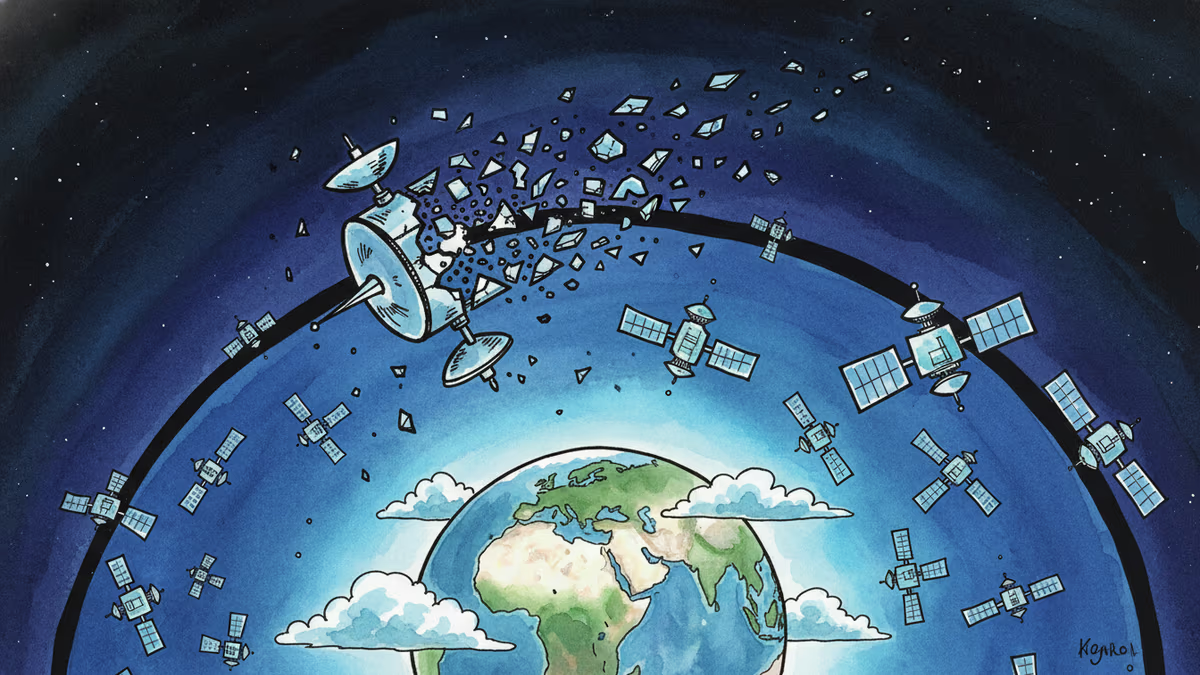
A SpaceX Starlink satellite broke apart after an anomaly, scattering trackable debris in low Earth orbit. As the satellite economy accelerates, the question of who owns the cleanup bill is getting harder to ignore.
One satellite went silent. It didn't go quietly.
SpaceX confirmed it lost contact with Starlink satellite 34343 following what the company called an "anomaly" — a word that reveals almost nothing. No cause, no timeline, no technical detail. But space-tracking firm Leo Labs filled in a crucial blank: it "immediately detected tens of objects in the vicinity" of the satellite after the event. Something broke apart up there.
What Actually Happened
SpaceX moved quickly to contain the narrative. In a post on X, the company stated that the event "poses no new risk to the Space Station, its crew, or to the upcoming launch of NASA's Artemis II mission." It added that it would continue monitoring both the satellite and any trackable debris in coordination with NASA and the US Space Force.
The reassurance isn't empty. At roughly 550 kilometers altitude, atmospheric drag means debris at this orbital height typically re-enters and burns up within weeks, not decades. That's by design — it's one reason SpaceX chose this orbital band for Starlink in the first place. In that narrow technical sense, this incident is manageable.
But "manageable" and "fine" are not the same thing.
The Math Is Getting Uncomfortable

There are now more than 6,000 active Starlink satellites in low Earth orbit. Amazon's Kuiper constellation is ramping up. OneWeb, China's Guowang, and a growing list of national programs are queuing launches. Analysts project that the total number of LEO satellites could triple by 2030.
Each of those satellites is a potential debris event. Most will deorbit cleanly. Some won't. And the cumulative risk of an unplanned breakup — like this one — scales with the number of objects sharing the same orbital lanes.
This is the backdrop against which scientists invoke the Kessler Syndrome: a theoretical cascade where debris collides with satellites, generating more debris, which collides with more satellites, until certain orbits become unusable. It's not considered imminent. But it's no longer considered purely theoretical either.
Three Ways to Read This Story
Depending on where you sit, this incident means something different.
For investors and operators, it's a reminder that satellite constellations carry operational risk that isn't always priced in. SpaceX can absorb the loss of one satellite easily — it launches batches of them routinely. Smaller operators don't have that cushion. A single anomaly could be a material event for a startup running a constellation of dozens.
For regulators and policymakers, it underscores a governance gap that has been widening for years. There is no binding international framework that assigns liability for unplanned debris, mandates cleanup timelines, or sets enforceable standards for anomaly reporting. The current system relies largely on voluntary industry norms. SpaceX's transparency here — posting on X within hours — is actually above average for the industry. That's a low bar.
For the general public, the connection is less obvious but increasingly real. Satellite internet, GPS precision, weather forecasting, financial transaction timing — these systems depend on orbital infrastructure that is shared and, right now, largely uninsured against cascading failure.
Authors
Related Articles
American Airlines just signed Starlink for 500+ aircraft. It's not just about faster inflight internet — it's a calculated move in the run-up to what could be the largest IPO in history.

SpaceX's upgraded Starship V3 completed its first test flight, deploying 20 Starlink simulators but losing the Super Heavy booster. With an IPO weeks away, the stakes just got higher.
SpaceX's IPO filing puts AI at the center, claiming a $26.5 trillion market opportunity. But can Grok compete with OpenAI and Anthropic for enterprise customers?
SpaceX filed a nearly 400-page S-1 with the SEC, targeting an IPO as early as June 12. Here's what the filing reveals—and what it doesn't.
American Airlines just signed Starlink for 500+ aircraft. It's not just about faster inflight internet — it's a calculated move in the run-up to what could be the largest IPO in history.
SpaceX's upgraded Starship V3 completed its first test flight, deploying 20 Starlink simulators but losing the Super Heavy booster. With an IPO weeks away, the stakes just got higher.
SpaceX's IPO filing puts AI at the center, claiming a $26.5 trillion market opportunity. But can Grok compete with OpenAI and Anthropic for enterprise customers?
SpaceX filed a nearly 400-page S-1 with the SEC, targeting an IPO as early as June 12. Here's what the filing reveals—and what it doesn't.
Thoughts
Share your thoughts on this article
Sign in to join the conversation