
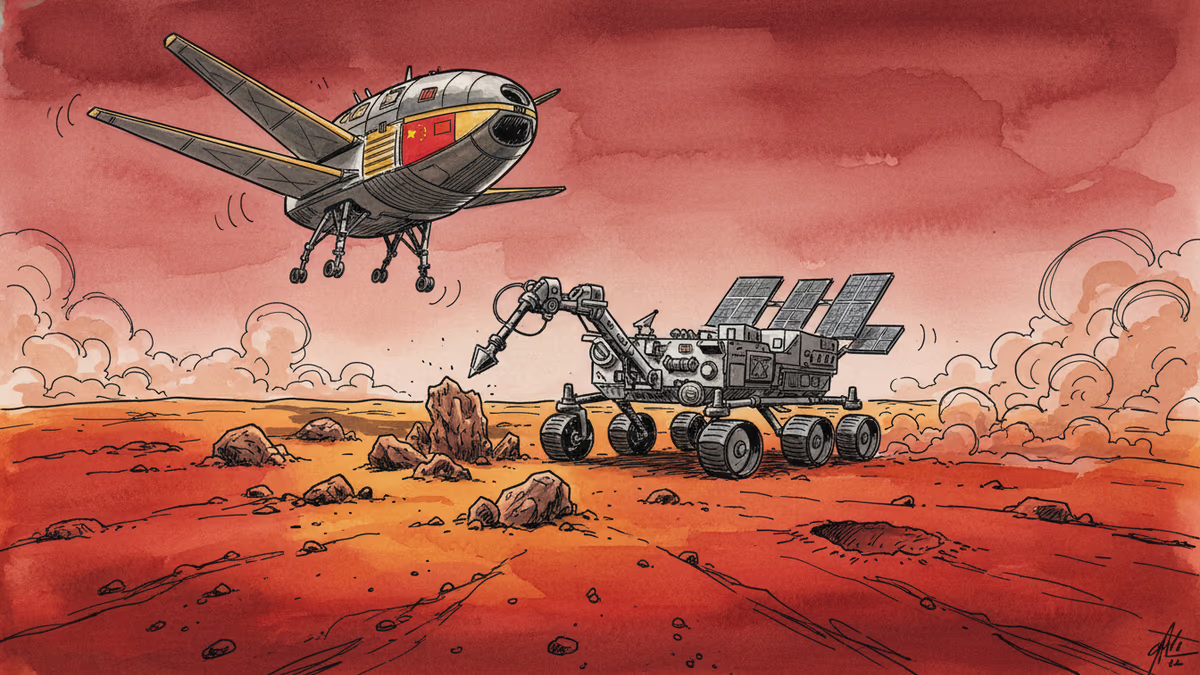
America Had the Best Shot at Finding Martian Life. Then Politics Killed It.
Despite NASA's promising discovery of potential microbial traces on Mars, budget cuts have stalled the sample return mission while China races ahead with its own plan.
$11 Billion Later, America Blinks First in the New Space Race
In July 2024, NASA's Perseverance rover stumbled upon something extraordinary: a rocky outcrop on Mars covered in peculiar spots. On Earth, these patterns are almost always the calling card of microbial life.
It wasn't definitive proof of aliens, but it was the strongest hint yet that life might not be a cosmic one-off. The only way to know for sure? Bring those rocks home.
Eighteen months later, that mission is on life support. Zero funding flows in 2026, congressional backing has evaporated, and those tantalizing rocks may be stranded forever. Meanwhile, America has effectively handed the pole position in humanity's greatest scientific quest to its biggest geopolitical rival: China.
The $4 Billion Miscalculation
How did America blow its lead? The Mars Sample Return (MSR) mission became a textbook case of how not to manage a flagship space program.
Costs ballooned from $7 billion to $11 billion. The timeline stretched from 2030 to 2040—a decade-long delay. Congress, already scarred by the James Webb Space Telescope's budget overruns, developed MSR fatigue.

"We had the best technology, the best scientists, and the best samples already identified," one former NASA official told MIT Technology Review. "But we couldn't manage our own ambitions."
China, meanwhile, is moving full steam ahead with its own sample return mission, targeting 2030. Their approach is leaner, their samples will likely be lower quality, but that won't matter for the history books.
Scientists vs. Accountants: An Old Story
The collapse of MSR reveals a deeper tension in American space policy. NASA's scientists dream big, but Congress controls the purse strings. When costs spiral, political support craters.
"China doesn't have this problem," notes one planetary scientist who worked on both countries' programs. "Their leadership makes a decision and sticks with it for decades. We change direction every election cycle."
European partners, initially committed to MSR, are now hedging their bets. Some are quietly exploring collaboration with China's mission instead.
The Irony of American Innovation
Here's the twist: America's technological superiority might have been its downfall. NASA designed an incredibly sophisticated mission—multiple launches, orbital rendezvous, precision landing. It was engineering poetry, but engineering poetry that proved too expensive and complex.
China's approach is simpler, cruder, but achievable. Sometimes "good enough" beats "perfect" when perfect never happens.
Authors
Related Articles

China is restricting AI researchers and startup founders from traveling abroad as the U.S.-China AI performance gap narrows to just 2.7%. What Beijing's talent lockdown means for the global AI race.

NASA's Artemis III has been redesigned as an Earth-orbit mission. SpaceX and Blue Origin say their landers won't be ready until late 2027. What does this mean for the future of lunar exploration?

Flying to Mars means navigating without trees, wind, or GPS. Here's the surprisingly elegant physics behind how spacecraft measure their own velocity in the void.

Artemis II splashed down successfully in the Pacific, marking humanity's first crewed deep space mission in over 50 years. But the harder question isn't whether we can go back — it's why we should.
China is restricting AI researchers and startup founders from traveling abroad as the U.S.-China AI performance gap narrows to just 2.7%. What Beijing's talent lockdown means for the global AI race.
NASA's Artemis III has been redesigned as an Earth-orbit mission. SpaceX and Blue Origin say their landers won't be ready until late 2027. What does this mean for the future of lunar exploration?
Flying to Mars means navigating without trees, wind, or GPS. Here's the surprisingly elegant physics behind how spacecraft measure their own velocity in the void.
Artemis II splashed down successfully in the Pacific, marking humanity's first crewed deep space mission in over 50 years. But the harder question isn't whether we can go back — it's why we should.
Thoughts
Share your thoughts on this article
Sign in to join the conversation