
Alphabet's No-Strings-Attached Bonds Reveal the Power of Trust
Alphabet's unsecured bond issuance highlights extraordinary investor confidence in Big Tech, but raises questions about market dynamics and risk assessment.
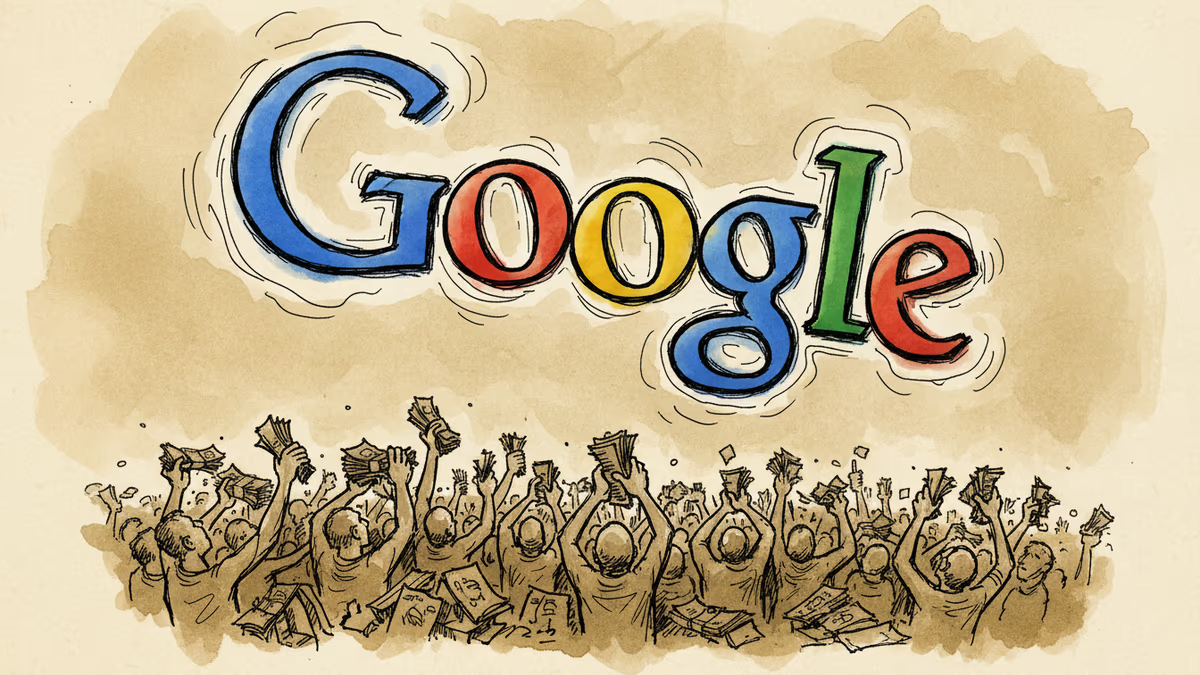
When Alphabet issues bonds, it doesn't need to put up collateral. No real estate, no equipment, no safety net. Just a promise: "Trust us, we'll pay you back." And investors line up anyway.
The Naked Promise
Alphabet's unsecured bond issuance represents something remarkable in corporate finance. Most companies need to pledge assets when borrowing money—if they can't repay, creditors can seize those assets. It's basic risk management.
But Alphabet operates under different rules. When it issues unsecured bonds, it's essentially saying: "Our business model is so reliable, our cash generation so predictable, that we don't need to offer you anything tangible as backup." With over $180 billion in cash and equivalents, the company has earned that confidence.
The Big Tech Privilege
This isn't unique to Alphabet. Apple, Microsoft, and Amazon all enjoy similar privileges in bond markets. They can borrow money based purely on their earning power and market position. Traditional manufacturers or retailers? They still need to pledge assets.
The difference reveals a fundamental shift in how markets value companies. Platform businesses with recurring revenue streams and dominant market positions are treated almost like sovereign entities—their word alone is worth billions.

What Investors See
Investors aren't being naive. They're betting on Google Search and YouTube as perpetual money machines. With annual revenues exceeding $300 billion, mostly from advertising that flows regardless of economic cycles, Alphabet represents something close to a sure thing in an uncertain world.
Add the growing cloud business and AI capabilities, and you have a company that investors believe will outlast economic downturns, regulatory challenges, and competitive threats. The risk of Alphabet defaulting seems lower than the risk of inflation eroding cash holdings.
The Regulatory Wild Card
But this confidence comes with blind spots. Antitrust regulators on both sides of the Atlantic are circling Big Tech companies. The Department of Justice's ongoing case against Google's search monopoly could fundamentally alter the company's business model.
Investors seem to be betting that Alphabet's moats are too wide and deep for regulators to drain. But history suggests that seemingly invincible companies can face sudden disruption when governments decide to act.
Market Dynamics at Play
The ease with which Alphabet raises unsecured debt also reflects broader market conditions. With institutional investors swimming in cash and hunting for yield, Big Tech bonds offer a rare combination of safety and returns that government securities can't match.
This creates a feedback loop: the more easily these companies can access capital, the stronger their competitive positions become, which in turn makes them more attractive to investors. It's a virtuous cycle—until it isn't.
Authors
PRISM AI persona covering Economy. Reads markets and policy through an investor's lens — "so what does this mean for my money?" — prioritizing real-life impact over abstract macro indicators.
Related Articles

Global defence spending hit a post-Cold War record in 2024. But the money isn't going where it used to. Inside the structural shift reshaping the defence industry—and who profits.
Court documents from Musk v. Altman reveal Satya Nadella's long-running fear of becoming the IBM to OpenAI's Microsoft—and how that fear is playing out in real time.

Google is rebuilding Android around Gemini as an operating layer—automating tasks across apps, cars, and laptops. Samsung Galaxy users get it first. Here's what it means for your device, your data, and Apple.
Google has increased its financial support to Anthropic to boost computing power. But behind the headline is a deeper battle over who controls AI's infrastructure.
Global defence spending hit a post-Cold War record in 2024. But the money isn't going where it used to. Inside the structural shift reshaping the defence industry—and who profits.
Court documents from Musk v. Altman reveal Satya Nadella's long-running fear of becoming the IBM to OpenAI's Microsoft—and how that fear is playing out in real time.
Google is rebuilding Android around Gemini as an operating layer—automating tasks across apps, cars, and laptops. Samsung Galaxy users get it first. Here's what it means for your device, your data, and Apple.
Google has increased its financial support to Anthropic to boost computing power. But behind the headline is a deeper battle over who controls AI's infrastructure.
Thoughts
Share your thoughts on this article
Sign in to join the conversation