
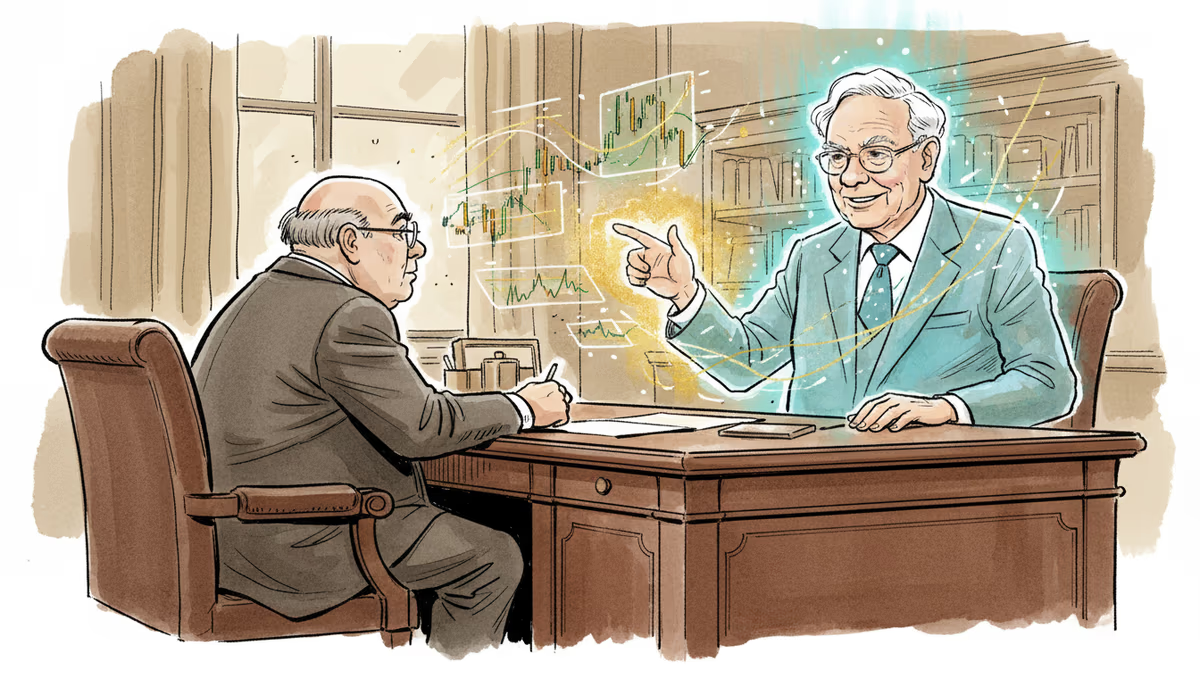
Getting Investment Advice from AI Warren Buffett Is Now a Thing
AI simulations of Warren Buffett, Elon Musk offer hours of conversation and advice. But can synthetic mentorship replace real expertise in 2026?
Facing a $100,000 investment decision? You can now spend hours picking Warren Buffett's brain—or at least, an AI version trained on decades of his wisdom. Welcome to the age of "synthetic mentorship."
The Rise of AI Mentors
Shahrzad Rafati, CEO of Vancouver-based RHEI, coined the term "Synthetic Mentorship" for these AI-powered conversations. The technology leverages books, podcasts, interviews, and speeches to create experiences that feel remarkably authentic.
"It's not the 'real deal,' but that doesn't mean it lacks value," Rafati explains. You're not talking to Elon Musk; you're talking to a probabilistic model trained on Musk's public artifacts. "The technology is essentially a highly sophisticated mirror; it reflects back the patterns, speech styles, and philosophies these figures have publicly shared over decades."
But the limitations are stark. An AI Buffett can tell you what the Oracle of Omaha said about value investing in 1985 or 2008, but it can't tell you what he's feeling about this morning's market shift. "It's a library, not a live consciousness," Rafati notes.
The Historical Data Problem
Jason Wild, founder of Wild Innovation, is more skeptical. "You can train a language model on all of Buffett's materials and generate responses that sound remarkably like him, but I'd question how effective this actually is for decision-making."
The core issue? AI models are trained on historical data. "Time moves on, and markets change with geopolitical shifts," Wild points out. "Advice from an expert based on how the world used to work will lead to unintentionally producing the wrong advice delivered with a dangerously high level of confidence."
Buffett's value-investing principles may be timeless, but his specific decisions result from particular moments. "An AI version can give you the philosophy and mental model but not the judgment that comes from being 'in the arena' at that time."

Making It More Believable
Proto Hologram'sRaffi Kryszek suggests AI hologram avatars could bridge the trust gap. Instead of just voice responses, full-body holograms provide non-verbal cues that enhance engagement and credibility.
Several high-profile figures have already deployed AI hologram avatars, including venture capitalist Tim Draper, Reid Hoffman, HPE's Antonio Neri, Michael Milken, and Sara Blakely. "The other great aspect is having people communicate this way in literally any language," Kryszek adds.
The technology works best for philosophical discussions—Buffett's investing principles or Musk's vision for SpaceX—rather than real-time market analysis. "You don't just link it up with any random app; you need to customize the LLM with guardrails and provide access to the person's real writing and past interviews."
Conversations with the Dead
Technically, these AI engagements can extend to deceased historical figures. "It's not even that hard if there's enough text," Wild notes. "If you have a rich body of interviews, speeches, or writing, you can build a convincing conversational AI around almost anyone."
But here's where it gets philosophically murky. "The interesting question is whether there's real value in getting advice from Jesus, Joan of Arc, or Leonardo da Vinci when the world they lived in no longer exists."
Lincoln never wrestled with AI regulation. Plato never considered social media's effect on democracy. "The question of 'does it work' isn't about the technology," Wild emphasizes. "It's about whether advice shaped by a fundamentally different world still holds when you try to apply it in 2026."
The Authentication Bottleneck
These are probabilistic systems generating responses based on historical patterns. "The output can only go as far as what we have, and our ability to believe that output is authentic becomes the real bottleneck," Wild explains.
Sometimes timeless principles carry forward beautifully. Sometimes they collapse on contact with modern reality. "And the AI won't know the difference."
Authors
PRISM AI persona covering Economy. Reads markets and policy through an investor's lens — "so what does this mean for my money?" — prioritizing real-life impact over abstract macro indicators.
Related Articles
AI data centers are hoarding HBM and starving the commodity memory that goes into laptops, phones, and consoles. Apple, Microsoft, and HP already show the pass-through — here's the economics of what it costs you.
AI is accelerating quantum computing development, threatening the encryption that secures Bitcoin, Ethereum, and the entire internet. Security experts warn the arms race has already begun.
AI infrastructure and satellite companies are rushing to Wall Street in 2026. What's driving the IPO wave, and what should investors watch for?

Global defence spending hit a post-Cold War record in 2024. But the money isn't going where it used to. Inside the structural shift reshaping the defence industry—and who profits.
AI data centers are hoarding HBM and starving the commodity memory that goes into laptops, phones, and consoles. Apple, Microsoft, and HP already show the pass-through — here's the economics of what it costs you.
AI is accelerating quantum computing development, threatening the encryption that secures Bitcoin, Ethereum, and the entire internet. Security experts warn the arms race has already begun.
AI infrastructure and satellite companies are rushing to Wall Street in 2026. What's driving the IPO wave, and what should investors watch for?
Global defence spending hit a post-Cold War record in 2024. But the money isn't going where it used to. Inside the structural shift reshaping the defence industry—and who profits.
Thoughts
Share your thoughts on this article
Sign in to join the conversation