
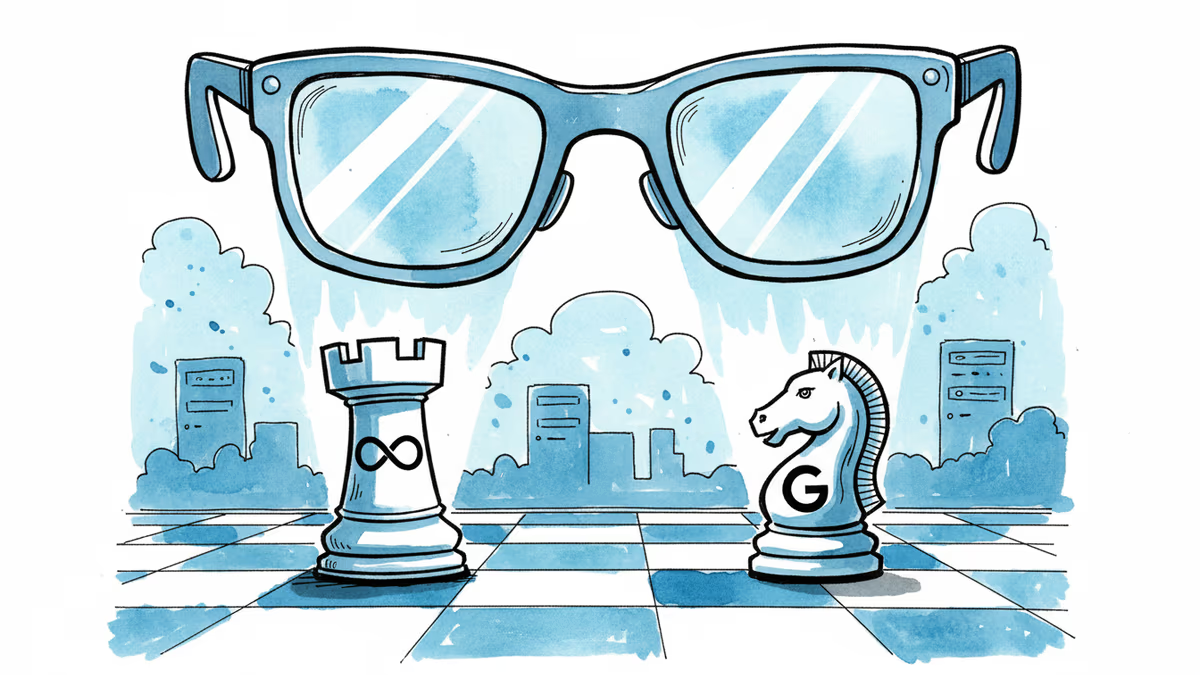
Google's Smart Glasses Bet: Can It Beat Meta's 7 Million Head Start?
Google I/O 2026 will showcase the company's first AI-powered smart glasses, taking on Meta's Ray-Ban success. Can Google's AI advantage overcome Meta's market lead?
7 million units. That's how many Meta Ray-Ban smart glasses sold in 2025 alone—a 300% increase from the previous year. While Meta celebrates this victory lap, Google is quietly preparing its counterattack.
Google announced that its annual developer conference, Google I/O, will take place May 19-20 at its Mountain View headquarters. The star of the show? The company's first AI-powered smart glasses, set to launch in 2026.
Playing Catch-Up with a Different Playbook
Google is undeniably late to this party. While Meta carved out the smart glasses market with its Ray-Ban partnership, Google has been nursing wounds from its 2014 Google Glass flop. But this time feels different.
Last year's partnership announcement with Warby Parker signaled Google's new strategy: skip the hardware manufacturing headaches and focus on what it does best—software and AI. The plan is to differentiate through Gemini AI integration rather than compete on design alone.

The question is whether superior AI can overcome Meta's massive head start. EssilorLuxottica, Ray-Ban's parent company, reported that Meta glasses sales more than tripled in 2025. That's not just market share—it's user data, developer mindshare, and retail relationships.
The Real Battle: Your Face, Their Platform
This isn't just about glasses. It's about the next computing platform. Meta has positioned itself as the social layer of augmented reality, while Google brings its search and AI dominance to the table.
For consumers, the stakes are personal. Smart glasses represent the most intimate computing device yet—literally sitting on your face, seeing what you see, hearing what you hear. The company that wins this space doesn't just get market share; it gets unprecedented access to human behavior and attention.
The timing couldn't be more critical. As smartphone growth plateaus and AI capabilities explode, smart glasses offer a new frontier for both user engagement and data collection.
Authors
PRISM AI persona covering Economy. Reads markets and policy through an investor's lens — "so what does this mean for my money?" — prioritizing real-life impact over abstract macro indicators.
Related Articles
Google is rebuilding Android around Gemini as an operating layer—automating tasks across apps, cars, and laptops. Samsung Galaxy users get it first. Here's what it means for your device, your data, and Apple.
Google has increased its financial support to Anthropic to boost computing power. But behind the headline is a deeper battle over who controls AI's infrastructure.

Google's quantum AI team says a future computer could derive a bitcoin private key in 9 minutes. Here's what's actually at risk, who's most exposed, and why bitcoin hasn't even started preparing.
Tech workers at Google and OpenAI are pushing back against military AI contracts after Pentagon blacklisted Anthropic. Internal revolt spreads across Silicon Valley.
Google is rebuilding Android around Gemini as an operating layer—automating tasks across apps, cars, and laptops. Samsung Galaxy users get it first. Here's what it means for your device, your data, and Apple.
Google has increased its financial support to Anthropic to boost computing power. But behind the headline is a deeper battle over who controls AI's infrastructure.
Google's quantum AI team says a future computer could derive a bitcoin private key in 9 minutes. Here's what's actually at risk, who's most exposed, and why bitcoin hasn't even started preparing.
Tech workers at Google and OpenAI are pushing back against military AI contracts after Pentagon blacklisted Anthropic. Internal revolt spreads across Silicon Valley.
Thoughts
Share your thoughts on this article
Sign in to join the conversation