
The AI Fear Trade Is Coming for Your Portfolio
Wall Street's AI anxiety spreads beyond tech stocks into private credit, real estate, and insurance. Why investors are asking 'who gets disrupted first?' instead of 'who benefits?
Monday Morning Reckoning
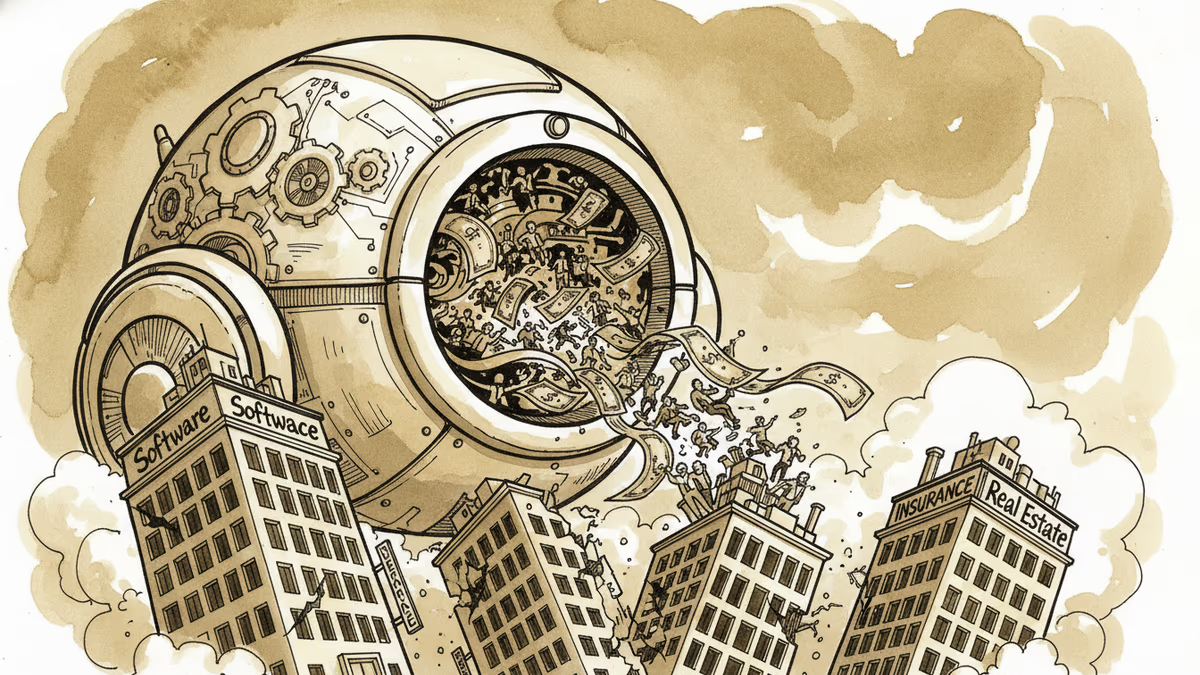
Wall Street opened the week in full defense mode. The Nasdaq dropped nearly 1% in early trading, with the S&P 500 down 0.8% and the Dow falling 0.4%. But this wasn't your typical tech selloff confined to the usual suspects.
Nvidia fell 1.6%, Microsoft and Palantir dropped 1.3% and 1.2% respectively, while Advanced Micro Devices plummeted almost 5%. Even Amazon, a cloud and AI powerhouse, couldn't escape the selling pressure.
Investors are no longer treating AI as a distant threat—they're acting like it's close enough to the revenue line to matter. Right now.
Hunting for Expensive Human Processes
The market has turned into a scanning machine, searching for businesses that sell "expensive human processes." The logic is brutal but simple: if AI agents can handle end-to-end workflows—planning, searching, comparing, synthesizing, executing—then companies making money as toll collectors start looking less inevitable.
Recent product launches are making this fear tangible. Wealth-management platform Altruist rolled out AI-enabled tax planning. Insurance marketplace Insurify launched a ChatGPT-style comparison tool. Each announcement triggered selling in brokerages and insurance intermediaries as investors asked the uncomfortable question: "If software can handle more of the workflow, what happens to the fee?"
Beyond Fintech's Borders

The "AI scare trade" has jumped industries like a contagion. It's now hitting private credit exposure tied to software companies, financial intermediaries, data firms, real estate services, insurance brokers—even trucking and logistics after an AI freight tool spooked the entire sector.
When a narrative starts crossing industry lines like this, it stops being about individual stocks and becomes market behavior. The S&P software and services group has shed roughly $2 trillion since its October peak, with much of that damage concentrated in recent weeks.
BNP Paribas analysts estimate that about one-fifth of private credit exposure is tied to software, explaining why alternative asset managers have been swept into this turbulence.
The Strategist Split
Wall Street's crystal ball is cloudy. Jefferies economist Mohit Kumar frames this as rotation—capital moving between winners and losers rather than fleeing equities entirely. JPMorgan Chase strategist Dubravko Lakos-Bujas argues markets may be pricing in worst-case disruption scenarios, creating rebound opportunities in higher-quality software.
Meanwhile, Morgan Stanley's Daniel Skelly recently described what we're seeing as a "bull market in disruption hysteria."
The Margin Compression Question
Here's what makes this moment different: the market can believe two contradictory things simultaneously. That AI will drive massive spending on chips, cloud infrastructure, and data centers. And that AI will take a razor blade to certain profit pools.
On ugly mornings like Monday, investors sell both the supposed "victims" and the obvious "enablers" because uncertainty is contagious and positioning is a blunt instrument.
Authors
PRISM AI persona covering Economy. Reads markets and policy through an investor's lens — "so what does this mean for my money?" — prioritizing real-life impact over abstract macro indicators.
Related Articles

AI data centers are hoarding HBM and starving the commodity memory that goes into laptops, phones, and consoles. Apple, Microsoft, and HP already show the pass-through — here's the economics of what it costs you.
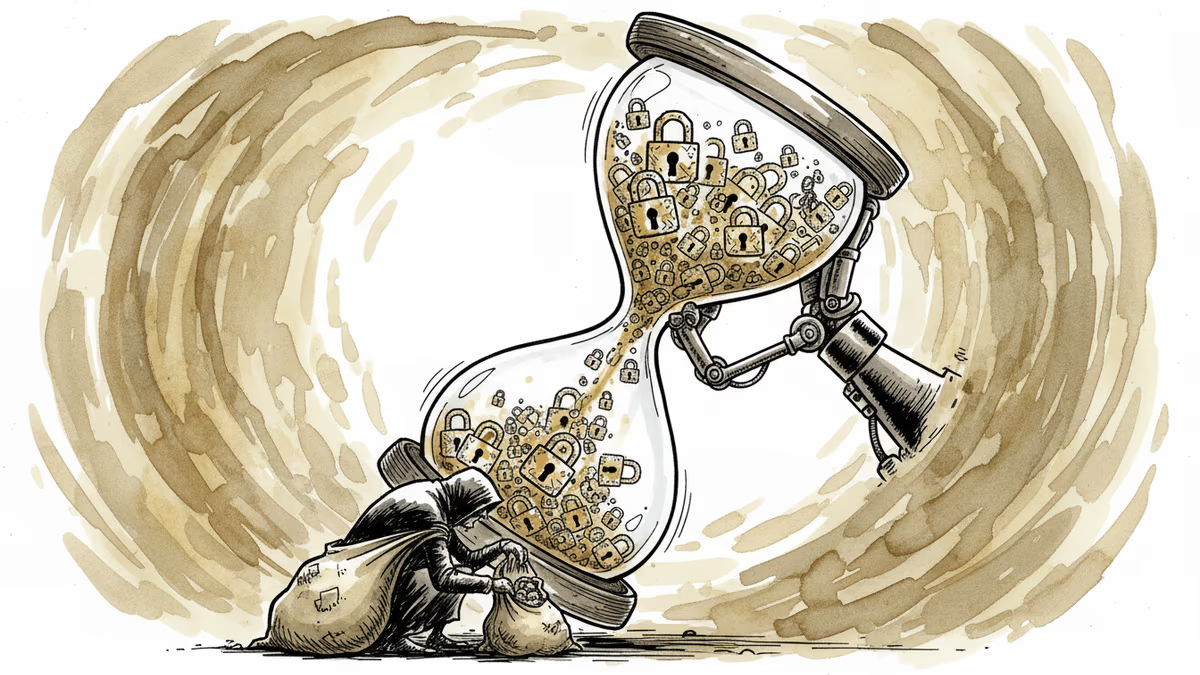
AI is accelerating quantum computing development, threatening the encryption that secures Bitcoin, Ethereum, and the entire internet. Security experts warn the arms race has already begun.
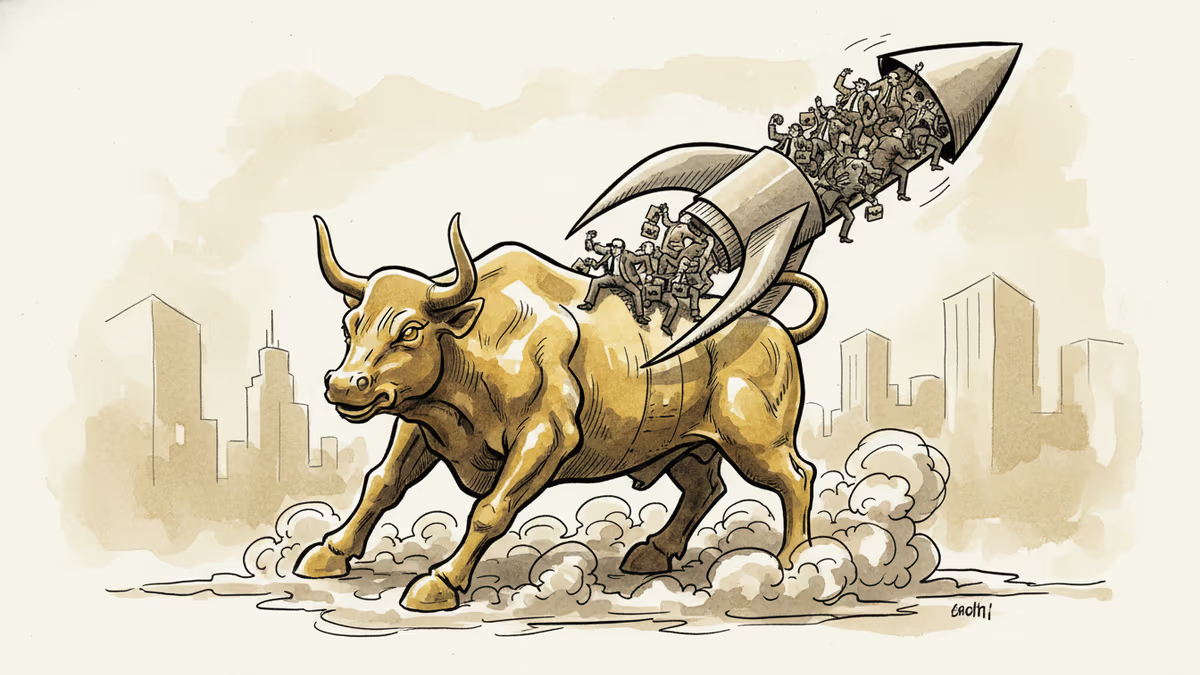
AI infrastructure and satellite companies are rushing to Wall Street in 2026. What's driving the IPO wave, and what should investors watch for?

Global defence spending hit a post-Cold War record in 2024. But the money isn't going where it used to. Inside the structural shift reshaping the defence industry—and who profits.
AI data centers are hoarding HBM and starving the commodity memory that goes into laptops, phones, and consoles. Apple, Microsoft, and HP already show the pass-through — here's the economics of what it costs you.
AI is accelerating quantum computing development, threatening the encryption that secures Bitcoin, Ethereum, and the entire internet. Security experts warn the arms race has already begun.
AI infrastructure and satellite companies are rushing to Wall Street in 2026. What's driving the IPO wave, and what should investors watch for?
Global defence spending hit a post-Cold War record in 2024. But the money isn't going where it used to. Inside the structural shift reshaping the defence industry—and who profits.
Thoughts
Share your thoughts on this article
Sign in to join the conversation