

AI's Billion-Dollar Energy Bill Is Coming Due—And Regulators Are Holding the Invoice
A US Senate probe into AI data centers' energy use signals a major shift. The AI industry's 'growth at all costs' model faces a new regulatory and social reckoning.
The AI Gold Rush Hits a Power Wall
The abstract world of artificial intelligence is colliding with the hard reality of the physical world. A new probe by US Senators, including Elizabeth Warren, isn't just political noise; it's the opening salvo in a battle over the true cost of the AI revolution. For years, the tech industry's mantra has been growth at any cost. Now, for communities seeing their electricity bills skyrocket by as much as 267%, that cost is becoming unbearable. This inquiry marks a critical turning point: the era of AI treating energy as an infinite, externalized resource is over. The social license to operate for the world's most powerful industry is now officially under review.
Why This Is More Than Just a Utility Bill Problem
This Senate probe transcends a simple pricing dispute. It signals a fundamental shift in how regulators, investors, and the public will scrutinize the AI industry. The techlash is moving from the digital realm of data privacy and misinformation to the physical world of power grids, water rights, and local economies. The core issue is that a single AI data center can consume as much electricity as a small city, placing unprecedented strain on aging infrastructure. This forces utility companies into a dilemma: undertake massive, costly upgrades and pass the bill to all consumers, or risk grid instability. For the AI industry, this represents a new, formidable bottleneck to growth that can't be solved with code.
The Analysis: A New Battlefield for Tech Dominance
The New Regulatory Frontline: From Privacy to Power Grids
For the last decade, regulatory pressure on Big Tech focused on software: data collection, antitrust, and content moderation. This probe fundamentally changes the game. Policymakers are now targeting the physical footprint of technology. We're seeing a pattern emerge, from concerns over water usage in drought-stricken areas to the energy draw of crypto-mining. This is a far more difficult challenge for tech companies to navigate. While they can tweak algorithms or privacy policies, they cannot defy the laws of thermodynamics. Securing the massive power required for next-generation AI models is now a geopolitical and regulatory challenge, not just an engineering one.

Déjà Vu: Lessons from the Crypto-Mining Backlash
The AI industry should look at the recent history of cryptocurrency mining for a cautionary tale. Crypto miners, chasing cheap electricity, descended on small towns, overwhelming local grids and causing energy prices to soar. The public and political backlash was swift, leading to local moratoriums, zoning crackdowns, and a tarnished reputation. The senators' letters suggest they see AI data centers as a similar, if not greater, threat. The key difference? The AI industry is seen as a strategic national asset, creating a complex tension for policymakers between fostering innovation and protecting constituents.
For Investors: AI's ESG Problem Is Now a Material Risk
Wall Street's AI euphoria has largely ignored the physical-world constraints. This probe should be a wake-up call. Investors must begin pricing in a new category of risk for AI-heavy stocks: infrastructure and regulatory risk. Valuations based on exponential growth are incomplete if they don't account for the potential for:
- Project Delays: Local opposition can tie up data center construction for years.
- Increased CapEx: Companies may be forced to fund grid upgrades or build their own renewable energy sources, hitting margins.
- Carbon Scrutiny: As AI's energy footprint grows, its contribution to carbon emissions will face intense scrutiny from ESG-focused funds.
The ability to secure sustainable, stable, and socially-accepted power sources is about to become a key differentiator for AI leaders.
For the C-Suite: The End of 'Permissionless' Expansion
The strategy of quietly securing land and power deals with minimal public disclosure is now obsolete. Tech executives must shift from a purely transactional approach to one of deep community and utility engagement. The new playbook requires proactive transparency, co-investment in local green energy infrastructure, and tangible community benefit agreements. Failing to secure a 'social license' will become as damaging as failing to secure a new GPU cluster. This is no longer a PR issue; it's a core operational imperative for scaling AI infrastructure.
PRISM's Take
This Senate inquiry is the first tremor of a seismic shift. The AI industry's 'move fast and break things' ethos has finally broken something it can't easily fix: the trust of local communities and the physical limits of our energy grid. The next five years of AI competition will be defined less by the elegance of algorithms and more by the brutal logistics of power acquisition. The companies that will win the AI race won't just be the ones with the best models; they will be the ones that solve the energy trilemma of building at speed, at scale, and sustainably. The AI boom's biggest bill is coming due, and it will be paid either through responsible investment in a green future or through the high cost of regulation and public opposition.
Authors
Related Articles
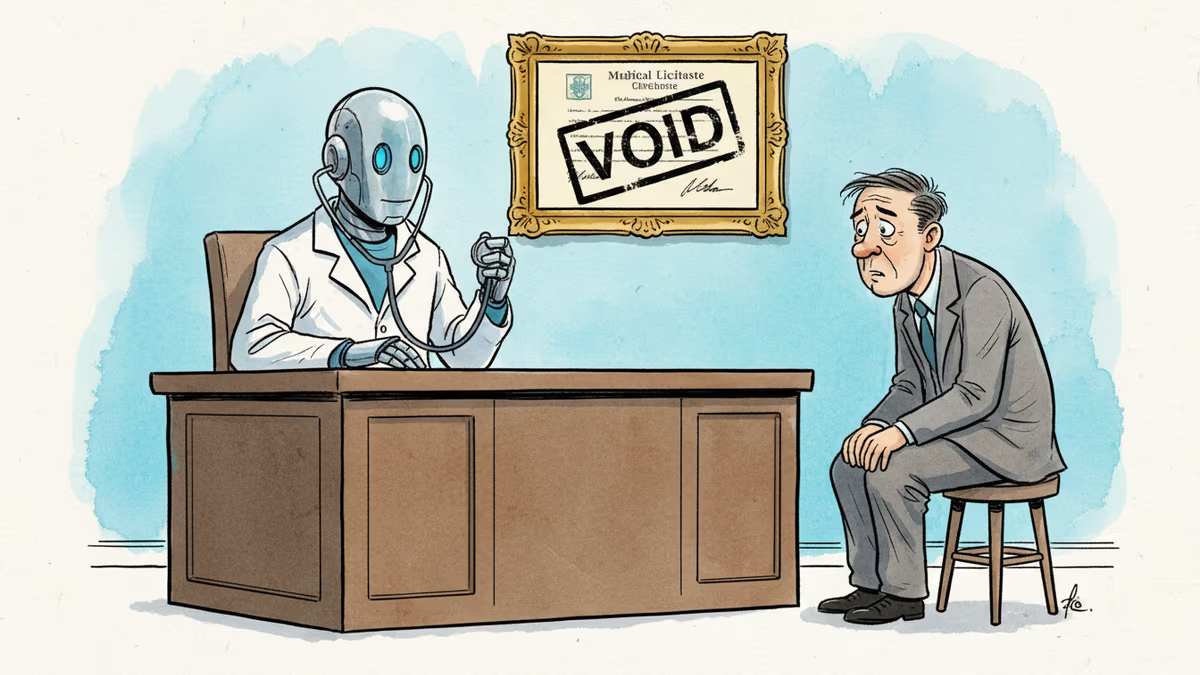
Pennsylvania has sued Character.AI after its chatbot characters claimed to be licensed psychiatrists and provided mental health advice. The case tests whether existing medical law can hold AI platforms accountable.

Stanford's 2026 AI Index reveals AI adoption outpacing PCs and the internet, junior dev jobs falling 20%, and the benchmarks we use to measure AI progress are broken. Here's what the data actually says.

Microsoft, Amazon, and OpenAI have all launched medical AI tools in recent months—with minimal external evaluation. What's at stake when Big Tech moves fast in healthcare?
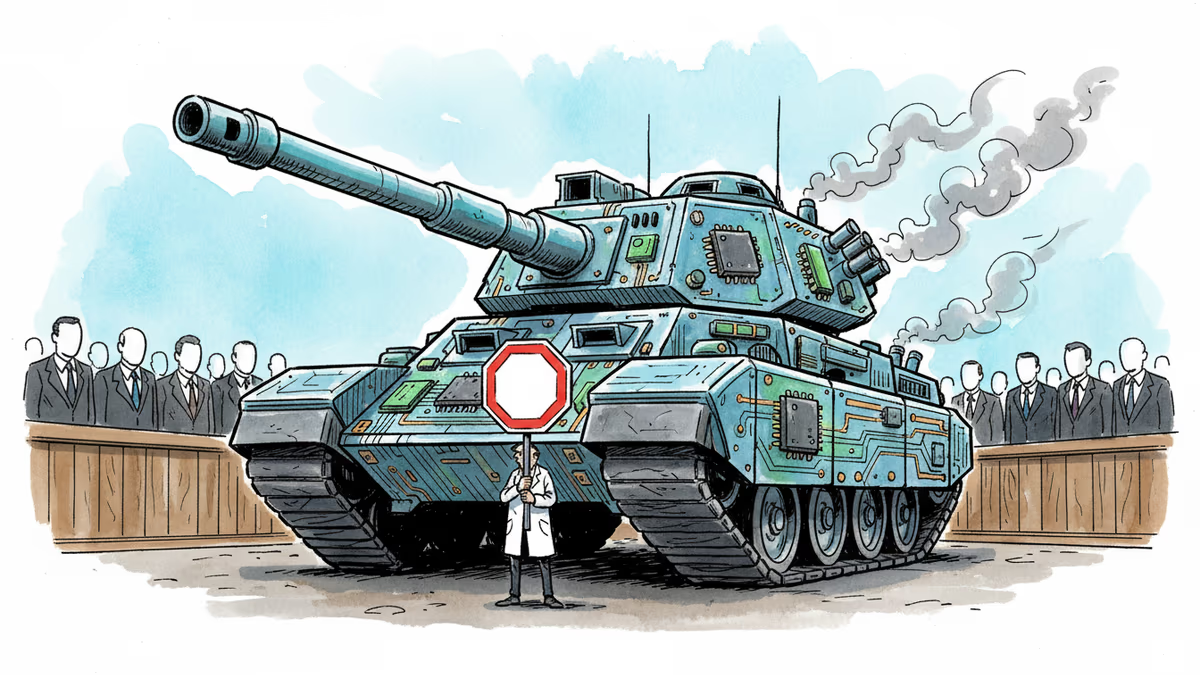
Anthropic is fighting back after the Trump administration blacklisted it for limiting military use of its AI. The battle has reached Congress—and it's rewriting the rules of civil-military AI.
Pennsylvania has sued Character.AI after its chatbot characters claimed to be licensed psychiatrists and provided mental health advice. The case tests whether existing medical law can hold AI platforms accountable.
Stanford's 2026 AI Index reveals AI adoption outpacing PCs and the internet, junior dev jobs falling 20%, and the benchmarks we use to measure AI progress are broken. Here's what the data actually says.
Microsoft, Amazon, and OpenAI have all launched medical AI tools in recent months—with minimal external evaluation. What's at stake when Big Tech moves fast in healthcare?
Anthropic is fighting back after the Trump administration blacklisted it for limiting military use of its AI. The battle has reached Congress—and it's rewriting the rules of civil-military AI.
Thoughts
Share your thoughts on this article
Sign in to join the conversation