
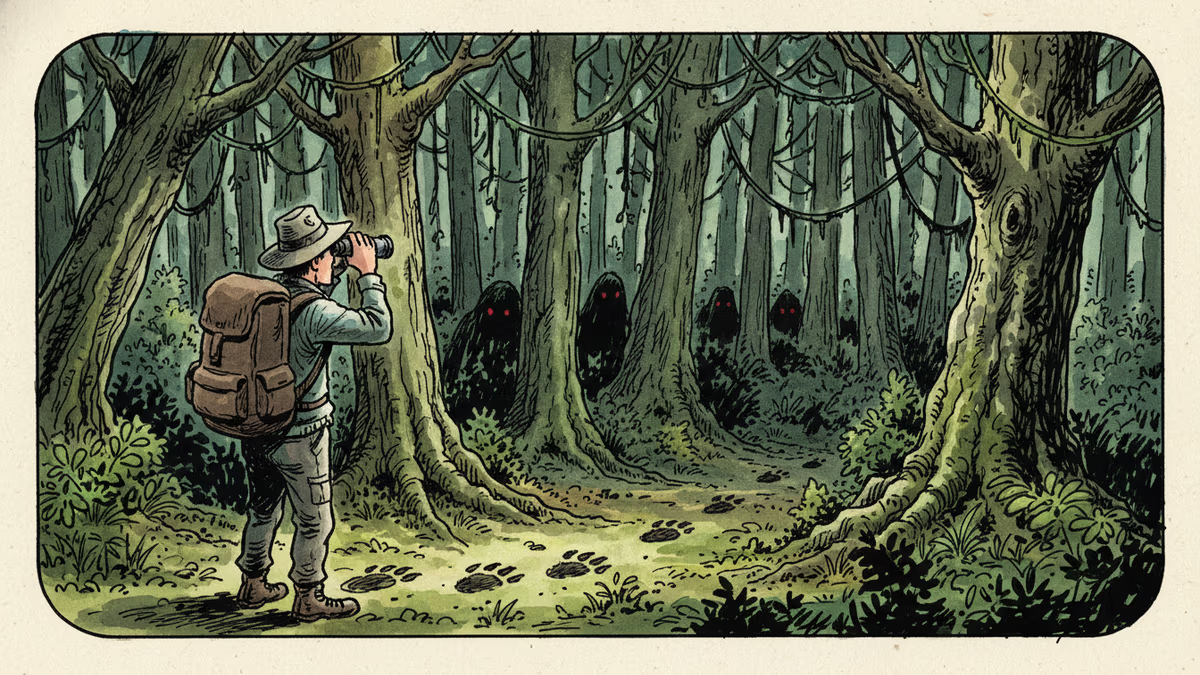
The Real Reason People Hunt for Bigfoot
Sociologists interviewed 130 'Bigfooters' to uncover what drives people to search for a creature that probably doesn't exist. The answer reveals something deeper about human nature.
The 7-Foot Mystery That Won't Die
It's arguably the most famous 59 seconds of cryptid footage ever shot. In 1967, somewhere in the forests of Northern California, Roger Patterson and Bob Gimlin captured something extraordinary: a towering, ape-like creature covered in dark fur, walking upright through the wilderness. At one pivotal moment, it turns to look directly at the camera—a glance that launched a thousand theories.
That grainy film clip became a cultural phenomenon. It's been parodied, analyzed, debunked, and defended countless times. It even got its own emoji. But here's what's really fascinating: despite decades of skepticism from mainstream science, people are still out there looking for Bigfoot.
They call themselves Bigfooters, and they're more organized than you might think. Armed with trail cameras, plaster casting kits, and audio recording equipment, they venture into the forests of Washington, California, Oregon, Ohio, Florida, and beyond, searching for evidence of North America's most elusive resident.
Why Spend Your Weekend Chasing Shadows?
Sociologists Jamie Lewis and Andrew Bartlett wanted to understand what drives this community. What makes someone dedicate precious time and resources to hunting for a creature that—let's be honest—probably doesn't exist?
During the pandemic lockdowns, Lewis conducted interviews with more than 130 Bigfooters and several academics. Their findings, published in the recent book "Bigfooters and Scientific Inquiry: On the Borderlands of Legitimate Science," reveal something unexpected about the nature of belief and community in the modern world.
It's Not Just About the Monster
Here's the twist: for most Bigfooters, it's not really about finding Bigfoot.

Sure, they'd love to discover definitive proof. But the interviews revealed deeper motivations. Many participants described their activities as community-building exercises. Online forums buzz with shared experiences, expedition planning, and mutual support. Weekend camping trips to "research hotspots" function as social gatherings for people who might otherwise never connect.
"I've made some of my best friends through this," one interviewee explained. "We share something that most people don't understand."
Then there's the adventure factor. For office workers and suburban dwellers, tramping through remote wilderness areas offers an escape from routine. Whether they spot a Sasquatch or just some interesting wildlife, participants consistently reported feeling refreshed and reconnected with nature.
The Science of Pseudo-Science
What surprised the researchers most was how scientific many Bigfooters try to be. They document findings, compare evidence, and debate methodologies with the seriousness of academic researchers. The difference lies in their standards of proof and willingness to entertain possibilities that mainstream science has largely dismissed.
"I was a skeptic until I had my own encounter," one participant shared. "Now I know there are things out there that science hasn't caught up with yet."
This represents what Lewis and Bartlett term "borderland science"—inquiry that exists outside established scientific institutions but doesn't completely reject scientific methods. It's a gray area where curiosity meets belief, and where the rules of evidence get... flexible.
The Deeper Hunt
Perhaps most tellingly, many Bigfooters expressed frustration with a world that seems increasingly mapped, measured, and explained. In an age of GPS satellites and Google Earth, the idea that something large and mysterious could still be out there offers a kind of hope.
"I don't want to live in a world where we've discovered everything," one interviewee said. "There should still be mysteries."
This sentiment points to something profound about human nature: our need for wonder, for the possibility that the world is bigger and stranger than we imagine. In a time when artificial intelligence can generate art and algorithms predict our preferences, perhaps hunting for Bigfoot is really about hunting for magic.
Authors
Related Articles

Samsung Electronics' union branch revealed that 84% of survey respondents oppose the government's roughly $290 billion (₩400 trillion) semiconductor megaproject in Gwangju. Government, management, the union and shareholders are all reading the same national project in sharply different ways.

Nvidia shipped roughly a billion RISC-V cores in 2024, then announced it would run CUDA on the open standard. We break down how royalty-free instruction sets and open software stacks are trying to route around CUDA's lock-in. Part 2 of the Semiconductor Sovereignty series.

US AI-chip export controls split into three layers in the first half of 2026 — January easing, a May crackdown on circumvention, and a pending bill. Nvidia erased China from its guidance and still posted a record $81.6 billion quarter. A look at the export policy that both shields and cages it.

AMD's MI325X matches or beats Nvidia on memory and bandwidth — yet Nvidia's 86-92% share holds. The real moat is CUDA, 20 years in the making. Part 1 of 4.
Samsung Electronics' union branch revealed that 84% of survey respondents oppose the government's roughly $290 billion (₩400 trillion) semiconductor megaproject in Gwangju. Government, management, the union and shareholders are all reading the same national project in sharply different ways.
Nvidia shipped roughly a billion RISC-V cores in 2024, then announced it would run CUDA on the open standard. We break down how royalty-free instruction sets and open software stacks are trying to route around CUDA's lock-in. Part 2 of the Semiconductor Sovereignty series.
US AI-chip export controls split into three layers in the first half of 2026 — January easing, a May crackdown on circumvention, and a pending bill. Nvidia erased China from its guidance and still posted a record $81.6 billion quarter. A look at the export policy that both shields and cages it.
AMD's MI325X matches or beats Nvidia on memory and bandwidth — yet Nvidia's 86-92% share holds. The real moat is CUDA, 20 years in the making. Part 1 of 4.
Thoughts
Share your thoughts on this article
Sign in to join the conversation