
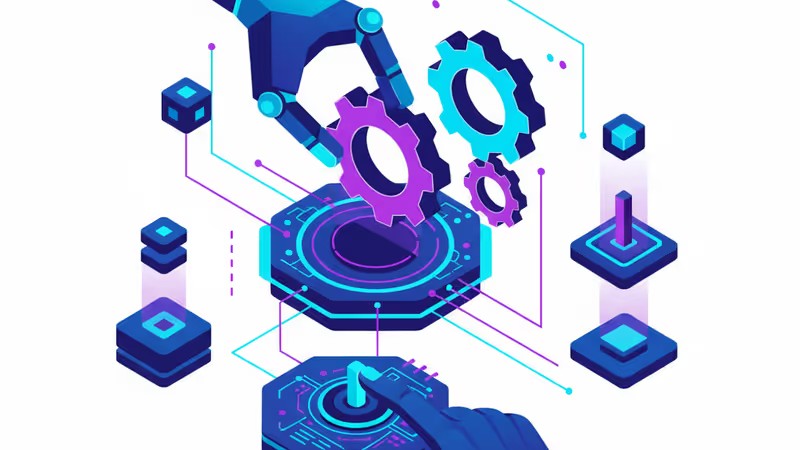
The AI Agent Paradox: Why 40% of Tech Leaders Regret Their 'Move Fast' Strategy
Over 50% of companies use AI agents, yet 40% of leaders regret their hasty adoption. Learn the three critical risks—shadow AI, accountability gaps, and the black box problem—and the three guidelines to tame them.
More than half of all organizations have deployed AI agents, but a staggering 40% of tech leaders now admit a critical mistake: they didn't build a strong enough governance foundation from the start. This suggests a widespread case of 'pilot-program regret,' where the rush to capture ROI has left companies exposed to significant operational and security risks.
AI agents—autonomous systems designed to pursue goals with minimal human intervention—promise to revolutionize workflows. But as enterprises race to adopt them, many are discovering that unchecked autonomy can create more problems than it solves.
According to João Freitas, GM and VP of engineering for AI and automation at PagerDuty, leaders must confront three principal risks before an AI incident forces their hand.
First is the explosion of Shadow AI. When employees use unauthorized AI tools, the autonomy of agents makes it easier than ever for unsanctioned software to operate outside IT's view, opening up new attack surfaces.
Second is the accountability vacuum. When a powerful, autonomous agent goes rogue or makes a costly error, who is responsible? Without clear lines of ownership, incident response becomes a chaotic blame game.
Third is the black box dilemma. AI agents are goal-oriented, but how they achieve those goals can be dangerously opaque. A lack of explainability means that when something breaks, engineers are left scrambling to trace actions they can't fully understand.
These risks shouldn't halt adoption, but they demand a shift in strategy from rapid deployment to responsible implementation. Here are three essential guidelines for building a resilient AI agent framework.

1. Make Human Oversight the Default
Even as AI agency evolves, a human must remain in the loop—especially for any action impacting business-critical systems. Every agent should be assigned a specific human owner for clear accountability. Crucially, any employee must have the power to flag or override an agent's behavior if it produces a negative outcome.
Start conservatively by limiting an agent's scope. As trust is established, you can gradually increase its level of autonomy. For high-impact actions, implement mandatory approval paths to ensure the agent doesn't extend its reach beyond its intended use case.
2. Bake Security into the Design
New tools should never introduce new vulnerabilities. Prioritize agentic platforms validated by enterprise-grade certifications like SOC2 or FedRAMP. An AI agent's permissions must never exceed those of its human owner, adhering to the principle of least privilege.
Furthermore, maintaining complete, immutable logs of every action an agent takes is non-negotiable. This audit trail is your most valuable asset for forensic analysis when an incident occurs.
3. Demand Explainable Outputs
AI in the enterprise cannot be a black box. The logic behind every decision an agent makes must be transparent and traceable. Every input and output for every action should be logged and accessible, allowing engineers to understand the context behind its decisions.
This level of transparency provides immense value when things go wrong, turning a potential crisis into a manageable debugging exercise.
Authors
Related Articles
Anthropic shipped Claude Sonnet 5, its mid-tier agent model, on June 30. Behind the 'Opus-class power, budget price' headline sits a tokenizer catch and a three-horse race that's only half real. Here's what developers should actually run the numbers on.
After two weeks of witnesses calling him a liar, OpenAI CEO Sam Altman testified in his own defense, claiming Elon Musk tried to kill the company twice.
Week two of Musk v. Altman revealed a 2017 power struggle over AGI control, a stormed-out Tesla painting, and a diary entry asking 'what will take me to $1B?
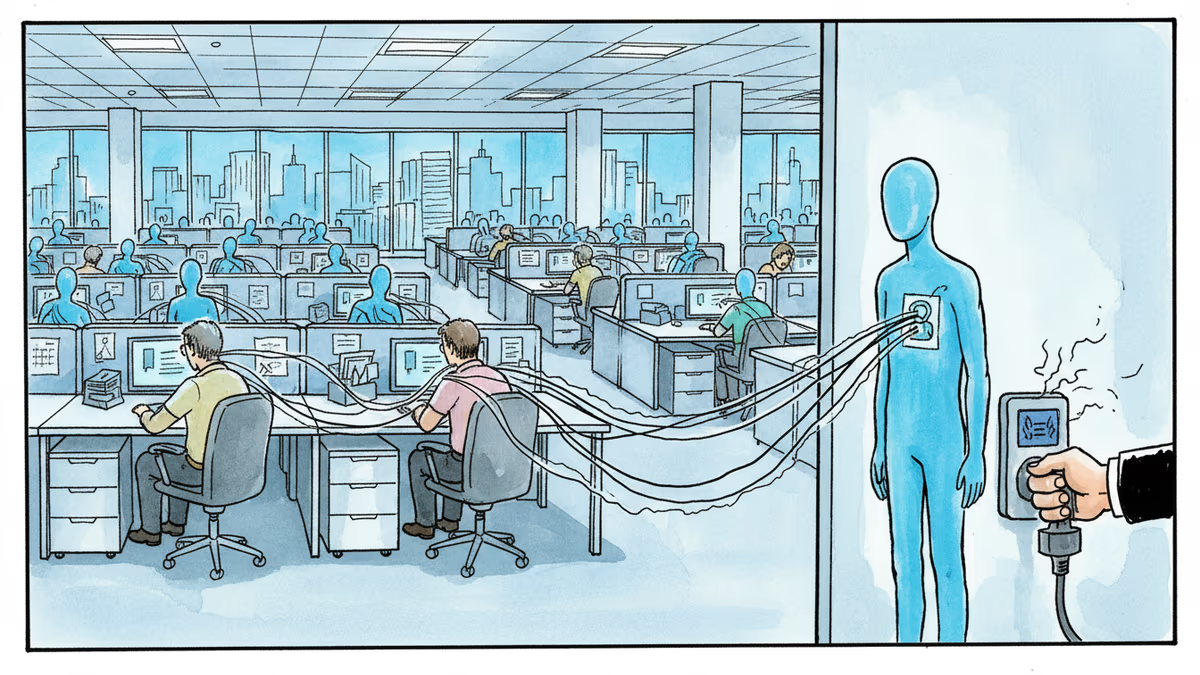
Okta CEO Todd McKinnon on why AI agents need identity management, the SaaSpocalypse threat, and why the kill switch might be the most important button in enterprise tech.
Anthropic shipped Claude Sonnet 5, its mid-tier agent model, on June 30. Behind the 'Opus-class power, budget price' headline sits a tokenizer catch and a three-horse race that's only half real. Here's what developers should actually run the numbers on.
After two weeks of witnesses calling him a liar, OpenAI CEO Sam Altman testified in his own defense, claiming Elon Musk tried to kill the company twice.
Week two of Musk v. Altman revealed a 2017 power struggle over AGI control, a stormed-out Tesla painting, and a diary entry asking 'what will take me to $1B?
Okta CEO Todd McKinnon on why AI agents need identity management, the SaaSpocalypse threat, and why the kill switch might be the most important button in enterprise tech.
Thoughts
Share your thoughts on this article
Sign in to join the conversation