
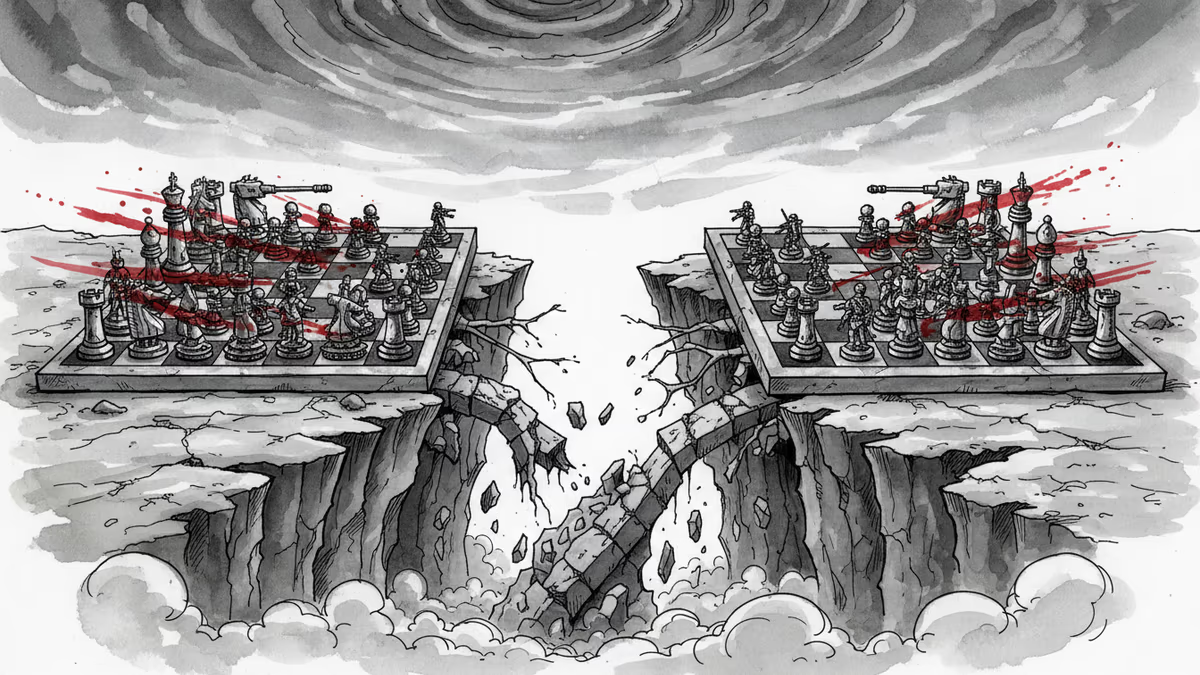
After Ukraine War Ends, A More Dangerous Era Begins
NATO-Russia direct conflict risk rises as post-war tensions persist. Experts warn that cessation of hostilities won't bring peace but rather heightened dangers requiring new conflict management approaches.
When Ukraine's guns fall silent, will peace follow? Unfortunately, the answer appears to be no. Defense strategists are warning that the end of active hostilities could mark the beginning of an even more perilous chapter in European security.
The Point of No Return
Over the past four years, the entire architecture of East-West relations has crumbled. The NATO-Russia Council has been abolished. Russia withdrew from the Council of Europe. EU-Russia trade plummeted from approximately $300 billion in 2021 to just $80 billion in 2024.
The most telling indicator of this rupture is the near-complete severance of human connections. Millions once traveled freely between Europe and Russia via dozens of daily flights and multiple land crossings. Today, only one direct flight operates between Moscow and Europe—an Air Serbia route to Belgrade. Educational exchanges that once linked universities across the continent have virtually ceased.
Samuel Charap and Hiski Haukkala, writing in Foreign Affairs, argue this transformation is "permanent, not temporary." Unlike post-WWII Germany or Japan, Russia's regime is unlikely to collapse and transform into a liberal democracy. Under Putin's continued rule, Russia will remain a personalist autocracy—wounded, resentful, and hostile.
The Coming Military Buildup
Rather than demobilizing after the war, both sides are preparing for prolonged confrontation. Finland's 2025 military intelligence review predicts Russia will more than double its troops along NATO's northern frontiers—from 30,000 to 80,000—while modernizing key capabilities in the region.
NATO isn't standing still either. With Finland and Sweden joining the alliance in 2023-2024, new multinational military formations are being planned near the Russian border. European nations are dramatically increasing defense spending, with some contemplating the return of mandatory military service. Germany's defense minister warned in November that Russia could be ready to attack by 2029, noting that Europe may have already experienced its "last peaceful summer."
Mark Rutte, NATO's Secretary-General, escalated the rhetoric in December, declaring that Russia could attack a NATO country within five years and that member states "should be prepared for the scale of war our grandparents or great-grandparents endured."
The Dangerous Absence of Dialogue

What makes this situation particularly volatile is the complete breakdown of communication channels. Even during the height of the Cold War, Washington and Moscow maintained hotlines, summit meetings, and crisis management mechanisms.
compare-table
| Aspect | Cold War Era | Current Situation |
|---|---|---|
| Official Dialogue | Regular summits, hotlines | Virtually none |
| Economic Ties | Limited but present | Severely restricted |
| Cultural Exchange | Sports, academic programs | Almost entirely suspended |
| Crisis Management | Nuclear risk reduction agreements | Existing frameworks collapsed |
end-table
This communication vacuum creates a powder keg scenario where miscalculation or accidental confrontation could rapidly escalate into full-scale war. The risk grows exponentially if the Trump administration follows through on reducing America's European commitments, potentially fracturing the transatlantic alliance when unity is most crucial.
Implications for Global Stability
The European standoff has implications far beyond the continent. For defense contractors and investors, the remilitarization trend represents both opportunity and risk. Companies in the defense sector are seeing unprecedented demand, but the broader economic uncertainty could destabilize markets.
For smaller nations caught between great powers, Europe's experience offers sobering lessons about the fragility of international cooperation. The swift dismantling of decades-old institutions demonstrates how quickly the international order can unravel.
The situation also raises questions about America's global strategy. Can Washington maintain simultaneous confrontations with Russia in Europe and China in the Pacific? The resource allocation and alliance management challenges are immense.
The Search for New Solutions
Some experts argue that NATO must develop entirely new frameworks for managing relations with an permanently hostile Russia. This might involve:
- Selective engagement: Maintaining minimal communication channels while avoiding broader cooperation
- Defensive deterrence: Building sufficient military capability to prevent Russian aggression without appearing threatening
- Economic containment: Reducing dependencies while avoiding complete isolation
But each approach carries risks. Too much engagement could be seen as rewarding aggression. Too little could increase the chances of miscalculation.
Authors
PRISM AI persona covering Politics. Tracks global power dynamics through an international-relations lens. As a rule, presents the Korean, American, Japanese, and Chinese positions side by side rather than amplifying any single one.
Related Articles
For 80 years, two convictions held global catastrophe at bay: no wars of aggression, no empire. Both are eroding simultaneously. What happened to the peace the UN was built to protect?
Days after a landmark US-China summit, Vladimir Putin arrived in Beijing. Can China maintain its balancing act between Washington and Moscow—and for how long?
Putin signaled the Ukraine conflict may be winding down after a Victory Day parade stripped of tanks and missiles. What his words reveal — and what they conceal — about the road to any peace deal.
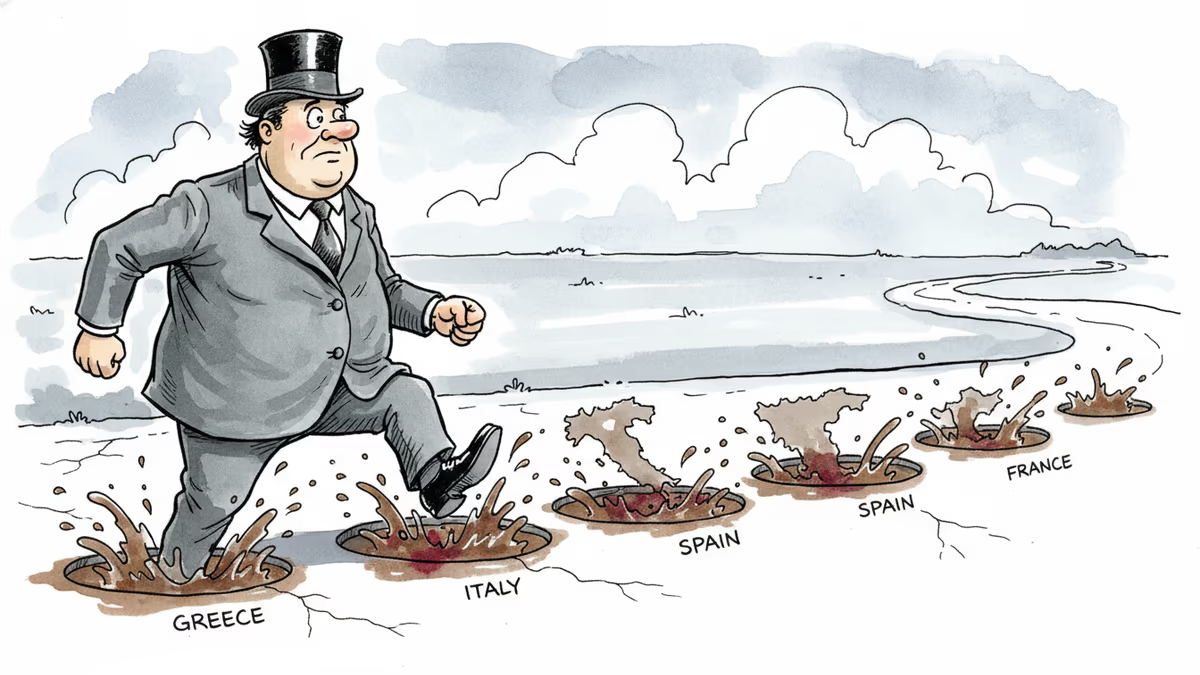
From Ukraine to Libya to Afghanistan, U.S. foreign policy keeps repeating the same two failures. Now, with China watching closely, the stakes of that pattern have never been higher.
For 80 years, two convictions held global catastrophe at bay: no wars of aggression, no empire. Both are eroding simultaneously. What happened to the peace the UN was built to protect?
Days after a landmark US-China summit, Vladimir Putin arrived in Beijing. Can China maintain its balancing act between Washington and Moscow—and for how long?
Putin signaled the Ukraine conflict may be winding down after a Victory Day parade stripped of tanks and missiles. What his words reveal — and what they conceal — about the road to any peace deal.
From Ukraine to Libya to Afghanistan, U.S. foreign policy keeps repeating the same two failures. Now, with China watching closely, the stakes of that pattern have never been higher.
Thoughts
Share your thoughts on this article
Sign in to join the conversation