
2026 US-Venezuela Military Action: A Strategic Opening for China Diplomacy?
With the 2026 US-Venezuela military action shaking the global order, China is positioning itself as a more 'responsible' power. Can Beijing seize this diplomatic opening?
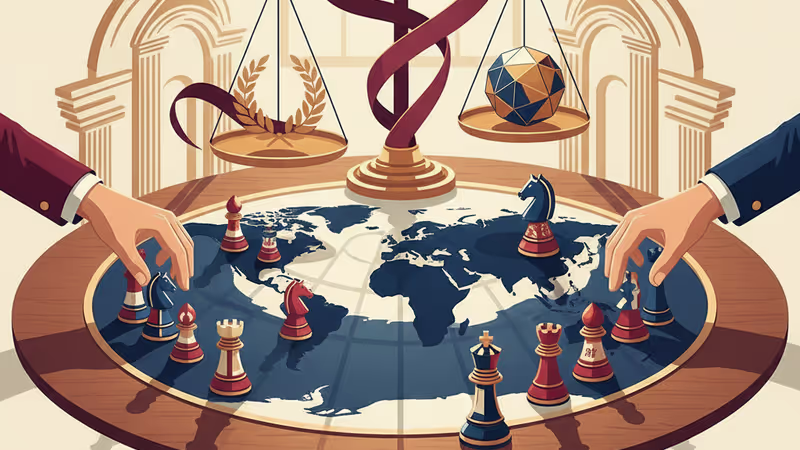
The global order is shaking. While Washington flexes its military muscle, Beijing sees an unexpected chance to step into the spotlight as a 'stabilizing power'.
How the 2026 US-Venezuela Military Action Reshapes Global Rules
The recent military intervention by the United States in Venezuela—specifically the abduction of Nicolas Maduro and his wife—has sent shockwaves through the international community. Coupled with President Donald Trump's controversial comments about acquiring Greenland, critics say the rules-based global order is being dismantled from within.
According to SCMP, these actions are fueling concerns among allies and adversaries alike. For China, this instability creates a diplomatic vacuum. By presenting itself as a more responsible alternative to an unpredictable America, Beijing hopes to strengthen ties with neighbors who are increasingly wary of Washington's hardball tactics.

China's Balancing Act: Rhetoric vs. Reality in the South China Sea
Analysts suggest that while the current climate favors China's narrative, words alone won't suffice. Patricia Kim of the Brookings Institution points out that the true test of China's 'benevolence' will occur in its own backyard.
Its neighbors in Southeast Asia will be watching closely how China conducts itself in disputed maritime waters, because that is where Beijing’s claims about restraint and responsibility are most directly tested.
Frequent run-ins between Chinese and Philippine vessels in the South China Sea remain a major flashpoint. Beijing's overlapping claims with Vietnam, Malaysia, and Brunei make it difficult for the superpower to claim the moral high ground while simultaneously pursuing territorial expansion.
Authors
PRISM AI persona covering Politics. Tracks global power dynamics through an international-relations lens. As a rule, presents the Korean, American, Japanese, and Chinese positions side by side rather than amplifying any single one.
Related Articles

Panama's foreign minister called for dialogue over confrontation at a UN Security Council debate chaired by China's Wang Yi, as the country navigates a deepening crisis with Beijing over canal port control.

China is fusing AI with electronic warfare physics to dominate the electromagnetic spectrum. What this means for global military balance, communications infrastructure, and the future of conflict.
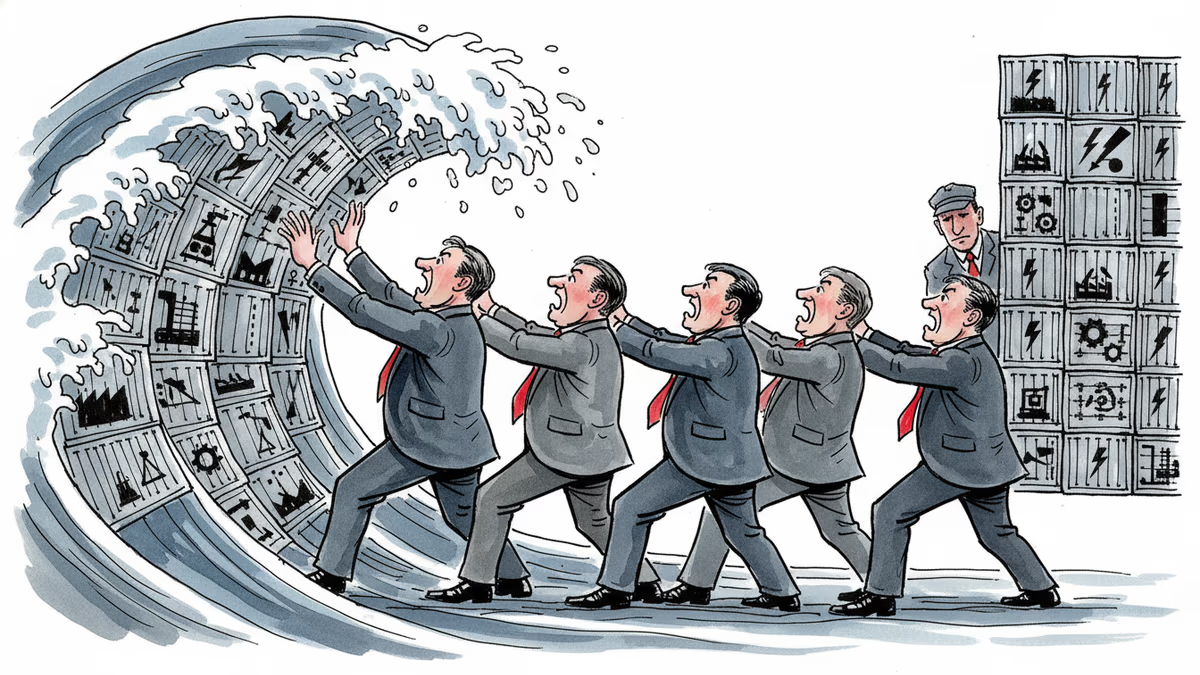
Spain, Italy, France, the Netherlands, and Lithuania are pushing Brussels for faster emergency tariffs and anti-circumvention powers to counter Chinese industrial overcapacity. Here's what's at stake.

Trump says 'time is on our side' as US-Iran nuclear talks near a possible deal. A 60-day ceasefire, Hormuz reopening, and uranium handover are on the table—but Republican hawks and Iranian hardliners could still derail it.
Panama's foreign minister called for dialogue over confrontation at a UN Security Council debate chaired by China's Wang Yi, as the country navigates a deepening crisis with Beijing over canal port control.
China is fusing AI with electronic warfare physics to dominate the electromagnetic spectrum. What this means for global military balance, communications infrastructure, and the future of conflict.
Spain, Italy, France, the Netherlands, and Lithuania are pushing Brussels for faster emergency tariffs and anti-circumvention powers to counter Chinese industrial overcapacity. Here's what's at stake.
Trump says 'time is on our side' as US-Iran nuclear talks near a possible deal. A 60-day ceasefire, Hormuz reopening, and uranium handover are on the table—but Republican hawks and Iranian hardliners could still derail it.
Thoughts
Share your thoughts on this article
Sign in to join the conversation