

Innospace Rocket Crashes 30 Seconds After Liftoff in Setback for South Korea's Private Space Bid
South Korean startup Innospace's first commercial rocket, the Hanbit-Nano, crashed 30 seconds after launching from Brazil. This analysis covers the mission failure, the technology involved, and the implications for the private space race.
South Korea's first commercial orbital rocket, the Hanbit-Nano, crashed just seconds after its launch from Brazil, its operator Innospace Co. confirmed. The vehicle, carrying five customer satellites, lifted off from the Alcantara Space Center on Monday evening local time but fell back to Earth just 30 seconds later due to a reported "abnormality."
The failure marks a significant setback for the startup's ambition to become the first private South Korean company to place a commercial satellite into orbit. According to the company, the rocket crashed within a designated ground safety zone, and no casualties or additional damage were reported.
A Fiery, Short-Lived Flight

The rocket blasted off at 10:13 p.m. local time, according to a Yonhap report. A YouTube livestream of the event reportedly showed flames appearing immediately after liftoff before the broadcast was suspended. Innospace later confirmed the vehicle's failure and crash.
The launch had already faced three postponements from its original November 22 date, adding to the pressure on this inaugural commercial mission. A success would have been a landmark moment for South Korea's burgeoning private space industry.
The Mission and the Machine
The Hanbit-Nano was tasked with a high-stakes delivery: deploying a payload of five satellites into a 300-kilometer low Earth orbit. The two-stage vehicle was powered by a 25-ton thrust hybrid engine for its first stage, with a liquid methane and oxygen engine for the second stage.
Authors
Related Articles
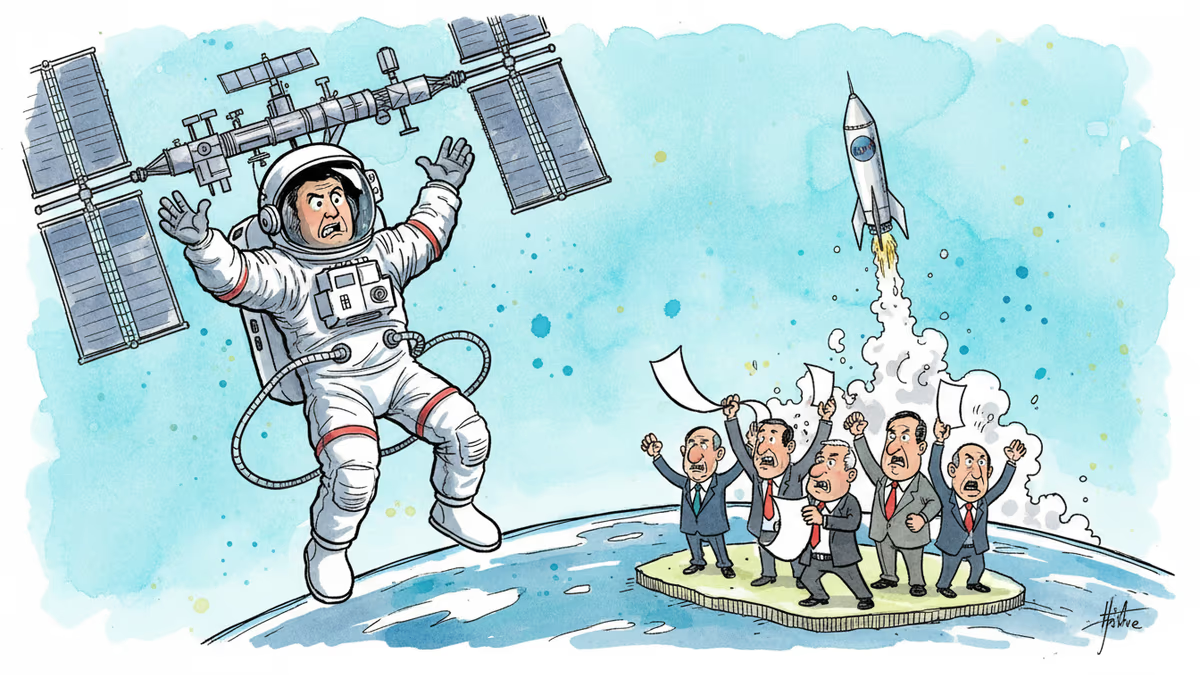
Senator Ted Cruz pressures NASA with legislation after the agency delays competition for ISS replacement. The political battle reveals deeper tensions in space commercialization.

After 15 years of appeals, Google receives conditional approval to export high-precision geographic data from South Korea, enabling full Google Maps functionality and challenging local navigation apps.

US allies like Australia, Canada, Germany, and Spain are investing billions to build domestic launch capabilities, challenging American and Chinese dominance in space access

Nvidia and the South Korean Science Ministry have agreed to swiftly set up a new R&D center in 2026, focusing on AI startups and semiconductor R&D.
Senator Ted Cruz pressures NASA with legislation after the agency delays competition for ISS replacement. The political battle reveals deeper tensions in space commercialization.
After 15 years of appeals, Google receives conditional approval to export high-precision geographic data from South Korea, enabling full Google Maps functionality and challenging local navigation apps.
US allies like Australia, Canada, Germany, and Spain are investing billions to build domestic launch capabilities, challenging American and Chinese dominance in space access
Nvidia and the South Korean Science Ministry have agreed to swiftly set up a new R&D center in 2026, focusing on AI startups and semiconductor R&D.
Thoughts
Share your thoughts on this article
Sign in to join the conversation