
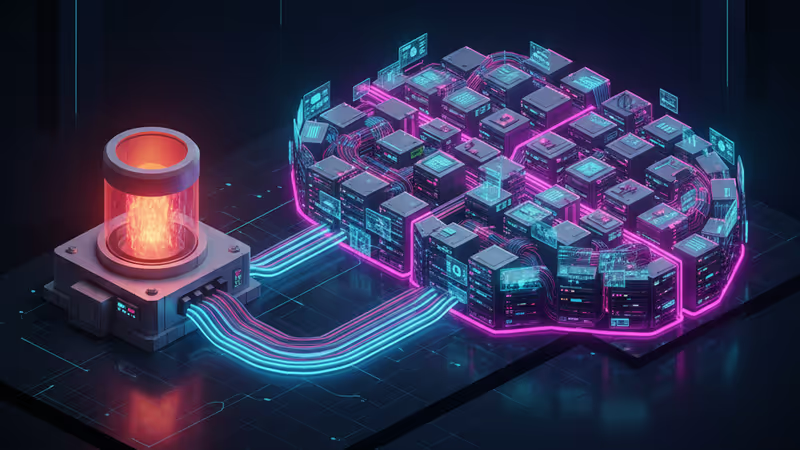
The Un-Sexy Nuclear Startup That Could Power the AI Revolution
Last Energy's $100M raise signals a major shift in nuclear tech. Discover why their 'boring' 1960s reactor design could be the key to powering the AI boom.
The Lede
The artificial intelligence boom is built on a simple, brutal equation: more compute requires more power. With global electricity grids already strained, a new cohort of nuclear startups is racing to fill the gap. But while many chase futuristic designs, Last Energy just raised $100 million for a surprisingly retro idea: mass-producing a small, simple reactor based on a 1960s design. This isn't a moonshot; it's a factory-floor bet that the key to unlocking nuclear's future lies in its past.
Why It Matters
Last Energy's strategy signals a crucial pivot in the energy sector, shifting from bespoke, decade-long mega-projects to standardized, manufactured products. For the tech industry, this represents a potential paradigm shift from being a passive consumer of grid power to a direct commissioner of its own private, carbon-free energy sources. The second-order effect is profound: data centers, AI foundries, and large industrial sites could decouple from the public grid, creating micro-grids that offer predictable pricing, energy security, and a solution to the AI industry's looming power bottleneck. This changes the calculus for where a multi-billion dollar data center can be built, potentially unlocking development in regions with underdeveloped grid infrastructure.
The Analysis
From Moonshot to Assembly Line: The SMR Pivot
The buzz around Small Modular Reactors (SMRs) has been building for years, promising a safer, cheaper, and faster alternative to conventional nuclear plants. Yet the industry has been plagued by delays and cost overruns. Last Energy, alongside competitors like X-Energy and Antares, is riding a new wave of investment fueled by the insatiable energy demands of AI. But their approach is fundamentally different. Instead of investing in novel physics or exotic coolants, Last Energy is focusing on what it calls "mass-produced power."
Their bet is that the primary obstacle to nuclear power isn't the science—it's the economics of construction. By using a simple, proven design, they aim to move the complex work from a construction site to a factory assembly line, hoping to achieve the kind of cost reductions seen in industries like aerospace and automotive.
De-Risking Deep Tech: The 'NS Savannah' Playbook
The core of Last Energy's offering is a pressurized water reactor design first proven on the NS Savannah, the world's first nuclear-powered merchant ship. This is a deliberate strategy to sidestep decades of R&D and, crucially, regulatory uncertainty. By adopting a design that has a long history of safe operation, the company drastically reduces technical and regulatory risk—two of the biggest hurdles for any new nuclear venture.
This "boring is better" approach offers a playbook for other capital-intensive deep tech sectors. It suggests that innovation doesn't always require reinventing the wheel; sometimes, the most disruptive path is to apply modern manufacturing and business models to proven, reliable technology. It transforms the investor pitch from a high-risk science experiment into a more predictable manufacturing and logistics challenge.
PRISM Insight: The Reactor as a Product
Investment & Market Impact
The most radical part of Last Energy’s model isn't the reactor; it's the business strategy. They are selling a standardized power product, not a one-off construction project. This has several critical implications for investors and customers:
- Simplified Supply Chain: The company plans to encase each reactor core in 1,000 tons of steel, which arrives pre-fueled and acts as the final waste cask. This elegantly addresses two of the biggest public and political concerns with nuclear energy—on-site safety and long-term waste disposal—in a single engineering solution.
- Predictable Costs: By moving to a manufacturing model, Last Energy aims to offer a fixed price and a clear delivery timeline, a stark contrast to the notoriously unpredictable costs and schedules of traditional nuclear builds. This is essential for customers like data center operators who need to plan capacity years in advance.
- New Financial Model: This approach de-risks investment. Capital is being deployed to scale a manufacturing process, not to fund open-ended R&D. Success will be measured in units produced and deployed, much like selling server racks or turbines, creating a scalable, repeatable revenue model that is far more attractive to venture and growth equity investors than traditional project finance.
PRISM's Take
While competitors chase the next great breakthrough in fission, Last Energy is making a calculated bet that the future of nuclear power won't be defined by new physics, but by old-school industrial execution. By treating a reactor less like a monumental cathedral and more like a server rack—standardized, factory-built, and delivered as a complete product—they may have finally cracked the code on making nuclear power cheap, fast, and scalable enough to fuel the AI revolution. This isn't just an energy play; it's a manufacturing and logistics play disguised as a nuclear startup. And that pragmatism is precisely why it's attracting serious capital and could fundamentally reshape the energy landscape for the coming decade.
관련 기사
소니와 텐센트의 '호라이즌 클론' 게임 소송이 초고속 합의로 종결되었습니다. 이는 글로벌 게임 업계의 IP 보호와 거대 기업 간의 역학 관계에 대한 중요한 신호입니다.

OpenAI가 ChatGPT 앱 디렉토리와 SDK를 공개했습니다. 이는 AI가 차세대 운영체제로 진화하는 변곡점으로, 새로운 플랫폼 전쟁과 기회의 시작을 의미합니다.

인스타카트의 AI 가격 책정 도구가 FTC 조사를 받습니다. 단순한 A/B 테스트일까, 아니면 알고리즘에 의한 가격 차별의 시작일까? AI 시대의 공정성에 대한 심층 분석.
인도가 타타, 인텔과 손잡고 반도체 공급망의 새로운 허브로 부상하고 있습니다. '탈중국' 시대, 인도의 전략적 행보와 시장에 미칠 영향을 심층 분석합니다.