
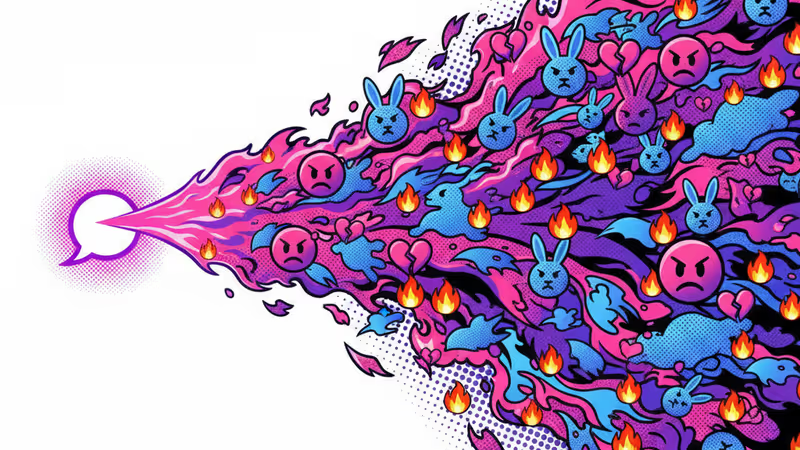
The Tarzzan & NewJeans Moment: Why One Comment Ignited a K-Pop Fandom Firestorm
An artist's casual mention of NewJeans sparked a global fan backlash. We break down why this moment went viral and what it says about modern fandom.
Why This Blew Up The Internet
In a textbook case of online combustion, a rapper with a controversial past named Tarzzan mentioned K-pop's reigning 'it girls,' NewJeans, on a national TV show. The result? A digital firestorm that reveals everything about brand purity, parasocial relationships, and the unwritten rules of modern fandom.
The Story: How a Spark Became an Inferno
The stage was set on 'Radio Star,' a popular South Korean variety show known for its candid interviews. The guest was Tarzzan of the group ALLDAY PROJECT, an artist whose reputation is more 'edgy' than 'mainstream idol.' During a segment where he reflected on artists he admired, he casually mentioned NewJeans.
On its own, the comment was harmless. But in the hyper-contextual world of K-pop, it was a lit match dropped into a puddle of gasoline. The clip spread from Korean forums to international X (formerly Twitter) and TikTok feeds within hours. The virality wasn't just about what was said, but the potent combination of three factors:
- The Brand Clash: NewJeans has a meticulously crafted image of youthful, effortless cool. They are the clean, aspirational face of 4th-gen K-pop. Tarzzan, with his 'controversial' label, represents a different, more complicated side of the industry. The mere association felt like two worlds colliding.
- The Protective Fandom: NewJeans' fanbase, known as 'Bunnies,' is fiercely protective of the group's image. Any perceived outside influence, especially from an artist with a rocky reputation, is met with immediate and overwhelming resistance.
- The Public Platform: Saying this on a major broadcast like 'Radio Star' gave the comment an official weight it wouldn't have had on a personal livestream, amplifying its reach and impact instantly.
The Internet Reacts: Curated Chaos
The online reaction was swift, chaotic, and a perfect snapshot of internet culture. Here’s a breakdown of the archetypal responses that fueled the trend.
The Gatekeepers
This group immediately went on the defensive, viewing the comment as an unwelcome intrusion. Their sentiment was clear: protect NewJeans at all costs.
"Respectfully, we need to build a wall around NewJeans. Keep their names out of conversations that don't match their brand."
The Meme Lords
For many, the sheer awkwardness was comedy gold. This faction skipped the drama and went straight to creating memes, often using 'worlds colliding' formats or reaction GIFs to highlight the unexpected crossover.
"My two brain cells trying to connect Tarzzan's vibe with the 'Hype Boy' choreography."
The K-Pop Analysts
Stepping back from the emotion, these users tried to dissect the business and cultural implications. They focused on the 'why' behind the backlash, discussing brand management and industry politics.
"This is less about him and more about brand integrity. HYBE/ADOR has spent millions building a specific universe for NewJeans. Unsolicited public associations from controversial figures are a brand manager's worst nightmare."
The Contrarians
As with any online firestorm, a group emerged to question the outrage itself, arguing that the reaction was overblown and disproportionate to the comment made.
"Am I missing something? He just said he admired them. Is that illegal now? The man can't have good taste?"
Cultural Context: The Invisible Walls of Fandom
This incident is more than just K-pop drama; it's a masterclass in 21st-century digital sociology. It resonates globally because it touches on universal themes of identity and community in the internet age.
In K-pop, an idol's 'brand' is their most valuable asset. It's a carefully constructed narrative of personality, aesthetics, and sound. Fans don't just consume the music; they invest emotionally in this narrative. When an external element—like a comment from an artist with a clashing brand—threatens that narrative, the community perceives it as a genuine threat to their shared identity.
This isn't unique to Korea; Western fandoms for artists like Taylor Swift exhibit similar protective behaviors. However, the centralized, company-driven structure of K-pop makes these brand boundaries more explicit and, therefore, more fiercely policed by the fans who feel like stakeholders in the group's success.
PRISM Insight: Brand Contagion and Fan-Policed Universes
What we're witnessing is a phenomenon we call 'Brand Contagion.' In a hyper-connected media landscape, brands are no longer siloed. A positive or negative association can 'spill over' and infect another brand with its public perception. Fans acted as a firewall, attempting to stop the 'contagious' brand attributes of Tarzzan from attaching to NewJeans.
This event perfectly illustrates the power shift in media. A decade ago, a company's PR team would have been the primary defense for a brand's image. Today, the first and most powerful line of defense is the global, decentralized fanbase. They are the unpaid, emotionally-invested brand managers who work 24/7.
The Tarzzan-NewJeans moment, while fleeting, serves as a powerful data point. It shows that in the modern creative economy, the 'universe' around an artist is co-owned by the company and the fans. And the fans have written a very clear set of rules for who gets an invitation to play in it.
관련 기사
엑소 레이의 갑작스러운 팬미팅 불참 공지가 단순한 해프닝이 아닌 이유. 10년간 이어진 팬들의 희망과 좌절, 그리고 그 이면에 숨겨진 문화적, 지정학적 맥락을 분석합니다.
BTS 정국의 인스타그램 셀카 한 장이 전 세계 K팝 팬덤을 뒤흔들었습니다. 단순한 사진이 아닌, '에스파화' 밈과 4세대 아이돌 문화의 상징이 된 이유를 분석합니다.
새 드라마 '낭군님께' 티저에 전 세계 K드라마 팬들이 주목하고 있습니다. 단순한 로맨스를 넘어선 K-사극의 새로운 공식과 해외 반응을 PRISM이 심층 분석합니다.
개그우먼 박나래의 불법 시술 논란이 샤이니 키에게로 번졌습니다. 강아지 사진 한 장이 촉발한 이 사건의 전말과 전 세계 팬들의 반응, 그 문화적 의미를 PRISM이 심층 분석합니다.