
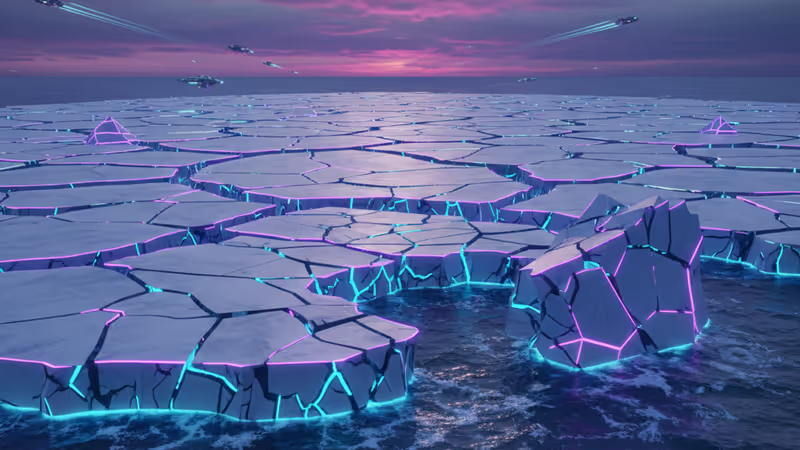
‘Doomsday Glacier’ Is Tearing Itself Apart, New Study Shows Startling Feedback Loop
A new study reveals Antarctica's 'Doomsday Glacier' is caught in a self-destructive feedback loop. Cracks are accelerating its flow, which in turn creates more cracks, speeding its path to collapse.
Antarctica's Thwaites Glacier, known as the “Doomsday Glacier” and one of the biggest unknowns in predicting global sea-level rise, is caught in a dangerous feedback loop, actively accelerating its own collapse. A new study from the International Thwaites Glacier Collaboration (ITGC) presents a detailed, alarming record of how the glacier's crucial eastern ice shelf is tearing itself apart from the inside out.
Researchers analyzing two decades of observational data (2002-2022) discovered that as cracks riddle the ice, the glacier's flow speeds up. This acceleration, in turn, generates even more cracks, creating a vicious cycle. According to the study, this process has effectively severed the ice shelf's connection to a stabilizing undersea ridge, transforming it from an anchor into a point of weakness.
A System Under Stress: The Damage in Numbers - **Total Crack Length**: Increased from ~**165 km** in 2002 to ~**336 km** in 2021. - **Ice Structure Change**: Instead of a few long cracks, the shelf is now fractured by numerous smaller ones, doubling the total fissure length and indicating widespread structural decay. - **Collapse Propagation**: During the winter of 2020, structural damage was observed propagating upstream at a rate of approximately **55 kilometers per year**.
The study reveals the weakening happened in distinct phases. First, long cracks grew along the direction of ice flow. Then, a swarm of shorter, cross-flow cracks emerged, shattering the shelf's integrity. GPS devices placed on the ice between 2020 and 2022 directly recorded this feedback loop in action, confirming that weakening in one area rapidly destabilizes the ice far upstream.
The researchers warn this pattern could be a playbook for how other Antarctic ice shelves collapse. The complete disintegration of Thwaites holds enough ice to raise global sea levels by about 65 centimeters (over 2 feet). This new evidence of a self-reinforcing collapse suggests that existing timelines for its demise may be too conservative.
PRISM Insight: The Thwaites Glacier is a real-time demonstration of a climate tipping point moving from theory to observation. This feedback loop shows how Earth's systems can shift into a state of non-linear, accelerated change, outpacing the linear projections of older climate models. It's a critical warning that the consequences of climate change may not only be severe but could also arrive far more suddenly than anticipated, challenging our infrastructure and economic stability.
본 콘텐츠는 AI가 원문 기사를 기반으로 요약 및 분석한 것입니다. 정확성을 위해 노력하지만 오류가 있을 수 있으며, 원문 확인을 권장합니다.
관련 기사

12년간 ULA를 이끌던 토리 브루노 CEO가 사임했다. 스페이스X와의 경쟁 속에서 차세대 로켓 벌칸을 막 발사한 시점, 그의 퇴장이 우주 산업에 미칠 영향을 분석한다.

마이크로소프트 비지오 2021 프로페셔널 윈도우 버전의 영구 라이선스를 96% 할인된 9.97달러에 구매하세요. 구독 없이 전문가용 다이어그램 툴을 소유할 기회입니다.

소니의 인기 헤드폰 WH-1000XM5가 블랙 프라이데이 가격인 248달러로 다시 돌아왔습니다. 신형 XM6 모델과 비교해 성능 차이는 미미해, 현시점 최고의 가성비 선택지로 떠올랐습니다.

인텔 모빌아이가 뉴욕시와 협력, 4,500대 차량의 '준사고' 데이터를 분석해 교통사고를 예방하는 '비전 제로' 프로젝트를 시작합니다. 데이터 기반의 선제적 인프라 개선이 핵심입니다.