
The Legacy of Trump's Department of Government Efficiency: A 2025 Autopsy
A deep dive into the Trump administration's 2025 attempt to create a Department of Government Efficiency. We analyze its goals, the fierce controversy it ignited, and its lasting impact on the future of U.S. governance.
In 2025, the Trump administration's push to establish a Department of Government Efficiency became one of its most consequential and polarizing initiatives. The ambitious effort, aimed at radically streamlining the federal bureaucracy, sparked a fierce political battle and ultimately yielded a mixed legacy of limited successes and significant pushback.
The administration's rationale was straightforward: to consolidate redundant functions, cut wasteful spending, and reduce the burden on taxpayers by shrinking a federal government it deemed bloated. Proponents argued this would speed up decision-making and deliver more effective services to the American public.
The initiative was widely seen as a direct implementation of ideas from 'Project 2025', a comprehensive transition plan developed by conservative groups. This roadmap was designed to enable a new conservative administration to assert control over the federal apparatus, with 'government efficiency' as a central theme.
However, the proposal met with immediate and stiff resistance. Democrats, federal employee unions, and watchdog groups decried it as an attack on civil service protections and an attempt to politicize government functions under the guise of 'efficiency.' The controversy intensified as the plan included measures to significantly curtail the authority of agencies like the Environmental Protection Agency (EPA) and the Department of Education.
"This isn't a reform for efficiency," one policy analyst from a think tank wrote at the time. "It's a power grab designed to centralize authority in the executive branch, bypassing the checks and balances of congressional oversight and judicial review."
After months of political wrangling, legislation to formally create the new department failed to pass Congress. Instead, President Trump used executive orders to enact partial reforms, merging some smaller agencies and reassigning functions within certain departments. According to the Office of Management and Budget (OMB), these actions resulted in an estimated $15 billion in savings in 2025, a figure that, while substantial, fell far short of the administration's initial projections.
본 콘텐츠는 AI가 원문 기사를 기반으로 요약 및 분석한 것입니다. 정확성을 위해 노력하지만 오류가 있을 수 있으며, 원문 확인을 권장합니다.
관련 기사

시리아, 가자 분쟁부터 언론인 피살 사건, 기후 위기까지. 우리 시대의 가장 어려운 진실을 기록한 다큐멘터리들을 통해 분쟁 저널리즘의 역할과 그들이 던지는 질문을 분석한다.
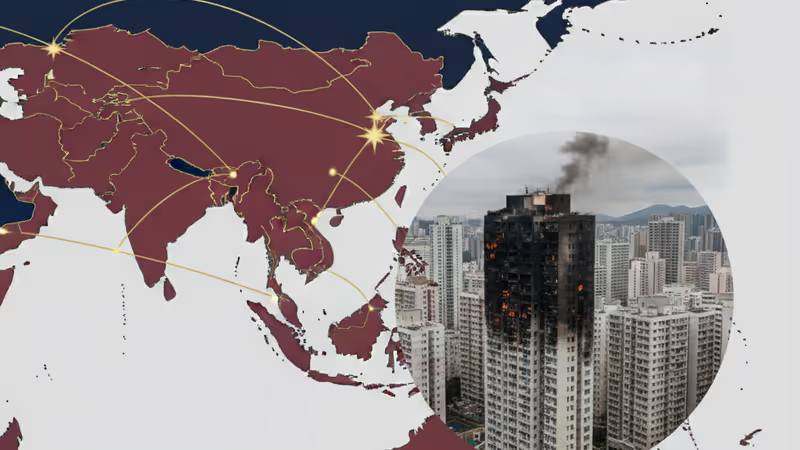
홍콩 타이포구 대형 화재로 159명이 사망하며 도시의 고질적인 주택 위기가 다시 수면 위로 떠올랐다. 이번 참사는 단순한 재난을 넘어 홍콩의 정치, 경제, 사회 시스템의 근본적 취약성을 드러낸다.

애덤 스미스 미 하원 군사위원장이 트럼프 행정부의 베네수엘라 석유 봉쇄는 마두로 정권 교체를 위한 정치적 도구라고 주장했습니다. 행정부의 공식 입장과 상반되는 이 발언의 배경과 의미를 분석합니다.

과거 말레이시아의 변방이었던 사라왁주가 어떻게 중앙 정치의 분열을 기회로 삼아 녹색 에너지와 첨단 기술을 중심으로 한 경제 강국으로 부상하고 있는지 심층 분석합니다.