
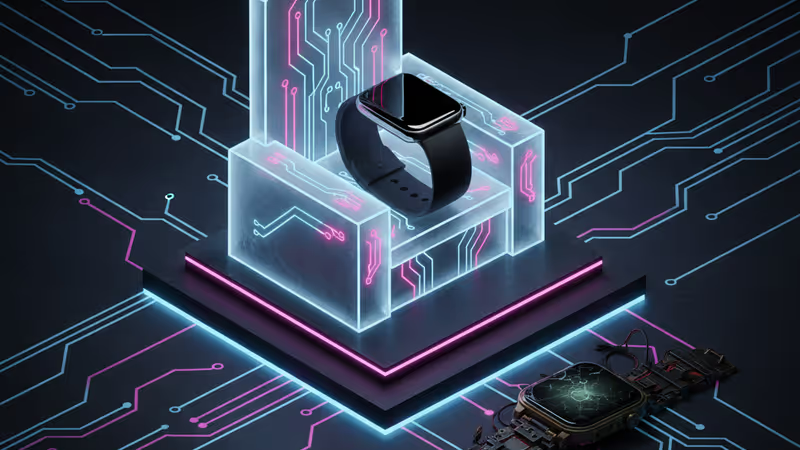
The Apple Watch SE Just Killed the Flagship: A Masterclass in Market Cannibalization
Apple's new Watch lineup isn't an upgrade, it's a strategic sacrifice. Discover why the 'entry-level' SE is now the default choice, and what it means for the future of wearables.
The Lede: The Smartest Purchase Isn't the 'Best' Watch
Apple's latest refresh of its smartwatch lineup isn't just about iterative hardware updates; it's a seismic shift in strategy. The most important product in the new portfolio is not the flagship Series 11, but the supposedly 'entry-level' SE 3. By packing the SE with features previously reserved for premium models—like an always-on display and the powerful S10 chip—Apple has deliberately made its own mid-tier offering nearly obsolete. This isn't a mistake; it's a calculated masterstroke in market segmentation that redefines the entire wearable landscape.
Why It Matters: The 'Good Enough' Revolution Comes to Your Wrist
For years, the smartwatch upgrade cycle has been driven by headline-grabbing health sensors. But the latest lineup signals a new era. The value proposition is bifurcating to two extremes: the exceptional value of the SE and the uncompromising performance of the Ultra. The middle-ground, represented by the Series 11, is being intentionally squeezed.
This matters because it changes the calculus for both consumers and competitors. Consumers no longer need to pay a premium for a near-premium experience. Competitors like Samsung and Google are now forced to contend with an Apple entry-level device that leapfrogs their mid-range offerings. Apple is effectively saying the core smartwatch experience is now a solved problem, and it's making that solved experience more accessible than ever, thereby strengthening its ecosystem's gravity.
The Analysis: Deconstructing Apple's Aggressive New Playbook
The iPhone Strategy, Perfected for the Watch
We've seen this movie before. The current Apple Watch strategy—SE (Value), Series (Core), Ultra (Pro)—is a direct echo of the iPhone's tiered model. The SE 3 now plays the role of the standard iPhone: the powerful, accessible default for the vast majority of users. The Series 11 is relegated to a 'plus' version, a niche upgrade for those who need specific health tools like EKG or the new FDA-cleared hypertension monitoring. The Ultra remains the 'Pro' model, catering to athletes and tech enthusiasts who demand peak performance and are willing to pay for it.
By making the SE 3 so competent, Apple is cannibalizing sales of the more expensive Series 11. This is a classic move of a confident market leader: it's better to disrupt yourself than to let a competitor do it. This strategy aims to maximize user acquisition at the entry-level while capturing maximum margin at the high-end.
The Real Moat Isn't Hardware, It's Regulation
The few exclusive features left on the Series 11, like FDA-cleared hypertension notifications, reveal Apple's true long-term game. The future of wearables isn't just about faster chips or brighter screens; it's about becoming indispensable, medically-certified health companions.
Achieving FDA clearance is an arduous and expensive process, creating a massive regulatory moat that startups and even large competitors will find difficult to cross. The recent patent dispute with Masimo over the blood oxygen sensor, while a legal headache for Apple, underscores the immense value and high stakes of this territory. Every new health clearance transforms the Apple Watch from a discretionary gadget into a vital health tool, deepening user lock-in far more effectively than any blue iMessage bubble ever could.
PRISM Insight: Navigating the New Lineup
- Actionable Guidance for Consumers: Re-evaluate your definition of 'need'. Unless you have a specific medical condition that warrants continuous monitoring of Afib or blood pressure, the Apple Watch SE 3 is now the unequivocal choice. The feature gap between the SE and the Series has collapsed. For owners of a Series 9 or 10, the minor upgrades in the Series 11 make it an easy year to skip. The smart money is on the SE.
- Market Impact Analysis: The incremental nature of the Series 11 and Ultra 3 updates suggests a mature hardware cycle where R&D is shifting towards breakthrough technologies (like non-invasive glucose monitoring) and software-based health algorithms. The supercharged SE serves as the primary engine for user base expansion. For investors, the key metric is not just Watch sales, but the growth of Apple's Health division and its potential for future subscription services built upon this hardware foundation.
PRISM's Take
Apple has strategically sacrificed the Series 11 to redefine the market around two poles: mass-market value and high-end performance. The Series line is no longer the star of the show; it's a transitional model, a bridge for users with specific health needs. This calculated hollowing-out of the middle pushes customers to a clear decision: embrace the incredible value of the SE or go all-in on the aspirational Ultra. It's a ruthless, brilliant strategy that cements Apple's dominance by making its ecosystem both more accessible at the bottom and more formidable at the top, leaving rivals trapped in an increasingly irrelevant middle ground.
관련 기사

인스타카트가 AI를 이용해 일부 고객에게 식료품을 23% 더 비싸게 판매한 사실이 드러났습니다. 이것이 '디지털 가격 차별'의 시작이며, 소비자가 알아야 할 대응법을 심층 분석합니다.

우버의 '다크패턴' 구독 서비스가 24개 주로부터 집단 소송을 당했습니다. 이것이 구독 경제의 종말을 의미하는지, 당신의 지갑에 미칠 영향을 심층 분석합니다.

AI 붐의 이면, 데이터센터가 당신의 전기요금을 폭등시키고 있습니다. 미 상원의 칼끝이 빅테크를 향한 이유와 이것이 투자자와 시장에 미칠 영향을 심층 분석합니다.

그라인더가 단순 데이팅 앱을 넘어 AI와 헬스케어를 결합한 '게이 수퍼앱'으로 변신을 선언했다. 이 야심 찬 계획의 성공 가능성과 숨겨진 위험을 심층 분석한다.