
The AI That Builds Itself: Why OpenAI's Codex Signals a New Moore's Law for Software
OpenAI reveals its AI coding agent, Codex, now builds itself. PRISM analyzes why this recursive self-improvement loop could ignite a new Moore's Law for software.
The First Domino Falls: An AI Is Now Its Own Lead Developer
In a disclosure that feels ripped from science fiction, OpenAI has confirmed that its AI coding agent, Codex, is now predominantly responsible for its own development. Alexander Embiricos, the product lead for Codex, stated that "the vast majority of Codex is built by Codex." This isn't merely a case of a company using its own products. This is the ignition of a recursive self-improvement loop, a long-theorized concept in AI that has now officially left the lab and entered the commercial world. For tech leaders, developers, and investors, this marks a critical inflection point: the nature of software creation, and the speed at which it evolves, is about to fundamentally change.
Why It Matters: The Birth of the Generative Flywheel
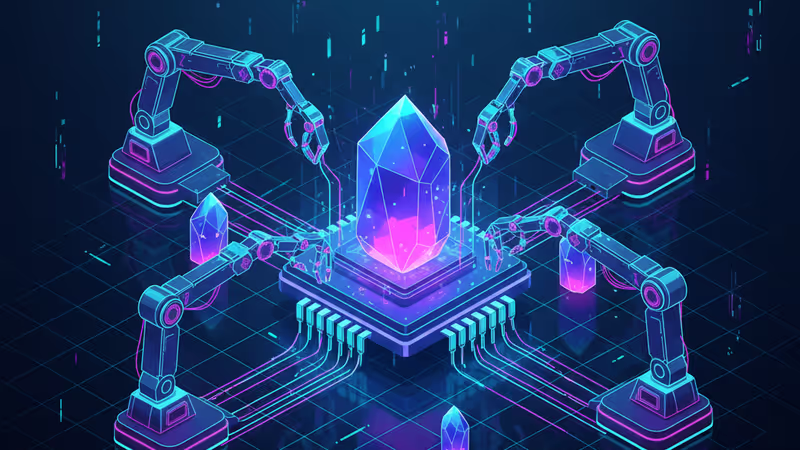
The immediate takeaway isn't just about productivity gains at OpenAI. The real story is the creation of an exponential feedback loop. An AI that can improve its own code can accelerate its own progress at a rate unachievable by human-only teams. This creates a powerful "generative flywheel":
- Step 1: Codex generates code to improve its own architecture, fix bugs, or add features.
- Step 2: These improvements make Codex a more powerful and efficient coding agent.
- Step 3: The more powerful version of Codex can then generate even more sophisticated improvements for itself, faster.
This cycle means the rate of improvement is no longer linear; it's exponential. This has profound second-order effects, potentially creating an insurmountable competitive advantage and redefining the speed limit for technological advancement itself.
The Analysis: A New Competitive Battleground
From Self-Hosting Compilers to Self-Building AI
In the history of computer science, a key milestone for any new programming language was achieving a "self-hosting compiler"—a compiler written in the language it compiles. It was a sign of maturity and robustness. What we are witnessing with Codex is the 21st-century equivalent for artificial intelligence. It's a signal that AI development is entering a new stage of maturity where the systems can become self-sustaining and self-accelerating. This isn't just about writing code; it's about the AI understanding its own structure and purpose well enough to intelligently modify it.
The Real Moat Isn't the Model, It's the Loop
Until now, the AI race has been defined by three factors: access to massive datasets, vast computing power, and top-tier research talent. OpenAI's move introduces a fourth, and potentially more decisive, factor: the efficiency of the self-improvement loop.
The new strategic question for competitors like Google, Anthropic, and Meta isn't just "How good is your model?" but "How fast can your model improve itself?" A slightly inferior model with a superior self-improvement flywheel could quickly overtake a market leader. This forces a strategic rethink for every major AI lab. They must now race to replicate this capability, turning AI development into a meta-game where the goal is to build the best AI for building AI.
PRISM Insight: The Future for Human Developers
Your Job Isn't Obsolete, It's Been Promoted
For the millions of software developers globally, this news is both daunting and liberating. It signals the final chapter for manual, line-by-line coding of boilerplate logic. However, it also elevates the role of the human developer to that of a system architect, a creative director, and an AI supervisor.
The most valuable skills of the next decade will not be writing perfect syntax, but rather:
- High-Level System Design: Defining the architectural blueprint and desired outcomes for an AI agent like Codex to execute.
- Prompt Engineering & Goal Setting: Articulating complex requirements and constraints in a way an AI can understand and implement effectively.
- Verification and Auditing: Acting as the final arbiter of quality, security, and correctness for AI-generated code, guiding the AI's learning process.
Essentially, the developer's role is moving up the value chain, away from being a craftsman of code and towards being a conductor of an AI orchestra.
PRISM's Take
This is more than an internal efficiency story; it's the first commercial proof-of-concept for a new Moore's Law for software. While Moore's Law dictated the exponential growth of hardware capabilities, the "Codex Effect" points to a future of exponential growth in software complexity and capability. The competitive landscape of technology will now be defined by who can build and sustain the most effective self-improving AI systems. OpenAI has just fired the starting gun on this new race, and its rivals are already behind.
관련 기사
스페인 거대 은행 BBVA가 12만 전 직원에게 ChatGPT를 도입합니다. 이는 단순한 기술 도입을 넘어 금융 산업의 미래를 건 AI 네이티브 전환의 시작입니다. PRISM이 그 심층 의미를 분석합니다.
BNY Mellon이 2만 명 직원에게 AI 개발 권한을 부여했습니다. 이는 단순한 기술 도입을 넘어 금융 산업의 미래를 바꿀 'AI 민주화'의 신호탄입니다. 그 심층적 의미를 분석합니다.

OpenAI가 투자한 AI 신약 개발사 '차이 디스커버리'가 1.3조 가치를 인정받았다. 이 투자가 바이오 산업과 AI의 미래에 던지는 의미를 심층 분석한다.
OpenAI가 GPT-5.2를 조용히 공개했습니다. 이는 AI 산업이 규모의 경쟁을 넘어 효율성과 안정성을 추구하는 새로운 국면으로 접어들었음을 시사합니다. 그 숨겨진 의미를 심층 분석합니다.