
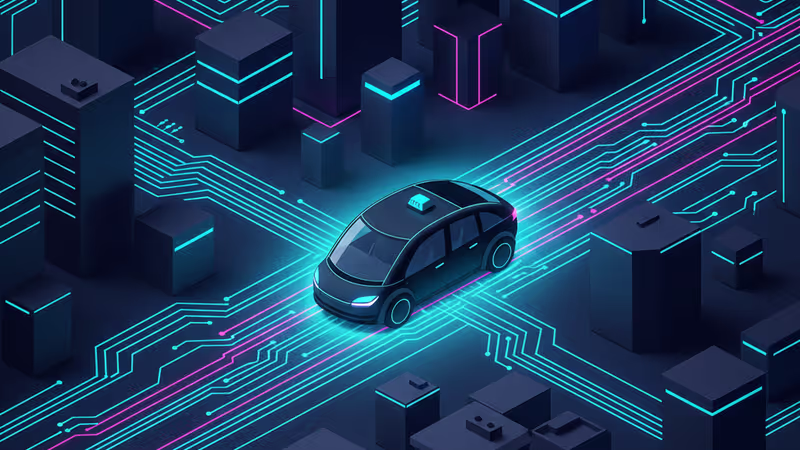
Tesla Goes 'Hands-Off' in Austin: Why This Robotaxi Gamble Could Make or Break the AV Industry
Tesla is now testing robotaxis without human safety monitors in Austin. Our expert analysis explains why this is a high-stakes challenge to Waymo and a critical moment for TSLA investors.
The Lede: More Than a Milestone, It's a Declaration
Tesla has finally removed the human safety net from its robotaxi test fleet in Austin, with vehicles now spotted operating without onboard monitors. This isn't just another software update or a minor milestone; it's a high-stakes strategic gamble designed to prove its controversial vision-only approach to autonomy can leapfrog competitors and redefine the future of transportation. For investors, rivals, and regulators, the game has just changed.
Why It Matters: The End of the "Beta" Narrative
For years, Tesla's Full Self-Driving (FSD) has existed in a state of 'perpetual beta,' a remarkable technical showcase that always required a human driver's ultimate responsibility. By removing the safety monitor, Tesla is signaling a profound shift in confidence. It's an attempt to force the narrative from 'driver assist' to 'true autonomy.' This move has critical second-order effects:
- Investor Validation: A significant portion of Tesla's (TSLA) formidable market capitalization is predicated on the promise of a future robotaxi network. This is the first tangible evidence that the promise could materialize, moving it from a line in an investor deck to a potential reality on public streets.
- Industry Pressure: This is a direct challenge to the meticulous, geofenced, and LiDAR-heavy approach of competitors like Waymo. If Tesla can successfully and safely scale a camera-only system, it could invalidate billions of dollars invested in more expensive sensor suites, fundamentally altering the unit economics of autonomous vehicles.
- Regulatory Showdown: Tesla is effectively daring regulators to intervene. After the public and regulatory backlash that led to the suspension of Cruise's operations in California, this is a bold and risky maneuver that will test the tolerance of city and state authorities.
The Analysis: A High-Stakes Bet on Cameras and Code
The Vision-Only Doctrine Put to the Test
At the heart of this development is the AV industry's most significant technical debate: cameras vs. LiDAR. Waymo has spent over a decade perfecting a system that uses a suite of expensive sensors—including LiDAR, radar, and cameras—to build a redundant, high-fidelity map of the world. This approach is reliable but costly and difficult to scale geographically.
Tesla, in contrast, argues that the road network is designed for human eyes, so a system based on cameras (vision), processed by a powerful neural network, is the only scalable solution. Removing the safety driver is the ultimate test of this doctrine. Without the fallback of LiDAR or a human, Tesla's software must now interpret every complex edge case—from confusing construction zones to unpredictable pedestrian behavior—with nothing but photons and algorithms. This is the moment the theory meets the unforgiving reality of public roads.
Navigating the Ghost of Cruise
It is impossible to view this move outside the context of what happened to GM's Cruise. Cruise operated a driverless service in San Francisco until a single, high-profile incident involving a pedestrian led to a complete operational shutdown and a crisis of public and regulatory trust. Tesla is now willingly stepping into that same minefield. Any significant failure in Austin won't just be a software bug; it will be a major public safety incident that could set back the company's autonomous ambitions—and potentially the entire industry—for years. The operational and PR protocols for handling incidents will be just as critical as the code itself.
PRISM Insight: The Scalability Gambit
For Investors & aarket Watchers: The core insight here is that this is a play for scale. Waymo's service, while impressive, is operational in just a few cities. Tesla's FSD is running on hundreds of thousands of customer-owned vehicles globally, collecting vast amounts of data. The goal of this driverless Austin test is to prove that this data advantage can be converted into a geographically unbound robotaxi network.
Success means Tesla could theoretically 'turn on' a robotaxi service in any city where its FSD is proficient, a scaling advantage no competitor can match. Failure, however, suggests that its data-driven approach still can't solve the long tail of edge cases, potentially validating Waymo's more cautious, hardware-intensive strategy. This test is a crucial catalyst for determining which philosophy will dominate the next decade of mobility.
PRISM's Take: The Real Test Begins Now
Tesla has successfully demonstrated a car can navigate Austin streets without a human babysitter. This is a formidable engineering achievement. However, the company is now graduating from a technical problem to a complex socio-technical one. The challenge is no longer just about software; it's about public trust, regulatory grace, and flawless operational safety at scale. By taking the training wheels off, Tesla is betting its entire autonomy thesis on the line. While the potential reward is industry dominance, the risk is a catastrophic loss of confidence that no software patch can fix. The era of 'what if' is over; the era of 'what now' has begun.
관련 기사

인스타카트가 AI를 이용해 일부 고객에게 식료품을 23% 더 비싸게 판매한 사실이 드러났습니다. 이것이 '디지털 가격 차별'의 시작이며, 소비자가 알아야 할 대응법을 심층 분석합니다.
우버의 '다크패턴' 구독 서비스가 24개 주로부터 집단 소송을 당했습니다. 이것이 구독 경제의 종말을 의미하는지, 당신의 지갑에 미칠 영향을 심층 분석합니다.
AI 붐의 이면, 데이터센터가 당신의 전기요금을 폭등시키고 있습니다. 미 상원의 칼끝이 빅테크를 향한 이유와 이것이 투자자와 시장에 미칠 영향을 심층 분석합니다.

그라인더가 단순 데이팅 앱을 넘어 AI와 헬스케어를 결합한 '게이 수퍼앱'으로 변신을 선언했다. 이 야심 찬 계획의 성공 가능성과 숨겨진 위험을 심층 분석한다.