
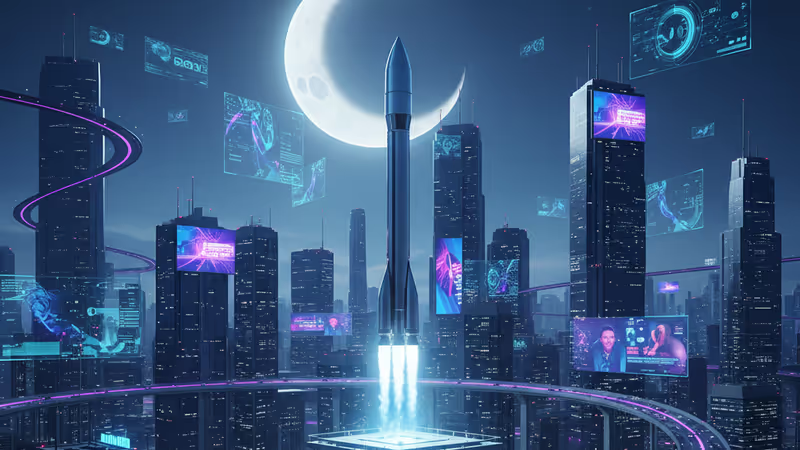
South Korea Greenlights $1.6B Project for Reusable Methane Rocket, Targeting 2034 Completion
South Korea has approved a $1.6 billion project to build a reusable methane-powered rocket by 2034. The initiative, led by KASA, aims to support a 2032 lunar mission and establish the nation's competitive edge in the space industry.
South Korea's government has officially approved a 2.3 trillion-won (US$1.6 billion) project to develop a reusable space launch vehicle powered by a methane engine, targeting completion by 2034. The country's space agency, KASA, announced Monday that the plan was sanctioned by a government funding assessment committee.
At the core of the project is the development of a single 80-ton-thrust methane engine designed to power both the first and second stages of the next-generation rocket. According to the Korea AeroSpace Administration (KASA), this marks a strategic shift from an earlier plan that involved developing two different types of engines, signaling a push for greater efficiency and cost-effectiveness in the design.
The immediate goal is to support South Korea's planned lunar lander mission in 2032. The rocket will initially be used as a single-use launch vehicle for that mission, before the fully reusable system is expected to be completed two years later. KASA said the project's ultimate aim is to develop a competitive reusable launch vehicle in stages.
What's a Hopping Test?A low-altitude, vertical takeoff and vertical landing (VTVL) flight test. It's a critical step to validate the complex guidance and engine-throttling systems that allow a reusable rocket stage to fly back and land precisely on its own.
The development timeline includes a test firing of the engine scheduled for the end of 2031, followed by a crucial hopping test the following year. "The approval will help us implement the government's ambition for technology-led growth," said Yoon Young-bin, head of KASA. He added that the project, along with the lunar lander, "will open a new era of low-cost, reusable space launch vehicles."
This isn't just a new rocket; it's South Korea's official entry ticket into the global commercial space race dominated by players like SpaceX. The choice of a methane engine is a clear signal that KASA is aligning with the next-generation industry standard, which prioritizes reusability and cleaner propellants. By tying the rocket's development directly to a high-profile lunar mission, Seoul is creating a pragmatic roadmap with a clear deadline, turning a long-term tech ambition into a tangible national objective.
본 콘텐츠는 AI가 원문 기사를 기반으로 요약 및 분석한 것입니다. 정확성을 위해 노력하지만 오류가 있을 수 있으며, 원문 확인을 권장합니다.
관련 기사
한국 정부가 2조 3천억 원을 투입해 2034년까지 재사용 가능한 메탄 로켓 개발을 공식 승인했다. 2032년 달 착륙선 발사를 지원하며 차세대 우주 기술 경쟁에 본격적으로 뛰어든다.
일본의 주력 H3 로켓이 12월 22일, 항법위성 '미치비키 5호'를 궤도에 올리는 데 실패했습니다. JAXA는 2단 엔진 조기 정지 원인을 조사 중이며, 일본판 GPS 구축 계획에 차질이 예상됩니다.

쿠팡이 3370만 명의 개인정보 유출을 인정한 후, 일일 활성 사용자(DAU)가 1400만 명대로 감소했습니다. 소비자 신뢰 하락이 사용자 이탈로 이어지는 과정을 분석합니다.

오픈소스 LLM 분야의 '다크호스'로 불리는 중국 AI 스타트업 딥시크가 미중 기술 전쟁의 판도를 바꿀 '비밀병기'로 떠오르고 있습니다. 그 지정학적 의미를 분석합니다.