
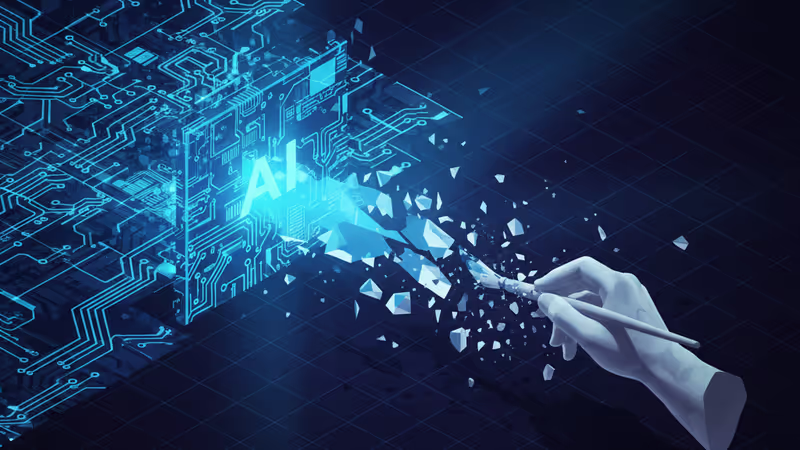
OpenAI's New Image Model Isn't Just Faster—It's a Strategic Assault on the Creative Enterprise
OpenAI's new GPT-Image-1.5 model is more than a speed upgrade. It's a strategic move to dominate the enterprise AI space. Our analysis explains why.
The Lede: Speed as a Weapon
OpenAI just announced a significant upgrade to its image generation model within ChatGPT, now available as GPT-Image-1.5 in its API. While the headlines will focus on the 4x speed boost and enhanced precision, the real story isn't about better pictures. It's a calculated strategic move to shift AI imagery from a novelty art tool into an indispensable, high-velocity utility for developers and businesses. OpenAI is sacrificing the esoteric artistry of rivals like Midjourney for something far more valuable in the long run: scalable, integrated, enterprise-grade infrastructure.
Why It Matters
This update is more than a simple feature bump; it's a tremor that redefines the competitive landscape. The AI image generation market is bifurcating, and this move clarifies OpenAI's position.
- The Battle for Workflow, Not Walls: While Midjourney continues to dominate the high-end, artistic generation space (think digital art for display), its closed ecosystem and lack of an API are significant weaknesses. OpenAI is exploiting this by building a horizontal platform. GPT-Image-1.5 is designed to be embedded everywhere, from marketing automation platforms to design software, making it the 'good enough' engine that's always at hand.
- The Economics of Scale: A 4x speed increase isn't just a user convenience; it's a fundamental change in unit economics. Faster generation means lower computational cost (inference cost), making it commercially viable to generate images at a massive scale. This unlocks applications previously too expensive to consider, like real-time personalized ad creatives or dynamic e-commerce product shots.
- Lowering the Skill Floor: The emphasis on "more precise edits" and "consistent details" signals a move away from the arcane art of 'prompt engineering.' The goal is to make professional-quality image creation accessible to marketers, product managers, and developers without them needing to become AI whisperers. This drastically expands the total addressable market.
The Analysis: From Magic Trick to Power Tool
To understand the gravity of this release, we must look at the evolution of the market and the competitive dynamics at play.
Historical Context: The End of the 'Wow' Era
The first wave of AI image generation, led by DALL-E and early Midjourney, was about producing surreal, shocking, and beautiful images that demonstrated the technology's potential. It was a magic show. We've now entered the second act: the era of utility. The market is maturing from asking "Can it do this?" to "How can I reliably integrate this into my product and business?" Consistency, speed, and API access are the new battlegrounds, and OpenAI is planting its flag firmly on this territory.
Competitive Dynamics: A Differentiated War
OpenAI isn't trying to out-Midjourney Midjourney. It's playing a different game entirely.
- vs. Midjourney: Midjourney is the boutique art studio, producing stunning, bespoke pieces. OpenAI's GPT-Image-1.5 is the high-volume manufacturing plant. By making its model available via API, OpenAI empowers a thousand other companies to build creative tools, while Midjourney remains a destination tool.
- vs. Stable Diffusion: Stable Diffusion's power lies in its open-source flexibility and fine-tuning capabilities, attracting a deeply technical user base. OpenAI is competing on simplicity and integration. It's betting that the majority of the market wants a powerful, turnkey solution integrated into a platform they already use (ChatGPT) and can easily build upon (the API).
PRISM Insight: The API is the Real Product
The most critical element mentioned in the source is the immediate availability of the new model in the API as GPT-Image-1.5. For developers and business leaders, this is the entire story.
OpenAI is aggressively building a comprehensive AI utility stack. With best-in-class models for text (GPT-4), code, and now high-speed imagery, it offers a single, unified API for the core components of modern AI applications. This creates an incredibly powerful moat. Why would a startup or enterprise juggle multiple AI APIs—one for text, another for images—when OpenAI provides a top-tier, integrated solution? This simplifies development, reduces vendor complexity, and locks developers into the OpenAI ecosystem.
The promise of "consistent details" is also a game-changer for businesses. A major hurdle for commercial use has been the inability to maintain brand identity or character consistency across multiple generations. If GPT-Image-1.5 solves this, it removes a massive barrier to adoption for marketing, advertising, and entertainment industries.
PRISM's Take
OpenAI's GPT-Image-1.5 is a trojan horse. While the public sees a faster image generator inside ChatGPT, the strategic objective is the domination of the B2B and developer AI market. By prioritizing industrial-grade speed, reliability, and API-first integration over niche artistic perfection, OpenAI is betting that the future of generative media isn't in a standalone app, but as a foundational, invisible layer powering a million other applications. This isn't just an update; it's a declaration that the war for AI platform supremacy is heating up.
관련 기사
OpenAI가 챗GPT의 핵심 기능인 '모델 라우터'를 철회한 진짜 이유를 분석합니다. 속도와 성능, 비용과 사용자 경험 사이의 딜레마, 그리고 구글과의 경쟁이 만든 전략적 후퇴의 의미를 짚어봅니다.
OpenAI가 공개한 'FrontierScience' 벤치마크는 단순한 성능 테스트를 넘어, '과학자 AI' 시대의 개막을 알립니다. AGI를 넘어선 새로운 AI 패권 경쟁의 의미와 산업에 미칠 영향을 심층 분석합니다.
BBVA의 12만 명 ChatGPT 도입은 단순 기술 채택이 아닙니다. 금융 산업의 운영 모델을 근본적으로 바꾸는 신호탄이자, AI 네이티브 뱅킹의 미래를 건 대담한 베팅입니다. 그 심층 의미를 분석합니다.
BNY 멜론이 2만 명의 직원을 AI 개발자로 양성합니다. 이는 단순 기술 도입을 넘어, 금융 산업의 운영 모델을 바꾸는 'AI 민주화'의 시작을 의미합니다.