
Nvidia's Real Endgame: Why a Scheduler Acquisition Is a Bigger Threat Than Its New AI Models
Nvidia's acquisition of Slurm developer SchedMD is a more strategic move than its new AI models. Discover why this signals a new era of ecosystem lock-in.
The Lede: Beyond the Chips
Nvidia's recent announcements—the acquisition of Slurm developer SchedMD and the release of the Nemotron-3 open model family—are not two separate news items. They are two fronts in a single, audacious campaign. While the world focuses on the horsepower of its GPUs, Nvidia is quietly building an inescapable AI ecosystem, moving from simply selling the 'picks and shovels' to owning the entire gold mine's operating system. For enterprise leaders and investors, understanding this pivot from silicon to system is critical.
Why It Matters: The Two-Pronged Attack on the AI Stack
Nvidia's strategy is to create a seamless, highly-optimized, and deeply integrated development environment that is technically 'open' but practically locks users into its ecosystem. This isn't just about hardware anymore; it's about controlling the entire workflow from model creation to large-scale deployment.
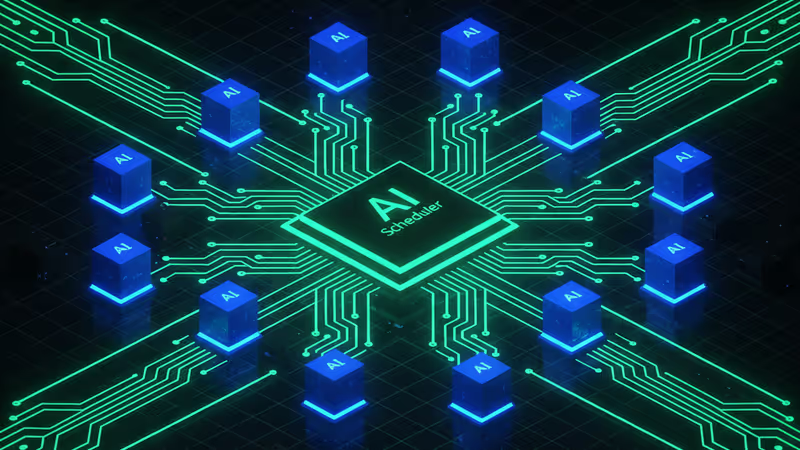
- Controlling the 'How': The Slurm Acquisition. Slurm is the unsung hero of high-performance computing (HPC) and large-scale AI. It's the traffic controller that manages and schedules massive computational jobs across thousands of GPUs. By acquiring SchedMD, Nvidia now stewards the de facto standard for workload orchestration. This gives them immense influence over how the world's most powerful AI systems are run, optimized, and managed—a foundational layer of the AI stack.
- Controlling the 'What': The Nemotron Models. Releasing powerful open models like Nemotron-3 is not just an act of goodwill. It's a strategic move to provide developers with high-quality, 'free' starting points that are, by design, hyper-optimized for Nvidia's CUDA software and hardware architecture. This creates a powerful incentive for developers to build within Nvidia's walled garden, even if the gate is left open.
The Analysis: Building an Unbeatable Moat
From Infrastructure King to Ecosystem Emperor
For over a decade, Nvidia’s moat was CUDA, its proprietary software platform that made programming its GPUs vastly easier than any alternative. Competitors could build powerful chips, but they couldn't break the CUDA software lock-in. The SchedMD acquisition is the next evolution of this playbook.
Slurm, which has been the open-source standard since 2002, is the central nervous system for academic supercomputers and enterprise AI clusters. While Nvidia promises vendor neutrality, their stewardship will inevitably lead to deeper, more seamless integration with their own hardware and software. This is a subtle but powerful form of leverage. Future Slurm features could be optimized first for Nvidia's DGX systems or its networking technology, creating performance gaps that competitors like AMD and Intel would struggle to close. It transforms Slurm from a neutral utility into a strategic asset.
Weaponizing 'Open' to Drive Adoption
The release of Nemotron-3 is the other side of this coin. The AI market is fragmenting, with powerful open-source models from Meta (Llama), Mistral, and others offering credible alternatives to closed systems like OpenAI's GPT series. Nvidia’s entry isn’t just to compete—it's to co-opt the open-source movement.
By providing models claimed to be the “most efficient” for building AI agents, Nvidia provides a compelling reason for developers to choose Nemotron over, say, Llama 3. Since these models will perform best on Nvidia hardware using Nvidia software tools and, now, an Nvidia-stewarded scheduler (Slurm), the choice becomes a self-fulfilling prophecy. The path of least resistance and highest performance will invariably lead back to Nvidia's full stack.
PRISM Insight: The True Cost for Competitors and Customers
Investment Impact: Redefining the Competitive Landscape
For investors, this signals that Nvidia's competitive advantage is deepening far beyond raw chip performance. The company is becoming a software and systems integrator, increasing switching costs for its enterprise customers. The more an organization's workflow relies on the Slurm-CUDA-Nemotron stack, the harder and more expensive it becomes to even consider alternative hardware. This justifies a higher valuation, as Nvidia is cementing its role as the foundational utility for the AI economy, not just a component supplier.
Business Implications: The 'Illusion of Choice'
For CTOs and enterprise tech leaders, this presents a strategic dilemma. In the short term, these moves promise better performance and easier-to-use tools. However, in the long term, they risk a profound dependency on a single vendor. The ecosystem becomes so tightly woven that opting for a non-Nvidia component at any layer—be it the chip, the software, or the scheduler—could result in a significant performance penalty. This creates an 'illusion of choice' where open standards are used to funnel customers towards a single, integrated solution.
PRISM's Take
Nvidia is executing a masterful strategy to transition from a hardware provider to the indispensable operating system for artificial intelligence. The acquisition of SchedMD is a far more significant strategic move than the release of another open model. It secures control over the foundational infrastructure layer, ensuring that even as AI models become commoditized, the system that runs them remains firmly in Nvidia's grasp. This is not merely an embrace of open source; it's the strategic weaponization of it to build an empire that will be incredibly difficult for competitors to assail for the next decade.
관련 기사
엔비디아가 Slurm 개발사 인수와 네모트론 3 모델 공개로 AI 풀스택 제국을 완성하고 있습니다. 이것이 개발자와 투자자에게 의미하는 바를 심층 분석합니다.
엔비디아가 오픈소스 AI 모델을 공개했습니다. 이는 단순한 기술 발표를 넘어, 빅테크 견제와 미중 기술 패권 경쟁 속에서 칩 제국의 미래를 건 전략적 승부수입니다. 그 숨은 의도를 심층 분석합니다.
FTC와 23개 주가 우버를 상대로 대규모 소송을 제기했습니다. 단순 과징금 문제를 넘어, 구독 경제의 어두운 민낯 '다크패턴'에 대한 전면전이 시작되었습니다.
구글 자금에 의존하며 생존 위기에 처한 모질라. 이는 단순한 브라우저의 문제가 아닌, 웹 다양성과 인터넷의 미래가 걸린 중대한 기로입니다. PRISM이 심층 분석합니다.