
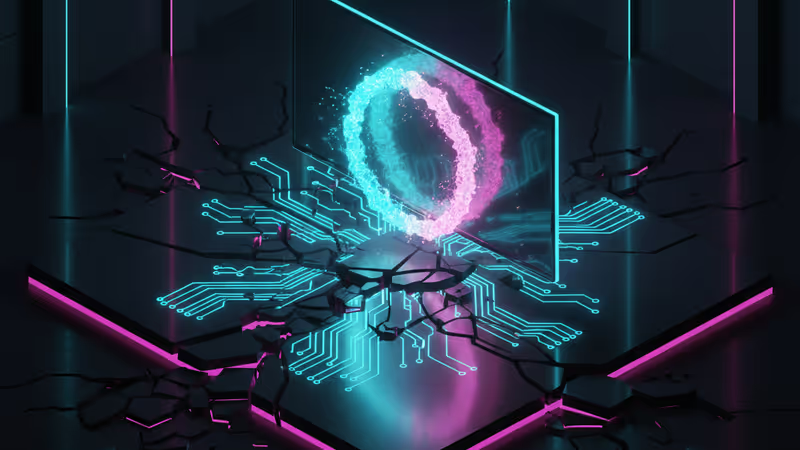
LG's New Flagship Isn't OLED—And That's a Strategic Bombshell for the TV Industry
LG, the king of OLED, is launching a flagship Micro RGB (Mini-LED) TV. Our analysis breaks down why this strategic pivot is a bombshell for Samsung and the entire TV industry.
The Lede: The OLED King Bets on LCD
LG, the undisputed champion and evangelist of OLED display technology, is making a calculated and aggressive move into its rival's territory. The confirmation of its flagship 'Micro RGB evo TV' for 2026 is far more than a new product release; it's a strategic pivot that signals a fundamental shift in the high-end television market. By deploying its top-tier Alpha 11 processor—previously reserved for its premium OLEDs—in a souped-up LCD panel, LG is tacitly admitting a crucial market reality: OLED isn't the only path to premium, and the war for the living room is entering a new, more complex phase.
Why It Matters
For years, the premium TV debate was a simple binary: LG's perfect-black OLEDs versus Samsung's ultra-bright QLEDs (a form of LCD). LG's move to launch a flagship-level LCD blurs these lines. This isn't a budget model; it's a direct assault on Samsung's most profitable segment, the high-end Mini-LED (or 'Neo QLED') market. The second-order effect is a potential fragmentation of the premium space. Instead of one technology reigning supreme, we are heading towards a future where different high-end technologies coexist, optimized for different use cases—the cinephile's dark room versus the brightly-lit family living room. This forces competitors to re-evaluate their own product roadmaps and marketing narratives.
The Analysis
Deconstructing "Micro RGB": Don't Confuse it with MicroLED

First, let's clarify the terminology, which is intentionally competitive. "Micro RGB" is LG's branding for what is essentially a highly advanced Mini-LED LCD television. This is not the holy-grail MicroLED technology (which uses self-emissive pixels like OLED but without the organic compounds), a technology that remains prohibitively expensive for mass-market consumers. Instead, Micro RGB likely refers to the use of minuscule RGB LEDs as a backlight, offering far more precise local dimming and better color purity than traditional LCDs. By branding it "Micro RGB evo," LG is leveraging the premium 'evo' moniker from its OLED line to bestow flagship status upon this new LCD challenger.
The OLED Champion's Gambit: Why Bet Against Yourself?
Why would LG, a company that has invested billions in OLED production and marketing, launch a potential internal competitor? There are three key strategic drivers:
- The Brightness Ceiling: While OLEDs offer infinite contrast, they still lag behind top-tier Mini-LED TVs in sheer peak brightness. In sun-drenched rooms, brightness can be more impactful for viewers than perfect blacks. The Micro RGB TV is LG's play to win the 'bright room' customer without compromise.
- Flanking the Competition: Samsung has successfully marketed its Neo QLED TVs as a premium alternative to OLED, capturing a significant market share. LG is no longer content to cede this ground. The Micro RGB line is a direct counter-offensive, using LG's brand reputation and processing prowess to attack Samsung's core strength.
- Market Diversification: Relying solely on OLED in the premium segment is risky. Concerns about burn-in (however minimal on modern sets) and production costs persist. A flagship LCD line provides a crucial hedge, diversifying LG's high-end portfolio and revenue streams.
Processor Over Panel: The Real Secret Weapon
The most telling detail in the announcement is the inclusion of the flagship Alpha 11 processor. For years, experts have argued that processing is just as important, if not more so, than the panel technology itself. LG's Alpha chips are renowned for their AI-powered upscaling, motion handling, and color science—all honed on the unforgiving canvas of OLED. By applying this elite processing brain to an advanced Mini-LED panel, LG is betting it can create an LCD TV that outperforms competitors not just on hardware specs, but on the final, perceived image quality. This is a powerful value proposition: the best of LG's brain, now in a brighter body.
PRISM's Take
LG's Micro RGB TV is a masterclass in pragmatic strategy. It's a confident, aggressive acknowledgment that no single display technology can satisfy the entire premium market. Rather than stubbornly defending its OLED castle, LG is launching an expeditionary force to conquer new territory. This isn't a retreat from OLED; it's the opening of a second front in the television wars. This move proves LG understands the market better than its critics: the ultimate goal isn't technological purity, it's market dominance.
This content is AI-generated based on source articles. While we strive for accuracy, errors may occur. We recommend verifying with the original source.
Related Articles

Pokémon Champions launched on Switch with bugs breaking core battle mechanics. But the deeper issue isn't the bugs — it's whether a game trying to please all players can satisfy any of them.

Florida is investigating OpenAI over alleged links to a mass shooting. As AI firms quietly restrict their most powerful tools, a harder question is taking shape: who's legally responsible when AI helps someone plan violence?
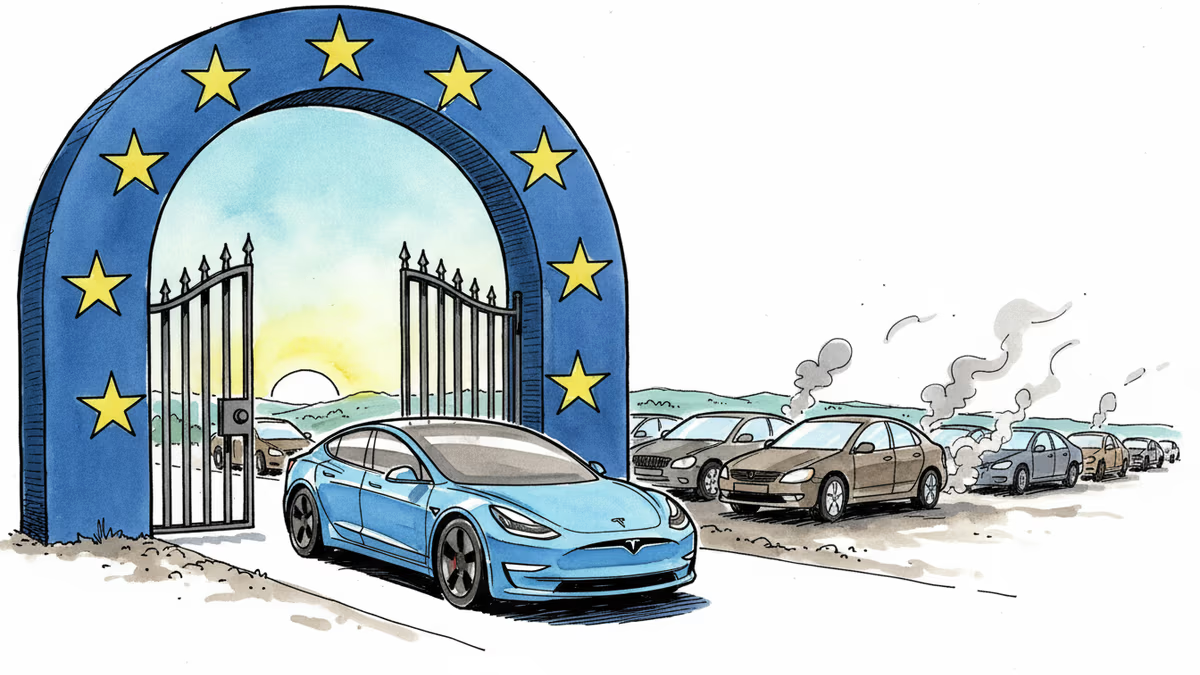
The Netherlands became the first European country to officially approve Tesla's FSD Supervised. With EU's type-approval framework, this could ripple across 27 member states fast.

Artemis II splashed down successfully in the Pacific, marking humanity's first crewed deep space mission in over 50 years. But the harder question isn't whether we can go back — it's why we should.
Pokémon Champions launched on Switch with bugs breaking core battle mechanics. But the deeper issue isn't the bugs — it's whether a game trying to please all players can satisfy any of them.
Florida is investigating OpenAI over alleged links to a mass shooting. As AI firms quietly restrict their most powerful tools, a harder question is taking shape: who's legally responsible when AI helps someone plan violence?
The Netherlands became the first European country to officially approve Tesla's FSD Supervised. With EU's type-approval framework, this could ripple across 27 member states fast.
Artemis II splashed down successfully in the Pacific, marking humanity's first crewed deep space mission in over 50 years. But the harder question isn't whether we can go back — it's why we should.
Thoughts
Share your thoughts on this article
Sign in to join the conversation