
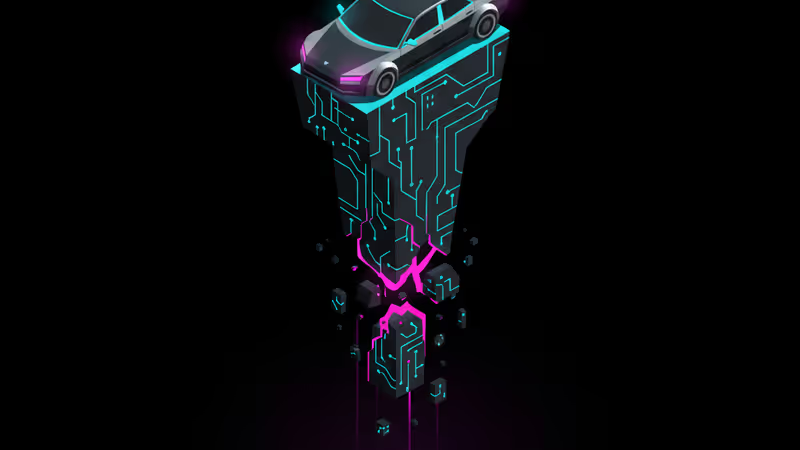
California's Tesla Ruling: The Beginning of the End for 'Full Self-Driving' Hype
A California judge found Tesla's 'Full Self-Driving' marketing deceptive. PRISM analyzes why this is more than a fine—it's a threat to Tesla's core valuation and a turning point for AI regulation.
The Lede: A Reality Check for Tesla's AI Narrative
While Wall Street pushes Tesla's valuation into the stratosphere on the promise of a robotaxi future, regulators on the ground have delivered a stunning rebuke: the very name fueling that dream, "Full Self-Driving," has been ruled deceptive. A California judge's decision to suspend Tesla's sales license—held back for now by a 60-day warning—is far more than a slap on the wrist. It's a fundamental challenge to the core narrative that defines Tesla not as a car company, but as an AI juggernaut. This ruling signals a critical turning point where regulatory reality is finally crashing into marketing hype, with profound implications for Tesla's valuation and the entire autonomous vehicle industry.
Why It Matters: More Than Just a Fine
For years, Tesla has operated in a gray area, using aspirational branding for its driver-assistance systems. This ruling drags the issue into the black-and-white of legal liability. The immediate threat isn't a 30-day sales halt in California; it's the precedent this sets. This decision provides a legal blueprint for other states and countries to challenge Tesla's marketing, potentially forcing a global rebranding of its flagship software. It exposes the fragile tightrope Tesla walks: its stock valuation relies on a future of full autonomy, while its present technology is now legally defined as being deceptively named.
The Analysis: Deconstructing the Deception
The Semantics of Safety: A Brand Built on a Blurry Line
The controversy around "Autopilot" and "Full Self-Driving" (FSD) is not new. Critics and safety advocates have long argued that the names dangerously overstate the systems' capabilities, creating a false sense of security for drivers. Tesla's recent addition of the "(Supervised)" suffix was a clear attempt to mitigate this legal risk. However, the judge's ruling suggests this was insufficient, stating a "reasonable consumer" would still be misled by the core brand name. This is a critical finding: a parenthetical disclaimer may not be enough to correct a fundamentally misleading product name. The ruling attacks the brand itself, not just the fine print.
The Billion-Dollar Disconnect: Wall Street vs. The DMV
The timing of this ruling is extraordinary. It comes as Tesla's stock hits record highs, driven almost entirely by enthusiasm for its AI-powered future, particularly its robotaxi ambitions. This creates a powerful disconnect. While investors are betting on the exponential value of "Full Self-Driving," a state regulator is officially calling the term a violation of civil code. This clash highlights the immense "narrative risk" embedded in Tesla's stock. The value is not in the cars it sells today, but in the software-driven future it promises—a promise whose very name is now under legal assault.
PRISM Insight: Investment and Industry Shockwaves
Investment Impact: The Narrative is Now a Liability
For investors, the key takeaway is that Tesla's brand—once its greatest asset—is now a source of regulatory liability. The risk isn't just about a potential, temporary sales dip in California. The danger is a forced, global rebrand of FSD that fundamentally deflates the autonomous driving narrative. If Tesla can no longer call its product "Full Self-Driving," it becomes much harder to sell the vision of a multi-trillion-dollar robotaxi network. This ruling emboldens the U.S. National Highway Traffic Safety Administration (NHTSA) and international regulators, turning a state-level issue into a potential global wildfire for the company's marketing and legal teams.
Industry Implications: The End of the Wild West
This ruling is a warning shot to the entire auto and tech industry. The era of ambiguous marketing for advanced driver-assistance systems (ADAS) is over. Companies like GM (Super Cruise) and Ford (BlueCruise), which have used more conservative and descriptive names, now appear prescient. We predict this will accelerate two major trends:
- A flight towards standardized terminology, likely based on the SAE Levels of Driving Automation, in all consumer-facing marketing.
- An increased focus on driver monitoring systems as a way to legally and technically enforce the reality that the human is still in command, regardless of the system's name.
PRISM's Take
This is the moment the autonomous vehicle industry gets its first real vocabulary lesson, courtesy of a California judge. The DMV's 60-day grace period is not just a chance for Tesla to change a few words on its website; it's a test of whether a tech giant's powerful narrative can survive a direct collision with public safety regulations. While Tesla's statement dismisses the ruling by noting a lack of consumer complaints in this specific case, it misses the point entirely. This isn't about past confusion; it's about preventing future tragedies. The state is drawing a hard line on the language of human-machine collaboration, and the outcome will define the marketing, legal, and technological landscape for AI-powered vehicles for the next decade.
관련 기사

경쟁사들이 AI의 지능(IQ)에 집중할 때, 애플은 감성(EQ)에 베팅하고 있습니다. 이는 아이폰을 '도구'에서 '동반자'로 바꾸는 거대한 패러다임 전환입니다.
OpenAI GPT-5.2가 챗봇 경쟁을 넘어 과학적 발견의 시대를 엽니다. AI가 단순 조수를 넘어 핵심 연구원으로 진화하는 현상의 의미와 산업별 파급 효과를 심층 분석합니다.
소니와 텐센트의 '호라이즌 클론' 게임 소송이 초고속 합의로 종결되었습니다. 이는 글로벌 게임 업계의 IP 보호와 거대 기업 간의 역학 관계에 대한 중요한 신호입니다.
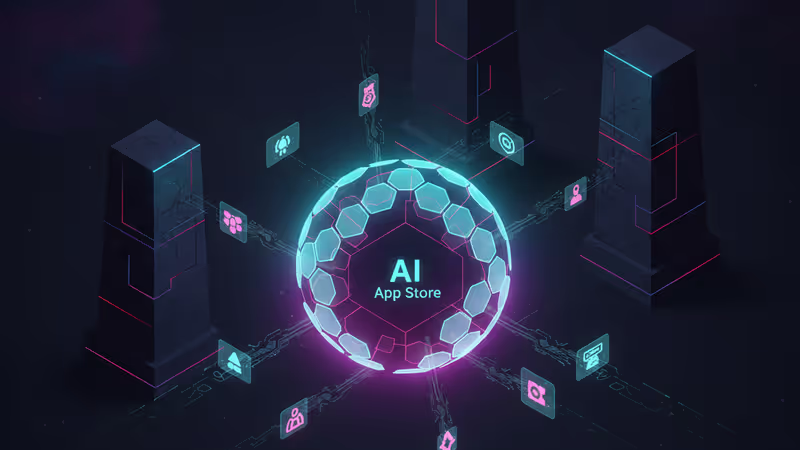
OpenAI가 ChatGPT 앱 디렉토리와 SDK를 공개했습니다. 이는 AI가 차세대 운영체제로 진화하는 변곡점으로, 새로운 플랫폼 전쟁과 기회의 시작을 의미합니다.